

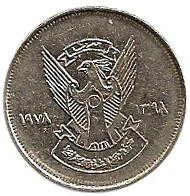
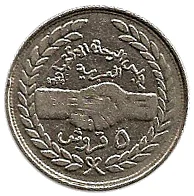
5 Piastres – Sudan
Circulating commemorative coins
Commemoration: Council of Arab Economic Unity
Sudan
Context
Year: 1978
Islamic (Hijri) Year: 1398
Issuer: Sudan 
Period:
(1969—1985)
Currency:
(1956—1992)
Demonetization: 8 June 1992
Total mintage: 5,040,000
Material
Diameter: 24 mm
Weight: 5 g
Shape: Round
Composition: Copper-nickel
Technique: Milled
Alignment: Medal alignment
flip
References
KM: #Click to copy to clipboard74
Numista: #30295
Value
Exchange value: 0.05 SDP
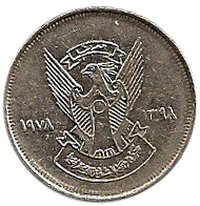
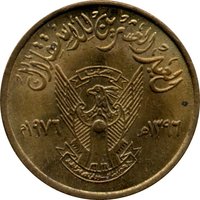
Obverse
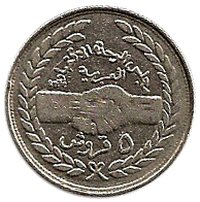
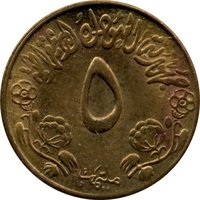
Reverse
Edge
Reeded
Mintings
| Year | Mint Mark | Mintage | Quality | Collection |
|---|---|---|---|---|
| 1978 | — | 5,040,000 |
Historical background
In 1978, Sudan's currency situation was characterised by mounting instability and the early signs of a profound economic crisis. The country was grappling with the severe consequences of ambitious but poorly managed development projects from the early 1970s, which had been funded by heavy external borrowing. This led to a massive accumulation of foreign debt, a widening trade deficit, and rampant inflation. The Sudanese pound, officially pegged to the US dollar, was becoming increasingly overvalued, creating a thriving black market for foreign exchange where the currency traded at a significant discount. This disparity between the official and parallel market rates distorted trade, encouraged capital flight, and signalled a growing loss of confidence in the government's economic management.
The underlying pressures were structural and exacerbated by a reliance on a volatile agricultural sector, particularly cotton. While a boom in Arab capital flows following the 1973 oil crisis had provided temporary relief, these funds often financed consumption rather than productive investment. By 1978, with global commodity prices unfavourable and debt servicing obligations becoming overwhelming, Sudan's foreign exchange reserves were critically depleted. The government, led by President Gaafar Nimeiry, was forced to implement austerity measures and entered negotiations with the International Monetary Fund (IMF) for its first standby agreement, which was secured in 1979.
Thus, 1978 stands as a pivotal prelude to a deeper devaluation and economic restructuring. The currency distortions of that year forced a reluctant recognition that the existing economic model was unsustainable. The subsequent IMF agreement would mandate a formal devaluation of the Sudanese pound and the beginning of a series of structural adjustment programmes, setting the stage for the severe austerity, subsidy removals, and social unrest that would mark the following decade and contribute to the eventual overthrow of Nimeiry's regime in 1985.
The underlying pressures were structural and exacerbated by a reliance on a volatile agricultural sector, particularly cotton. While a boom in Arab capital flows following the 1973 oil crisis had provided temporary relief, these funds often financed consumption rather than productive investment. By 1978, with global commodity prices unfavourable and debt servicing obligations becoming overwhelming, Sudan's foreign exchange reserves were critically depleted. The government, led by President Gaafar Nimeiry, was forced to implement austerity measures and entered negotiations with the International Monetary Fund (IMF) for its first standby agreement, which was secured in 1979.
Thus, 1978 stands as a pivotal prelude to a deeper devaluation and economic restructuring. The currency distortions of that year forced a reluctant recognition that the existing economic model was unsustainable. The subsequent IMF agreement would mandate a formal devaluation of the Sudanese pound and the beginning of a series of structural adjustment programmes, setting the stage for the severe austerity, subsidy removals, and social unrest that would mark the following decade and contribute to the eventual overthrow of Nimeiry's regime in 1985.
⭐ Somewhat Rare