

5 Francs – Belgium
Circulating commemorative coins
Commemoration: Marriage of The Duke
Belgium

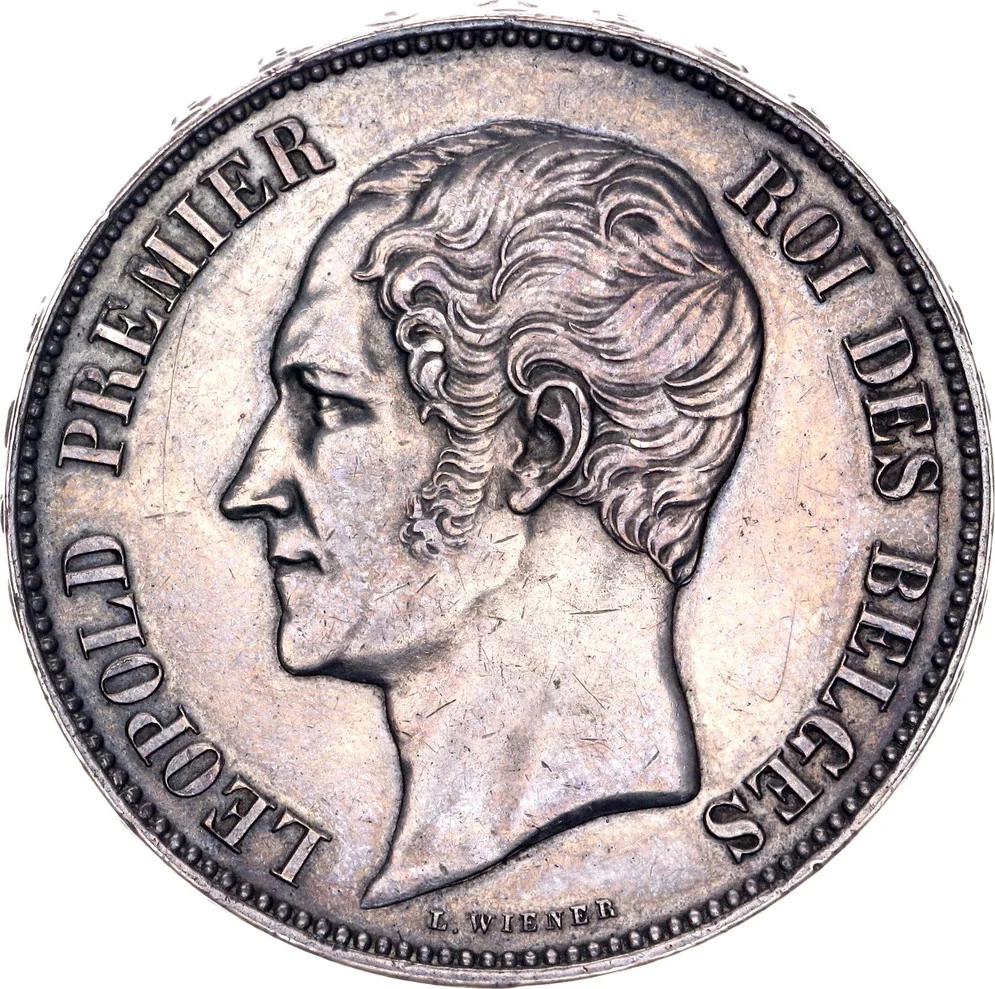
Obverse
Description:
Léopold I bust, left-facing
Inscription:
LEOPOLD PREMIER ROI DES BELGES
L.WIENER
L.WIENER
Translation:
Leopold the First King of the Belgians
L. Wiener
L. Wiener
Script: Latin
Language: French
Engraver: Léopold Wiener
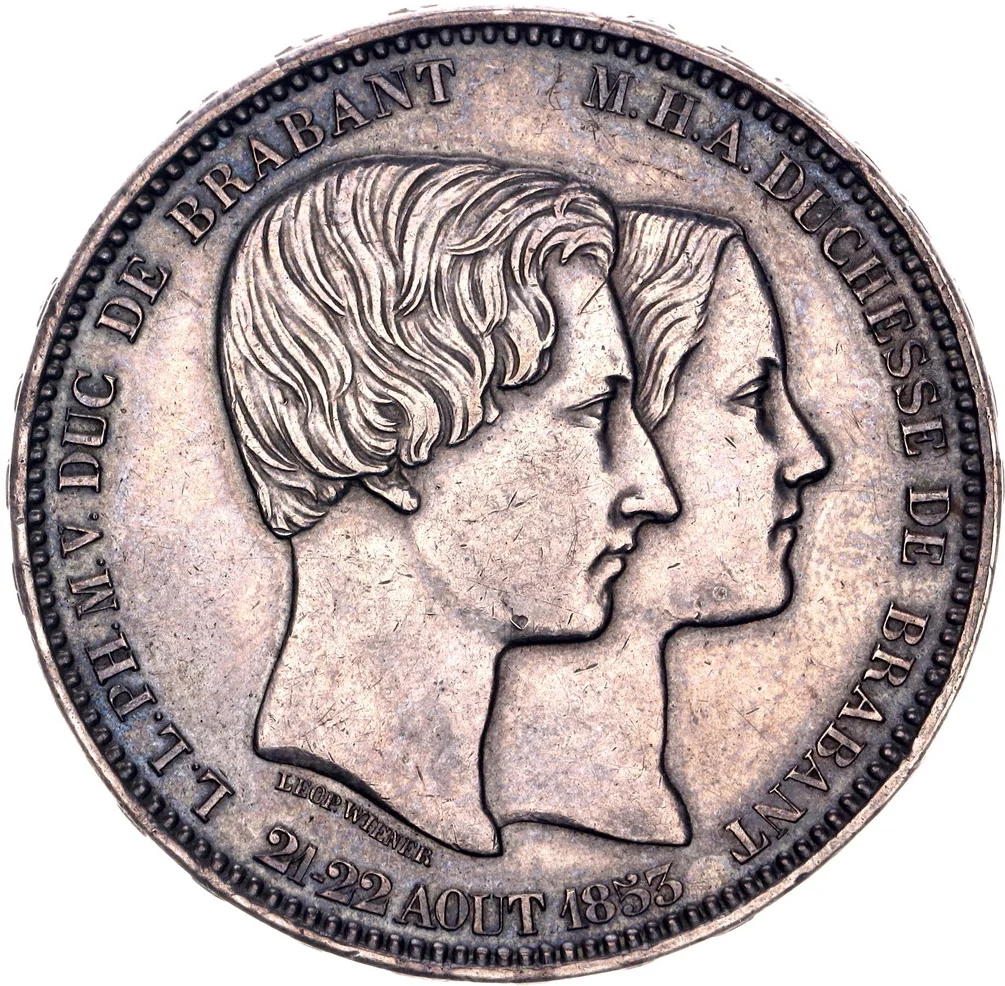
Reverse
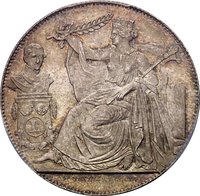
Description:
Two conjoined right-facing busts.
Inscription:
L.L.PH.M.V.DUC DE BRABANT
M.H.A DUCHESSE DE BRABANT
21-22 AOUT 1853
LEOP WIENER
M.H.A DUCHESSE DE BRABANT
21-22 AOUT 1853
LEOP WIENER
Translation:
L.L.PH.M.V. Duke of Brabant
M.H.A. Duchess of Brabant
21-22 August 1853
Leopold of Wavre
M.H.A. Duchess of Brabant
21-22 August 1853
Leopold of Wavre
Script: Latin
Language: French
Engraver: Léopold Wiener
Edge
Plain excused
Legend:
DIEU PROTEGE LA BELGIQUE ***
Translation:
GOD PROTECT BELGIQUE ***
Language: French
Categories
| Marriage |
Mints
| Name | Mark |
|---|---|
| Royal Mint of Belgium | — |
Mintings
| Year | Mint Mark | Mintage | Quality | Collection |
|---|---|---|---|---|
| 1853 | — | — |
Historical background
In 1853, Belgium's currency situation was defined by its adherence to the Latin Monetary Union (LMU) in all but name, several years before the formal treaty of 1865. Following its independence in 1830, Belgium had established a national monetary system based on the Belgian franc, which was pegged to the French franc at par (1:1). The system was bimetallic, meaning both gold and silver coins were legal tender at a fixed ratio (15.5:1), mirroring the French system established by Napoleon. This created a stable and predictable monetary environment crucial for a young, industrializing nation heavily dependent on trade with its neighbours, particularly France.
However, this bimetallic standard was under international strain. Fluctuations in the global market value of gold and silver versus the fixed mint ratio often led to the disappearance of the undervalued metal from circulation (Gresham's Law). In the early 1850s, new gold discoveries in California and Australia were beginning to depress the relative market value of gold, making silver coins more valuable as bullion. This created a persistent risk that silver coinage would be melted down or exported, leading to a shortage of everyday circulating currency for the Belgian public and commercial transactions.
Consequently, the Belgian government and the National Bank of Belgium, founded in 1850, were actively engaged in managing these practical challenges. Their focus was on ensuring sufficient coinage for the booming economy while maintaining the franc's stability and its crucial link to the French system. The period was thus one of operational management within a established bimetallic framework, but with growing awareness of its vulnerabilities, which would ultimately push Belgium to become a founding architect of the multinational Latin Monetary Union to formalize and defend the shared system.
However, this bimetallic standard was under international strain. Fluctuations in the global market value of gold and silver versus the fixed mint ratio often led to the disappearance of the undervalued metal from circulation (Gresham's Law). In the early 1850s, new gold discoveries in California and Australia were beginning to depress the relative market value of gold, making silver coins more valuable as bullion. This created a persistent risk that silver coinage would be melted down or exported, leading to a shortage of everyday circulating currency for the Belgian public and commercial transactions.
Consequently, the Belgian government and the National Bank of Belgium, founded in 1850, were actively engaged in managing these practical challenges. Their focus was on ensuring sufficient coinage for the booming economy while maintaining the franc's stability and its crucial link to the French system. The period was thus one of operational management within a established bimetallic framework, but with growing awareness of its vulnerabilities, which would ultimately push Belgium to become a founding architect of the multinational Latin Monetary Union to formalize and defend the shared system.
🌟 Limited