

100 lire – Vatican City
Add to wishlist
Vatican City
Context
Years: 1936–1938
Issuer: Vatican City
Ruler: Pius XI
Currency:
(1929—2001)
Demonetized: Yes
Total mintage: 10,245
Material
References
KM: #
Numista: #30045
Value
Exchange value: 100 VAL
Bullion value: $712.68
Obverse
Description:
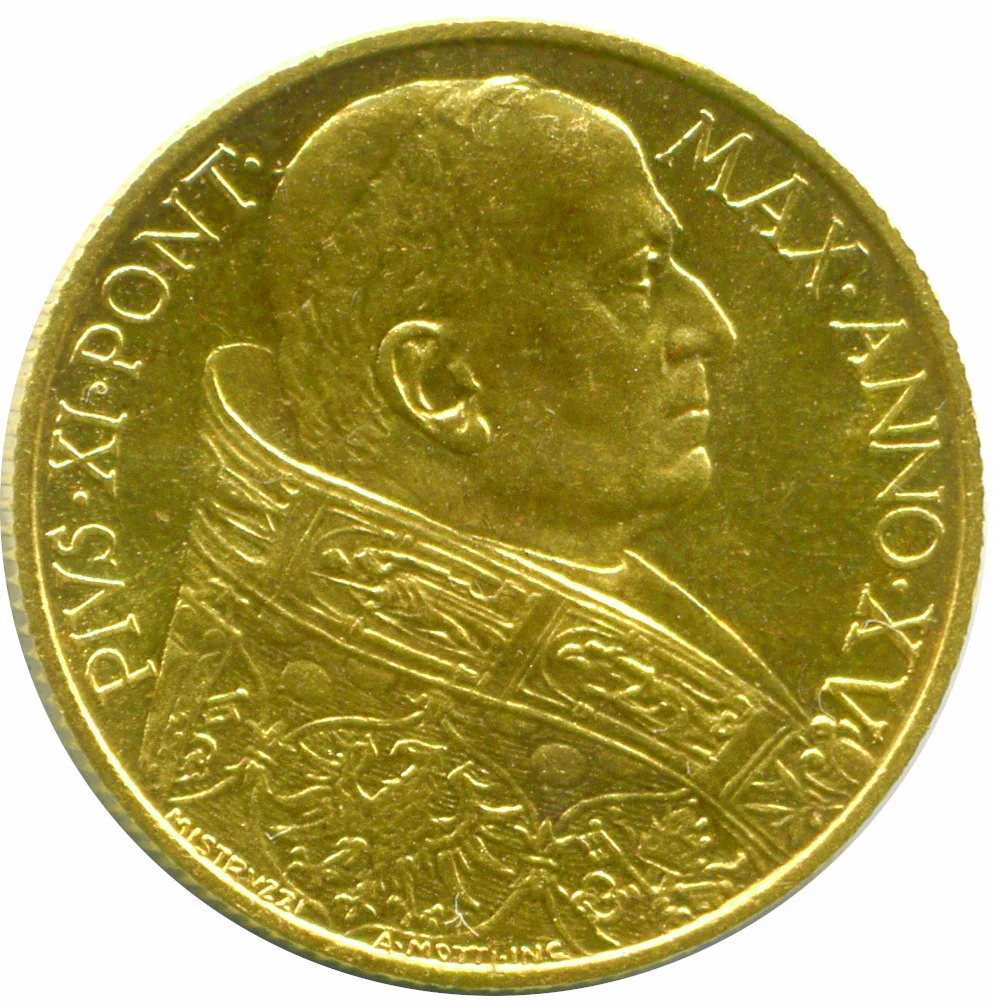
Pope Pius XI, left-facing bust.
Inscription:
PIVS · XI · PONT · MAX · ANNO· XV
MISTRVZZI A·MOTTI·INC
MISTRVZZI A·MOTTI·INC
Translation:
Pius XI, Pontifex Maximus, Year 15
Mistruzzi, by Mottti, Inc.
Mistruzzi, by Mottti, Inc.
Script: Latin
Language: Latin
Engraver: Attilio Silvio Motti
Designer: Aurelio Mistruzzi
Reverse
Edge
Categories
| Object> Globus cruciger |
| Person> Religious figure |
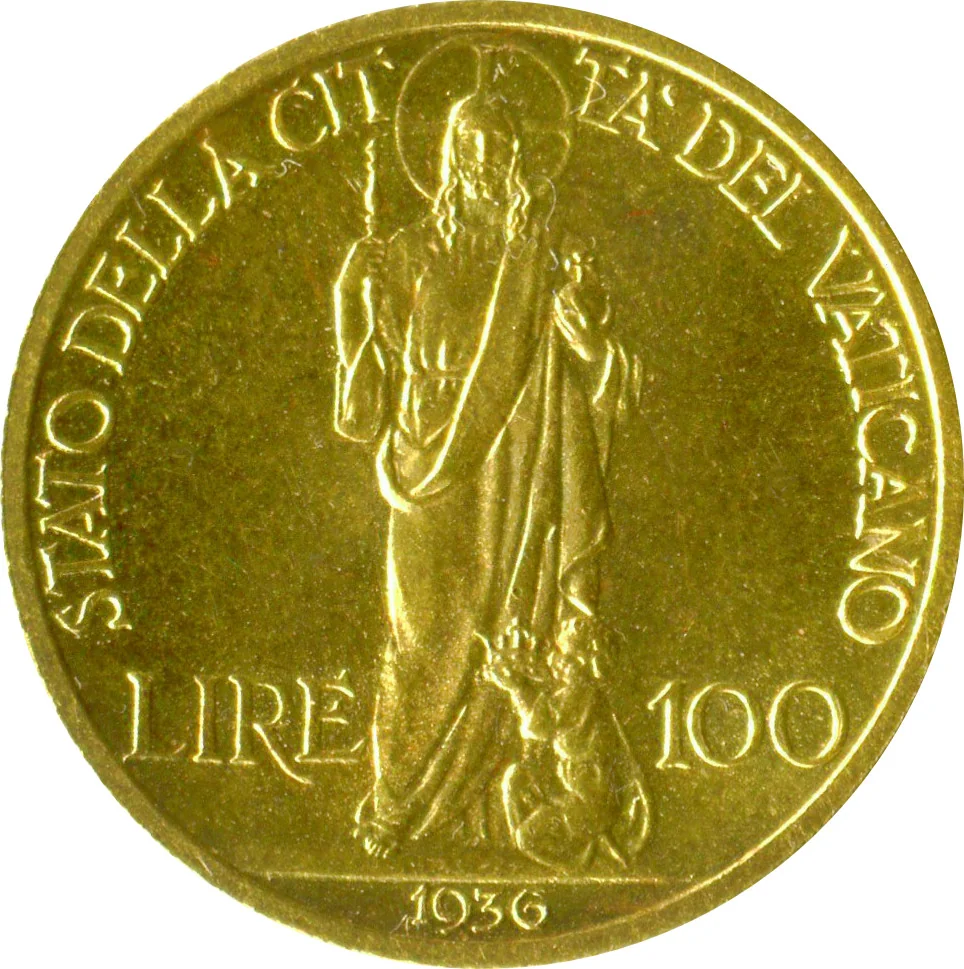
| Symbol> Crown |
| Religion> Religious objects |
Mintings
| Year | Mint Mark | Mintage | Quality | Collection |
|---|---|---|---|---|
| 1936 | — | 8,239 | ||
| 1937 | — | 2,000 | ||
| 1938 | — | 6 |
Historical background
In 1936, the currency situation in Vatican City was intrinsically tied to the broader monetary framework of Italy, following the terms of the 1929 Lateran Treaty. As a sovereign city-state, the Vatican possessed the right to issue its own coinage, which it began doing in 1929. However, under the treaty's financial conventions, the Vatican lira was established at par with the Italian lira and was legally interchangeable within the Italian monetary zone. This meant Vatican coins circulated freely in Italy and vice-versa, effectively making the Vatican's currency a satellite of the Italian system.
This arrangement placed the Vatican's financial stability at the mercy of Benito Mussolini's fascist regime. By 1936, Italy was grappling with the economic strains of the Great Depression and the costly invasion of Ethiopia, leading to a significant devaluation of the Italian lira. The Vatican, with its limited economic base and reliance on investments, donations, and museum revenues, had little independent monetary policy to counteract this. Its coinage, while symbolically important for sovereignty, was essentially a token of the struggling Italian economy.
Consequently, the Holy See's financial administrators, led by Cardinal and Secretary of State Eugenio Pacelli (the future Pope Pius XII), were primarily focused on managing the Vatican's substantial asset portfolio and gold reserves across international markets to preserve institutional wealth. The currency in daily circulation was a practical necessity, but the real financial strategy was one of defensive asset management, seeking stability beyond the lira amidst European economic and political turbulence on the eve of World War II.
This arrangement placed the Vatican's financial stability at the mercy of Benito Mussolini's fascist regime. By 1936, Italy was grappling with the economic strains of the Great Depression and the costly invasion of Ethiopia, leading to a significant devaluation of the Italian lira. The Vatican, with its limited economic base and reliance on investments, donations, and museum revenues, had little independent monetary policy to counteract this. Its coinage, while symbolically important for sovereignty, was essentially a token of the struggling Italian economy.
Consequently, the Holy See's financial administrators, led by Cardinal and Secretary of State Eugenio Pacelli (the future Pope Pius XII), were primarily focused on managing the Vatican's substantial asset portfolio and gold reserves across international markets to preserve institutional wealth. The currency in daily circulation was a practical necessity, but the real financial strategy was one of defensive asset management, seeking stability beyond the lira amidst European economic and political turbulence on the eve of World War II.
💎 Extremely Rare