

100 lire – Vatican City
Add to wishlist
Vatican City
Context
Years: 1929–1935
Issuer: Vatican City
Ruler: Pius XI
Currency:
(1929—2001)
Demonetized: Yes
Total mintage: 25,585
Material
References
KM: #
Numista: #30044
Value
Exchange value: 100 VAL
Bullion value: $1208.39
Obverse
Description:
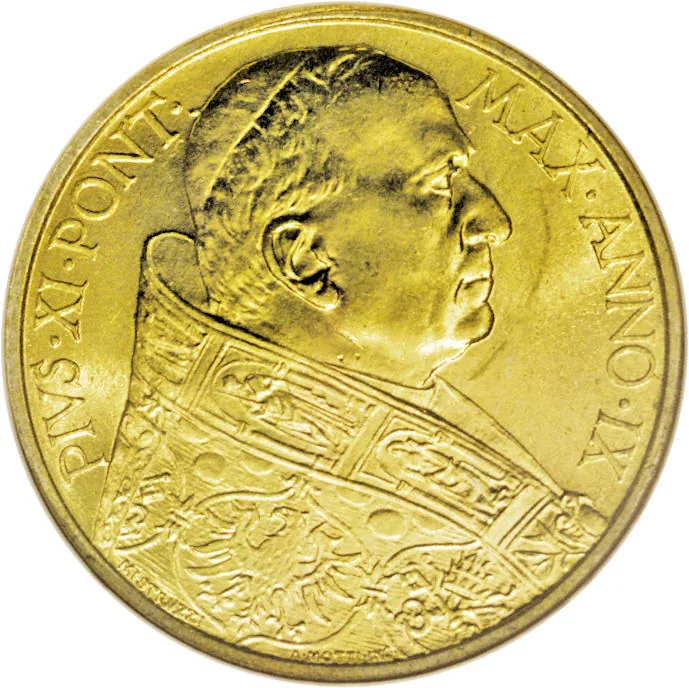
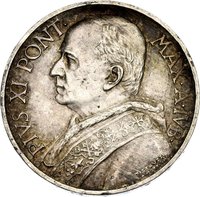
Pope Pius XI, left-facing bust.
Inscription:
PIVS·XI·PONT· MAX·ANNO·IX
MISTRUZZI A·MOTTI·INC
MISTRUZZI A·MOTTI·INC
Translation:
Pius XI Pontifex Maximus Anno IX
Mistruzzi A. Motti Inc.
Mistruzzi A. Motti Inc.
Script: Latin
Language: Latin
Engraver: Attilio Silvio Motti
Designer: Aurelio Mistruzzi
Reverse
Description:
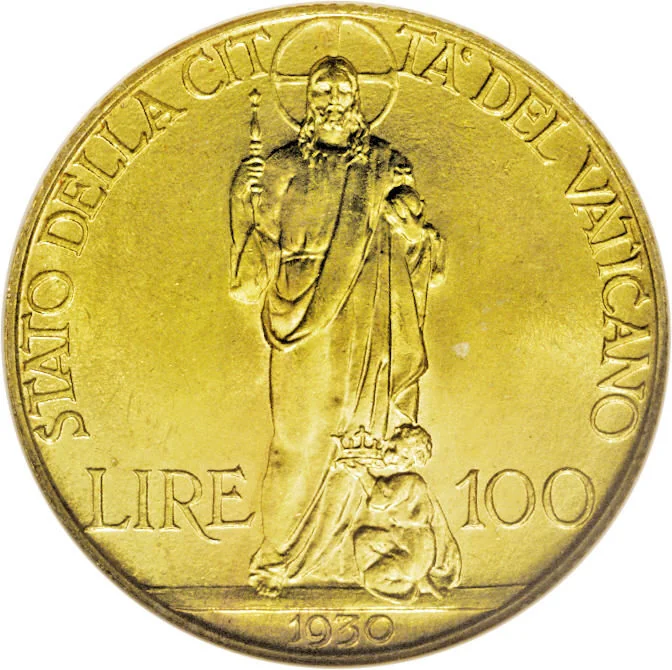
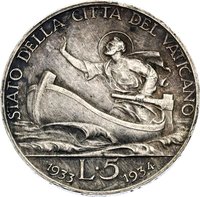
Christ stands holding a sceptre and globus cruciger, with a kneeling child offering a crown.
Inscription:
STATO DELLA CITTA' DEL VATICANO
LIRE 100
1930
LIRE 100
1930
Translation:
State of the Vatican City
100 Lire
1930
100 Lire
1930
Script: Latin
Language: Italian
Engraver: Aurelio Mistruzzi
Edge
Categories
| Object> Globus cruciger |
| Person> Religious figure |
| Symbol> Crown |
| Religion> Religious objects |
Mints
| Name | Mark |
|---|---|
| Rome | — |
Mintings
| Year | Mint Mark | Mintage | Quality | Collection |
|---|---|---|---|---|
| 1929 | — | 10,000 | ||
| 1930 | — | 2,621 | ||
| 1931 | — | 3,343 | ||
| 1932 | — | 5,073 | ||
| 1934 | — | 2,533 | ||
| 1935 | — | 2,015 |
Historical background
The currency situation in Vatican City in 1929 was fundamentally shaped by the Lateran Pacts, signed on February 11th of that year. These agreements between the Holy See and the Kingdom of Italy, which established Vatican City as a sovereign state, also addressed financial and economic matters. A key component was the financial convention, which provided the Holy See with a substantial lump sum (750 million Italian lire) and Italian state bonds as compensation for the loss of the Papal States in 1870. This settlement provided the nascent state with its initial capital and economic foundation.
Prior to 1929, the Holy See had no authority to issue its own official currency, operating within Italy's monetary system. The Lateran Treaty granted Vatican City the right to mint its own coinage. However, exercising full monetary sovereignty was neither practical nor desirable for such a small entity. Therefore, a practical solution was adopted: the Vatican would issue its own coins, but these would be limited in quantity and legally equivalent to Italian currency. This created a currency union where the Italian lira was the official circulating medium, and Vatican lire were minted as a symbolic expression of sovereignty rather than as a separate monetary policy.
Consequently, by the end of 1929, Vatican City's currency system was one of constrained sovereignty, fully integrated with Italy's. The first Vatican coins were minted that year, bearing the image of Pope Pius XI and the inscription "CITTÀ DEL VATICANO." They were legal tender within the Vatican and, crucially, throughout Italy (and later San Marino) due to a quota system agreed with the Italian government, which limited their issuance to an amount proportionate to the city-state's tiny population. This arrangement ensured monetary stability and practicality while upholding the new state's sovereign rights.
Prior to 1929, the Holy See had no authority to issue its own official currency, operating within Italy's monetary system. The Lateran Treaty granted Vatican City the right to mint its own coinage. However, exercising full monetary sovereignty was neither practical nor desirable for such a small entity. Therefore, a practical solution was adopted: the Vatican would issue its own coins, but these would be limited in quantity and legally equivalent to Italian currency. This created a currency union where the Italian lira was the official circulating medium, and Vatican lire were minted as a symbolic expression of sovereignty rather than as a separate monetary policy.
Consequently, by the end of 1929, Vatican City's currency system was one of constrained sovereignty, fully integrated with Italy's. The first Vatican coins were minted that year, bearing the image of Pope Pius XI and the inscription "CITTÀ DEL VATICANO." They were legal tender within the Vatican and, crucially, throughout Italy (and later San Marino) due to a quota system agreed with the Italian government, which limited their issuance to an amount proportionate to the city-state's tiny population. This arrangement ensured monetary stability and practicality while upholding the new state's sovereign rights.
💎 Very Rare