

5 new sheqalim – Israel
Add to wishlist
Circulating commemorative coins
Commemoration: With Gratitude to the Medical Teams in response during the pandemic
Israel
Material
Diameter: 24 mm
Weight: 8.2 g
Thickness: 2.3 mm
Shape: Dodecagonal
Technique: Milled
Alignment: Medal alignment
flip
References
Numista: #300017
Value
Exchange value: 5 ILS
Inflation-adjusted value: 5.65 ILS
Obverse
Description:
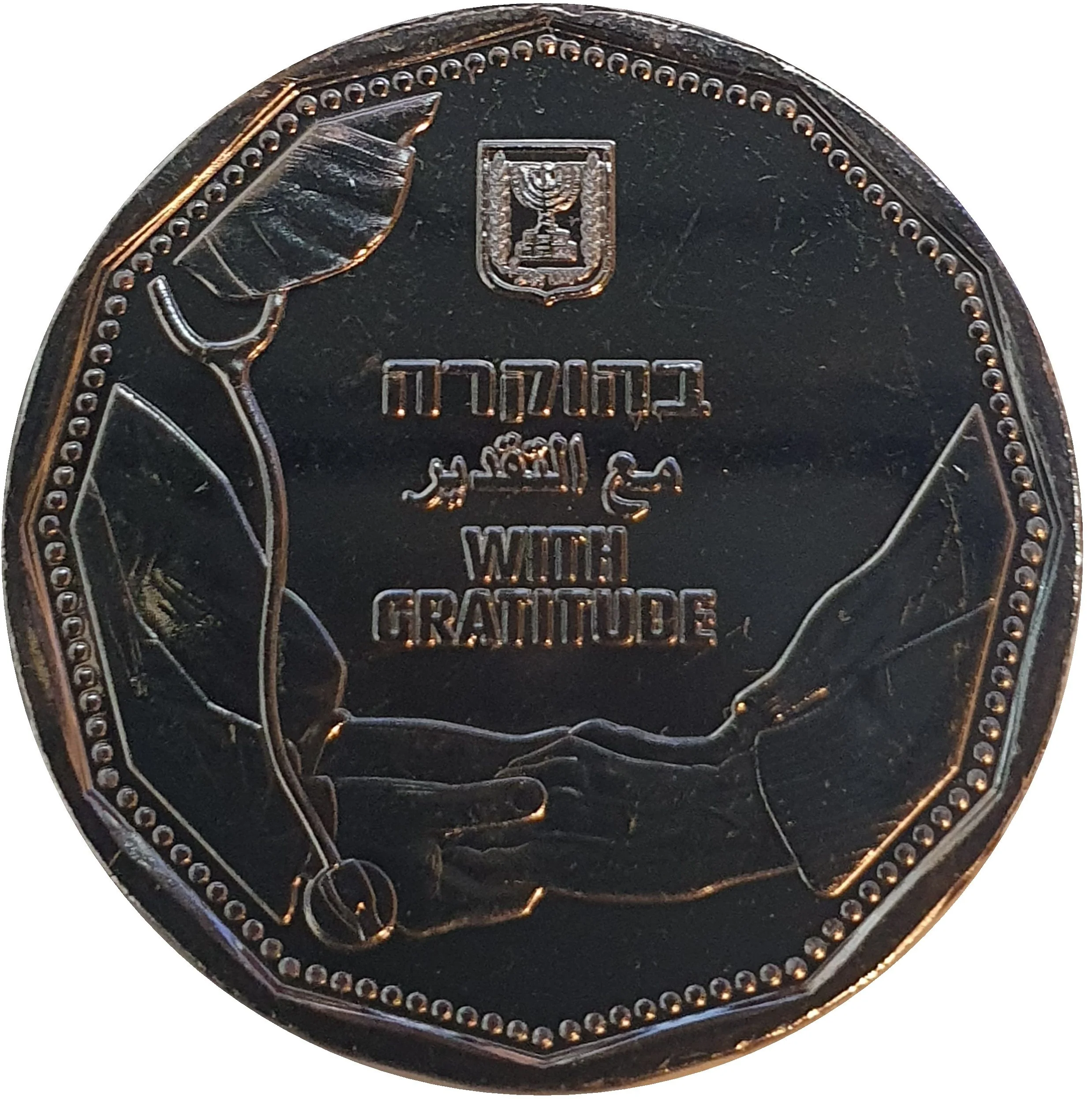
Two clasped hands, representing doctor and patient, alongside Israel's national emblem and the word "GRATITUDE" in Hebrew, Arabic, and English.
Inscription:
WITH GRATITUDE - בהוקרה
Translation:
WITH GRATITUDE - WITH APPRECIATION
Designer: Eitan Alon
Reverse
Description:
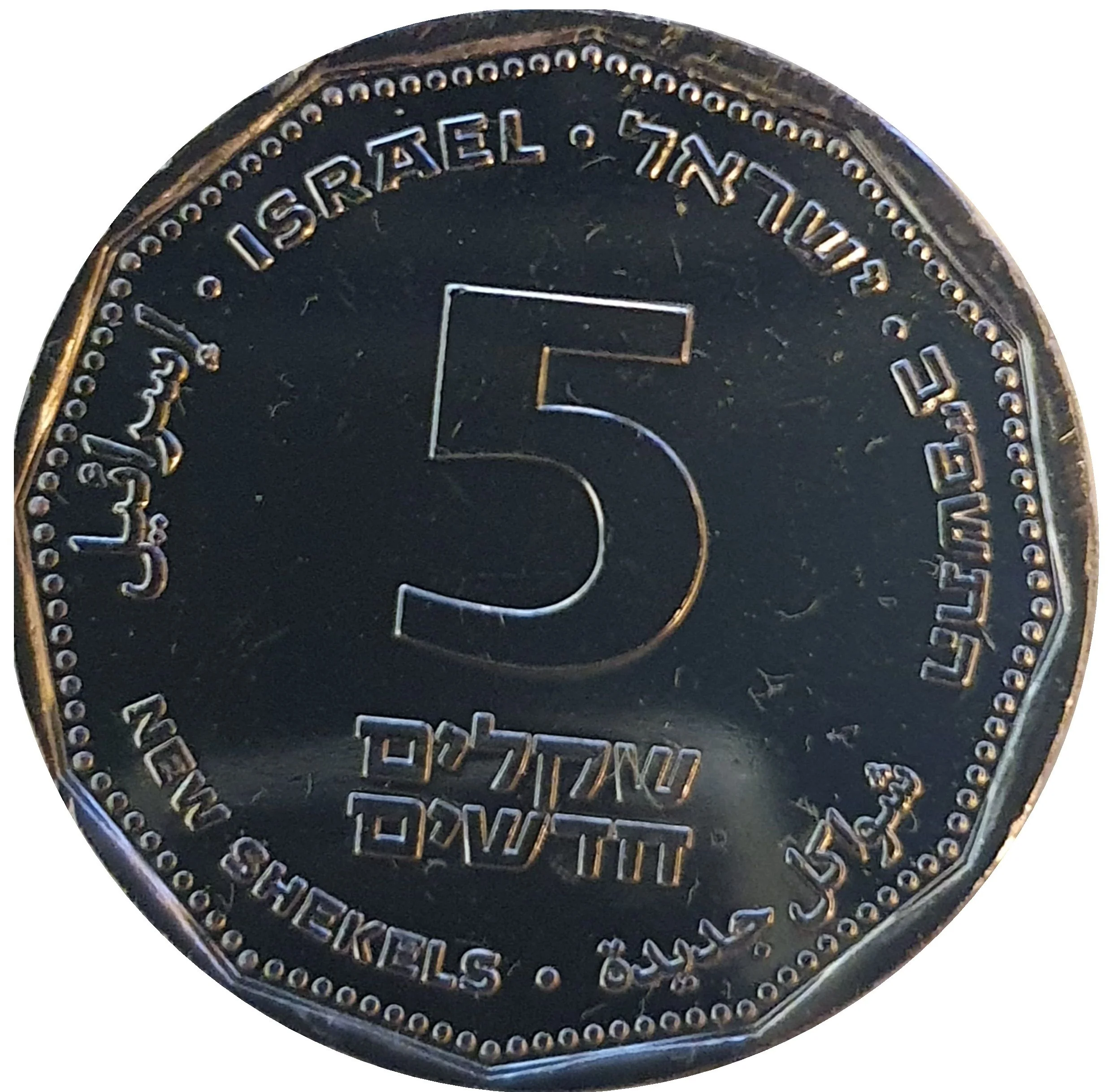
5 in Hebrew, English, Arabic; "Israel" in Arabic, English, Hebrew.
Inscription:
إِسْرَائِيل - ISRAEL - מְדִינַת יִשְׂרָאֵל
5
שקלים חדשים
NEW SHEKELS
תשפ"ב
5
שקלים חדשים
NEW SHEKELS
תשפ"ב
Translation:
Israel - ISRAEL - The State of Israel
5
New Shekels
NEW SHEKELS
2021/22
5
New Shekels
NEW SHEKELS
2021/22
Designer: Gabi Neumann
Edge
Plain
Mintings
| Year | Mint Mark | Mintage | Quality | Collection |
|---|---|---|---|---|
| 2022 | — | — |
Historical background
In 2022, the Israeli shekel (ILS) demonstrated remarkable strength for much of the year, continuing a multi-year trend. This resilience was driven by Israel's robust high-tech sector, which attracted significant foreign investment inflows, and the country's solid economic fundamentals, including consistent current account surpluses and substantial foreign exchange reserves held by the Bank of Israel. The shekel's strength was so pronounced that it became a concern for exporters and policymakers, as it made Israeli goods more expensive on the global market and posed a potential drag on economic growth.
However, the currency's trajectory shifted dramatically in the latter half of the year due to both domestic and global pressures. Globally, aggressive interest rate hikes by major central banks, particularly the U.S. Federal Reserve, made dollar-denominated assets more attractive, pulling capital away from many emerging markets, including Israel. Domestically, political uncertainty intensified with the November election and the formation of a new right-wing government proposing controversial judicial reforms. This sparked investor concerns about institutional stability, leading to capital outflows and weakening the shekel.
By the end of 2022, the shekel had depreciated significantly against the U.S. dollar, marking one of its weakest annual performances in years. The Bank of Israel responded by initiating a cycle of interest rate hikes to combat inflation (which had also risen due to global factors) and to support the currency. Thus, the year concluded with a shift from a strong-shekel environment to a period of currency volatility, where domestic political risk began to play an unprecedented role in influencing monetary policy and market sentiment.
However, the currency's trajectory shifted dramatically in the latter half of the year due to both domestic and global pressures. Globally, aggressive interest rate hikes by major central banks, particularly the U.S. Federal Reserve, made dollar-denominated assets more attractive, pulling capital away from many emerging markets, including Israel. Domestically, political uncertainty intensified with the November election and the formation of a new right-wing government proposing controversial judicial reforms. This sparked investor concerns about institutional stability, leading to capital outflows and weakening the shekel.
By the end of 2022, the shekel had depreciated significantly against the U.S. dollar, marking one of its weakest annual performances in years. The Bank of Israel responded by initiating a cycle of interest rate hikes to combat inflation (which had also risen due to global factors) and to support the currency. Thus, the year concluded with a shift from a strong-shekel environment to a period of currency volatility, where domestic political risk began to play an unprecedented role in influencing monetary policy and market sentiment.
🌱 Fairly Common