

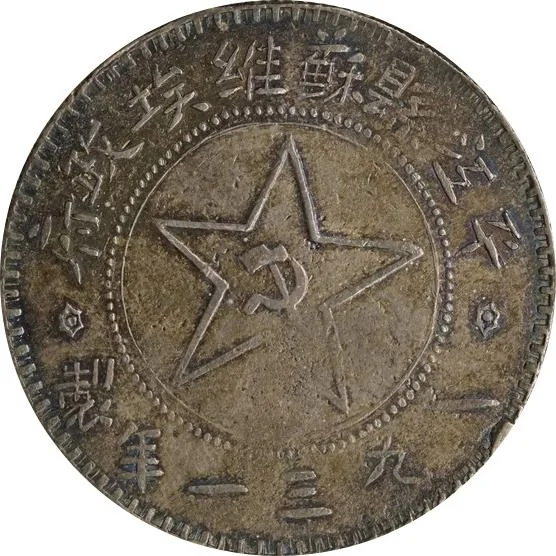
1 Yuan – Pingchiang County Soviet
China
Context
Year: 1931
Country: China 
Issuer: Pingchiang County Soviet
Issuing organization: Ping-chiang Worker's and Farmer's Bank
Currency:
(1930—1936)
Demonetized: Yes
Material
References
KM: #Click to copy to clipboard1
Numista: #298059
Obverse
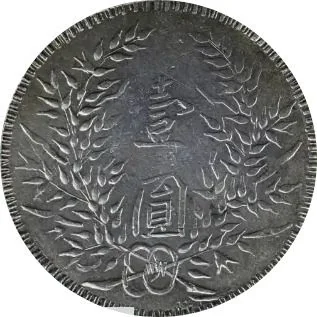
Reverse
Description:
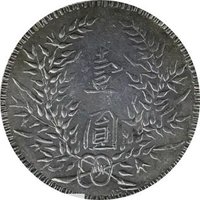
Two Chinese characters in a wreath, like the Fat Man dollar.
Inscription:
壹
圓
圓
Translation:
One Dollar
Language: Chinese
Edge
Reeded.
Categories
| Symbol> Hammer and sickle |
| Symbol> Wreath |
Mintings
| Year | Mint Mark | Mintage | Quality | Collection |
|---|---|---|---|---|
| 1931 | — | — |
Historical background
In 1931, the currency situation within the Pingchiang County Soviet, part of the larger Hunan-Hubei-Jiangxi Soviet base area, was defined by the extreme pressures of civil war and economic blockade. The region, under Communist control since the 1929 Pingjiang Uprising, was physically isolated by Kuomintang forces, severing normal trade and financial links with the wider Chinese economy. This necessitated the creation of an independent, self-sustaining financial system to fund the Red Army and local government, leading to the issuance of various local currencies and the experimentation with alternative means of exchange.
The primary currency issued was the Pingchiang County Soviet Bank note, printed on simple paper and bearing revolutionary slogans and symbols. These notes were intended to replace circulating Kuomintang currency and silver dollars, but their acceptance was challenging due to rampant inflation and public skepticism. The soviet government attempted to back the currency with promises of redemption in silver or goods, but limited reserves and the constant military threat undermined confidence. Consequently, more reliable traditional currencies, particularly silver coins, continued to circulate widely alongside the soviet notes, creating a complex dual-currency environment.
Ultimately, the currency system was fragile and temporary, reflecting the broader instability of the soviet base. The economic blockade caused severe shortages of essential goods, which in turn fueled inflation and devalued the paper currency. The entire financial experiment was abruptly concluded in mid-1931 when Kuomintang forces launched a major "Encirclement and Suppression" campaign, overrunning Pingchiang County and destroying the soviet government, thereby nullifying its currency entirely. The episode stands as a brief but illustrative example of the practical economic challenges faced by isolated Communist bases during the Chinese Soviet Republic period.
The primary currency issued was the Pingchiang County Soviet Bank note, printed on simple paper and bearing revolutionary slogans and symbols. These notes were intended to replace circulating Kuomintang currency and silver dollars, but their acceptance was challenging due to rampant inflation and public skepticism. The soviet government attempted to back the currency with promises of redemption in silver or goods, but limited reserves and the constant military threat undermined confidence. Consequently, more reliable traditional currencies, particularly silver coins, continued to circulate widely alongside the soviet notes, creating a complex dual-currency environment.
Ultimately, the currency system was fragile and temporary, reflecting the broader instability of the soviet base. The economic blockade caused severe shortages of essential goods, which in turn fueled inflation and devalued the paper currency. The entire financial experiment was abruptly concluded in mid-1931 when Kuomintang forces launched a major "Encirclement and Suppression" campaign, overrunning Pingchiang County and destroying the soviet government, thereby nullifying its currency entirely. The episode stands as a brief but illustrative example of the practical economic challenges faced by isolated Communist bases during the Chinese Soviet Republic period.
✨ Legendary