

10 euro (Slavonic Liturgical Language Recognition) – Slovakia
Add to wishlist
Non-circulating coins
Commemoration: 150th Anniversary of the Recognition of the Slavonic Liturgical Language
Slovakia
Context
Material
References
KM: #
Numista: #135210
Value
Exchange value: 10 EUR
Bullion value: $40.66
Inflation-adjusted value: 14.66 EUR
Obverse
Description:
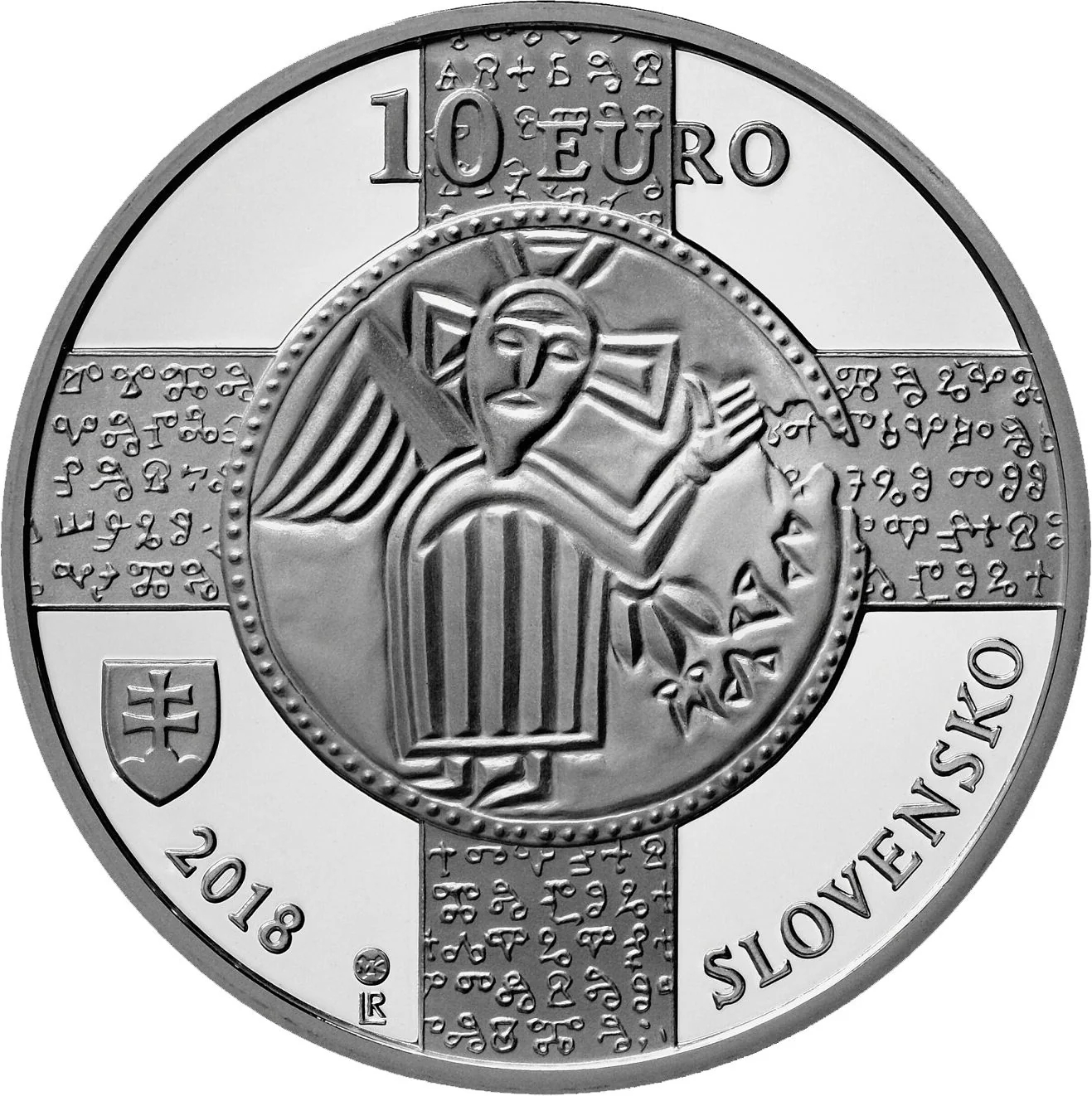
The obverse features an archaeological plaquette from Bojná, symbolising early Slovak Christianity, superimposed on a Greek cross. Glagolitic letters fill the cross arms. It includes Slovakia's coat of arms, '2018', 'SLOVENSKO', '10 EURO', and the mint mark and designer's initials (RL).
Inscription:
10 EURO
2018 SLOVENSKO
2018 SLOVENSKO
Translation:
10 EURO
2018 SLOVAKIA
2018 SLOVAKIA
Scripts: Glagolitic, Latin
Engraver: Dalibor Schmidt
Reverse
Description:
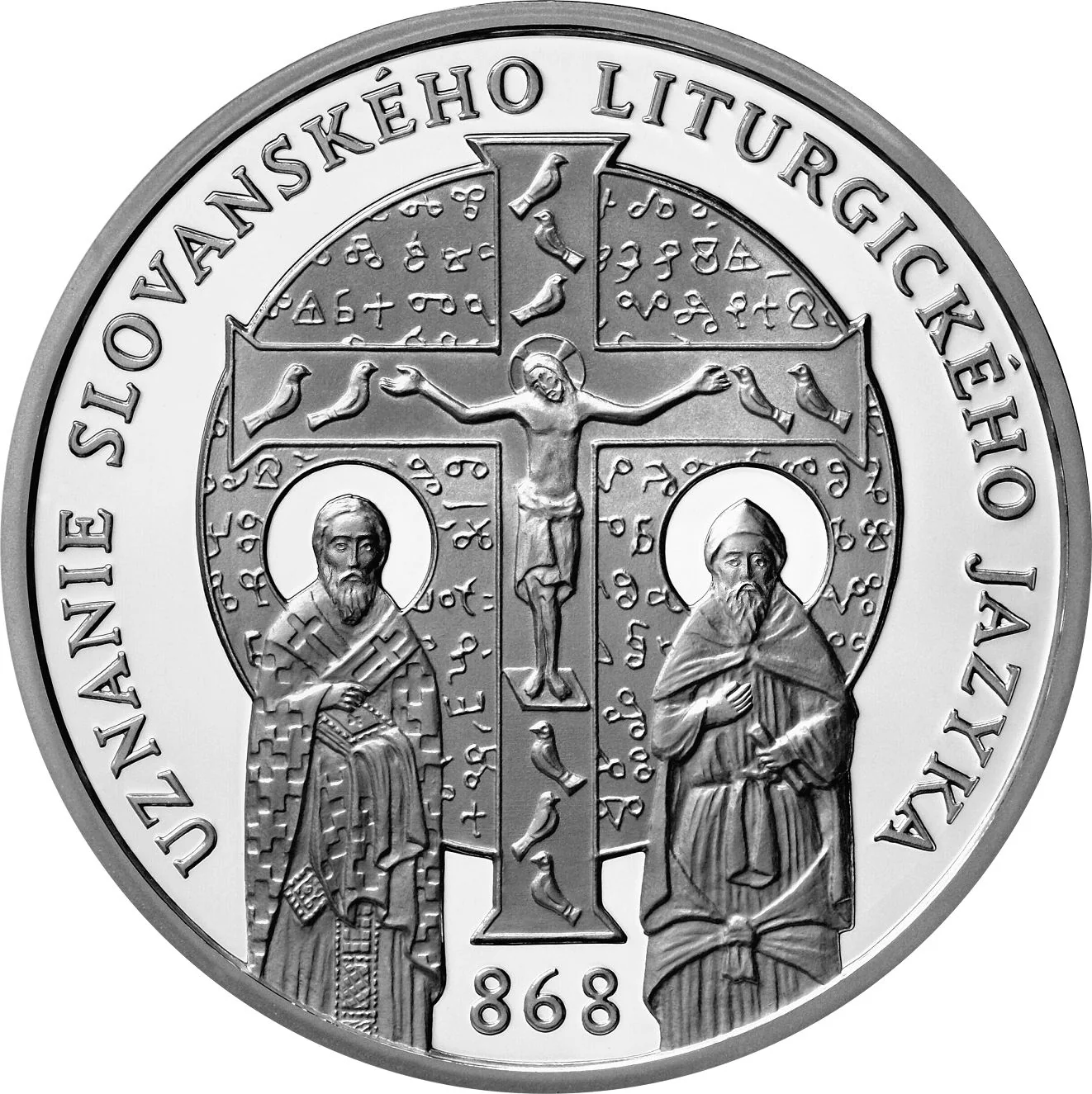
The reverse shows Cyril and Methodius beneath a crucifix, surrounded by a circle of Glagolitic letters. Along the lower edge, the inscription "UZNANIE SLOVANSKÉHO LITURGICKÉHO JAZYKA" arches above the year 868.
Inscription:
UZNANIE SLOVANSKÉHO LITURGICKÉHO JAZYKA
868
868
Translation:
Recognition of the Slavonic Liturgical Language
868
868
Scripts: Glagolitic, Latin
Language: Czech
Engraver: Dalibor Schmidt
Edge
Smooth with inscriptions in hollow
Legend:
• Konštantín a Metod • pápež Hadrián II. • Rím
Translation:
Constantine and Method; Pope Adrian II; Rome
Language: Slovak
Categories
| Person> Religious figure |
| Symbol> Cross |
Mints
| Name | Mark |
|---|---|
| Kremnica | — |
Mintings
| Year | Mint Mark | Mintage | Quality | Collection |
|---|---|---|---|---|
| 2018 | — | 2,900 | ||
| 2018 | — | 5,900 | Proof |
Historical background
In 2018, Slovakia was a well-established member of the Eurozone, having adopted the euro as its official currency on January 1, 2009. This move replaced the Slovak koruna (SKK) and integrated the country more deeply into the core of the European Union's economic and monetary framework. By 2018, the euro was a routine and accepted part of daily economic life, with a generation of Slovaks having grown up using only the common European currency. The country benefited from the stability, lower transaction costs, and enhanced trade that euro membership provided, particularly as a major exporter within the European single market.
The primary monetary policy for Slovakia in 2018 was set by the European Central Bank (ECB) in Frankfurt, not by a national bank. Slovakia's economic performance and inflation were thus influenced by ECB decisions aimed at the entire Eurozone. During this period, the ECB was maintaining historically low interest rates and a program of quantitative easing to stimulate the euro area economy following the sovereign debt crisis. For Slovakia, which enjoyed robust GDP growth (around 4% in 2018) and low unemployment, these accommodative policies contributed to rising wages and a booming real estate market, but also sparked some domestic concerns about potential overheating and housing affordability.
Domestically, there was no serious political movement or public debate in 2018 about leaving the euro, as support for the currency remained strong. The main financial discussions focused on national fiscal policy within the EU's rules, combating tax evasion, and managing the economic convergence with wealthier Western European nations. While some economists noted that the ECB's one-size-fits-all policy was perhaps too loose for Slovakia's strong cyclical position, the overall consensus was that the benefits of euro membership, including investment confidence and monetary stability, significantly outweighed any drawbacks. The currency situation was therefore one of stable integration, with Slovakia firmly embedded in the European monetary system.
The primary monetary policy for Slovakia in 2018 was set by the European Central Bank (ECB) in Frankfurt, not by a national bank. Slovakia's economic performance and inflation were thus influenced by ECB decisions aimed at the entire Eurozone. During this period, the ECB was maintaining historically low interest rates and a program of quantitative easing to stimulate the euro area economy following the sovereign debt crisis. For Slovakia, which enjoyed robust GDP growth (around 4% in 2018) and low unemployment, these accommodative policies contributed to rising wages and a booming real estate market, but also sparked some domestic concerns about potential overheating and housing affordability.
Domestically, there was no serious political movement or public debate in 2018 about leaving the euro, as support for the currency remained strong. The main financial discussions focused on national fiscal policy within the EU's rules, combating tax evasion, and managing the economic convergence with wealthier Western European nations. While some economists noted that the ECB's one-size-fits-all policy was perhaps too loose for Slovakia's strong cyclical position, the overall consensus was that the benefits of euro membership, including investment confidence and monetary stability, significantly outweighed any drawbacks. The currency situation was therefore one of stable integration, with Slovakia firmly embedded in the European monetary system.
💎 Very Rare