

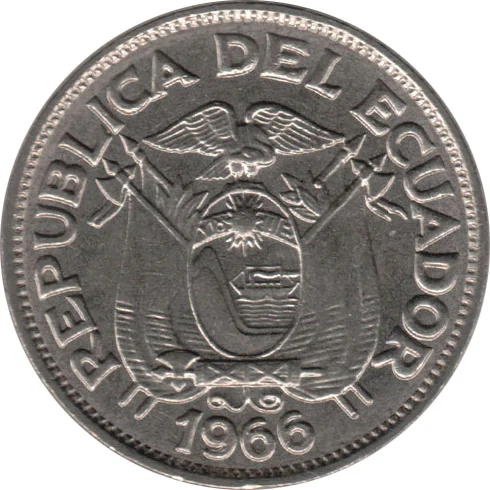
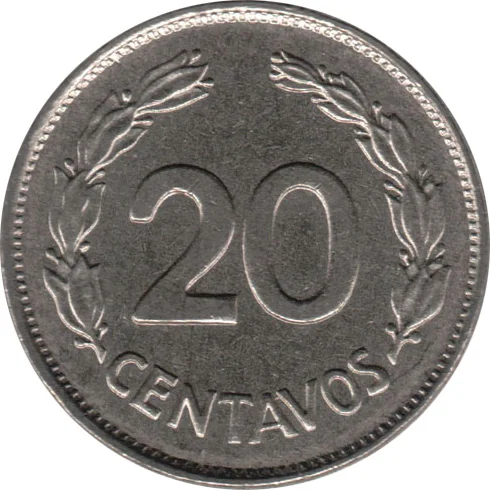
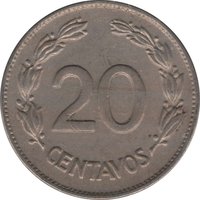
20 centavos – Ecuador
Add to wishlist
Ecuador
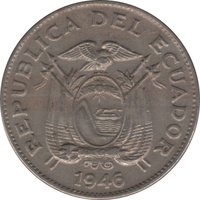
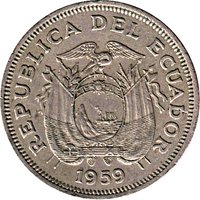
Obverse
Reverse
Edge
Plain
Categories
| Symbols> Coat of Arms |
Mints
| Name | Mark |
|---|---|
| Hamburgische Münze | — |
Mintings
| Year | Mint Mark | Mintage | Quality | Collection |
|---|---|---|---|---|
| 1959 | — | 14,400,000 | ||
| 1962 | — | 14,400,000 | ||
| 1966 | — | 24,000,000 | ||
| 1969 | — | 24,000,000 | ||
| 1971 | — | 12,000,000 | BU | |
| 1972 | — | 48,432,000 |
Historical background
In 1959, Ecuador found itself in a precarious monetary situation, characterized by severe inflation and a rapidly depreciating national currency, the sucre. The post-World War II period had seen the country grapple with fiscal imbalances, driven by expansive government spending, a reliance on volatile agricultural exports (primarily bananas and cacao), and a growing external debt. By the late 1950s, these pressures culminated in a loss of confidence in the sucre, leading to a sharp divergence between the official exchange rate and a thriving black market where the currency's value was significantly lower.
The government's response, under President Camilo Ponce Enríquez, was hesitant and ultimately ineffective. Attempts to control inflation through price freezes and import restrictions proved unsustainable and distorted the economy. Most critically, Ecuador lacked a central bank with the authority to manage monetary policy independently; the Banco Central del Ecuador, established in 1927, was effectively obligated to finance government deficits. This direct monetization of debt fueled the inflationary spiral, eroding purchasing power and creating widespread economic uncertainty.
Consequently, 1959 served as a critical juncture, exposing the fundamental weaknesses of Ecuador's monetary framework. The crisis set the stage for the major economic reforms that would follow in the next decade, most notably the pivotal 1961 Monetary Law. This law would grant true central banking functions to the Banco Central, aiming to stabilize the currency and establish a more disciplined financial system, marking the end of an era of unstructured fiscal and monetary practice.
The government's response, under President Camilo Ponce Enríquez, was hesitant and ultimately ineffective. Attempts to control inflation through price freezes and import restrictions proved unsustainable and distorted the economy. Most critically, Ecuador lacked a central bank with the authority to manage monetary policy independently; the Banco Central del Ecuador, established in 1927, was effectively obligated to finance government deficits. This direct monetization of debt fueled the inflationary spiral, eroding purchasing power and creating widespread economic uncertainty.
Consequently, 1959 served as a critical juncture, exposing the fundamental weaknesses of Ecuador's monetary framework. The crisis set the stage for the major economic reforms that would follow in the next decade, most notably the pivotal 1961 Monetary Law. This law would grant true central banking functions to the Banco Central, aiming to stabilize the currency and establish a more disciplined financial system, marking the end of an era of unstructured fiscal and monetary practice.
🌱 Very Common