

20 Balboas – Panama
Panama
Context
Material
References
KM: #Click to copy to clipboard81
Numista: #297888
Value
Exchange value: 20 PAB
Bullion value: $178.70
Obverse
Description:
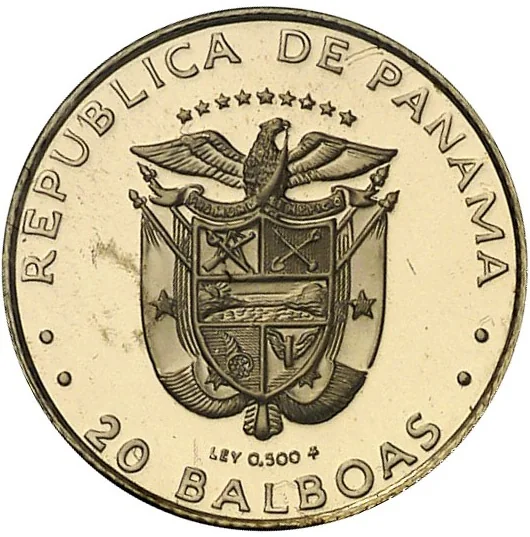
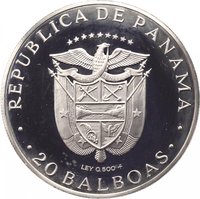
Panama's coat of arms with nine stars, country name above, fineness, mintmark, and denomination below.
Inscription:
REPUBLICA DE PANAMA
*********
PRO MUNDI BENEFICIO
LEY 0.500 FM
20 BALBOAS
*********
PRO MUNDI BENEFICIO
LEY 0.500 FM
20 BALBOAS
Translation:
REPUBLIC OF PANAMA
FOR THE BENEFIT OF THE WORLD
LAW 0.500 FM
20 BALBOAS
FOR THE BENEFIT OF THE WORLD
LAW 0.500 FM
20 BALBOAS
Script: Latin
Reverse
Edge
Categories
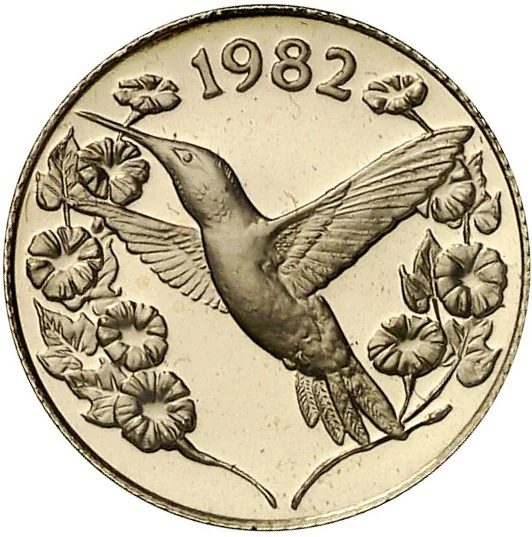
| Animal> Bird |
| Symbols> Coat of Arms |
Mints
| Name | Mark |
|---|---|
| Franklin Mint | FM |
Historical background
In 1982, Panama’s currency situation was uniquely stable in a region often plagued by monetary volatility, thanks to its long-standing and total dollarization. Since 1904, following its independence from Colombia, the U.S. dollar had functioned as the official legal tender, a system solidified by the 1904 Monetary Agreement. This meant Panama did not have a central bank issuing its own paper currency for circulation. Instead, the country issued its own coins, the balboa, which were pegged at par (1:1) with the U.S. dollar and circulated alongside U.S. banknotes. This arrangement provided a strong anchor against inflation and exchange rate risk, fostering confidence in the financial system.
However, this dollarized system also meant Panama had no independent monetary policy, ceding control over interest rates and money supply to the U.S. Federal Reserve. The economic climate in 1982 was heavily influenced by the global recession and the Latin American debt crisis, which began to impact Panama through high international interest rates and constrained credit. While the currency itself was stable, the nation's economy, heavily dependent on the U.S.-controlled Canal and international services, faced growing external debt pressures and a slowdown in its key sectors.
Politically, the period was dominated by the military rule of General Manuel Noriega, who was consolidating power behind the scenes. The stability of the currency system stood in stark contrast to the increasing political instability and allegations of corruption. Economic management in 1982 was thus focused on navigating the global financial headwinds within the rigid constraints of dollarization, while the political foundations that would lead to the crisis of the late 1980s were being laid. The currency regime remained a bedrock of the economy, even as other fiscal and political vulnerabilities grew.
However, this dollarized system also meant Panama had no independent monetary policy, ceding control over interest rates and money supply to the U.S. Federal Reserve. The economic climate in 1982 was heavily influenced by the global recession and the Latin American debt crisis, which began to impact Panama through high international interest rates and constrained credit. While the currency itself was stable, the nation's economy, heavily dependent on the U.S.-controlled Canal and international services, faced growing external debt pressures and a slowdown in its key sectors.
Politically, the period was dominated by the military rule of General Manuel Noriega, who was consolidating power behind the scenes. The stability of the currency system stood in stark contrast to the increasing political instability and allegations of corruption. Economic management in 1982 was thus focused on navigating the global financial headwinds within the rigid constraints of dollarization, while the political foundations that would lead to the crisis of the late 1980s were being laid. The currency regime remained a bedrock of the economy, even as other fiscal and political vulnerabilities grew.
✨ Legendary