


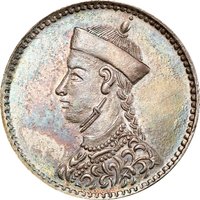
Obverse
Description:
Guangxu bust in cap and floral robe, facing left.
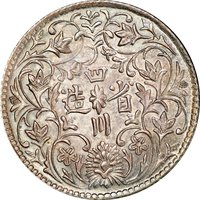
Reverse
Description:
Guangxu bust in cap and floral robe, facing left.
Edge
Reeded.
Mintings
| Year | Mint Mark | Mintage | Quality | Collection |
|---|---|---|---|---|
| — | — | — |
Historical background
In 1903, the currency situation in Tibet was a complex reflection of its political and economic position, caught between tradition and external pressures. The primary circulating medium was the Tibetan silver tangka (or srang), a coin minted in Lhasa and other locations like Derge. However, the monetary system was fragmented and unstable. The quality and silver content of tangkas varied significantly between different regional mints, leading to confusion in trade. Furthermore, a chronic shortage of minted coinage meant that physical silver, measured by weight in sang units, and even barley, served as common mediums of exchange, especially in rural areas.
Crucially, this localized system was being penetrated by foreign currencies due to increasing trade and British imperial ambition. Indian rupees, particularly those from Nepal (the Mohar) and British India, circulated widely, especially in southern Tibet along trade routes. The Maria Theresa thaler, a European silver coin, also had a presence through Central Asian trade networks. This influx created a multi-currency environment where exchange rates fluctuated, often to the disadvantage of Tibetan merchants. The economic instability was compounded by the Tibetan government's limited capacity to control its money supply or standardize coinage effectively.
This monetary disarray occurred against the backdrop of the British Younghusband Expedition, which was advancing on Tibet in late 1903 with the stated aim of resolving trade disputes. A key British grievance was the arbitrary valuation of Indian rupees by Tibetan officials, which hampered British commercial interests. Thus, the currency situation was not merely an economic issue but a direct geopolitical flashpoint. The existing financial chaos underscored the weakening authority of the Lhasa government and highlighted how Tibet's economic sovereignty was being eroded by both market forces and the impending military threat, which would culminate in the 1904 invasion of Lhasa.
Crucially, this localized system was being penetrated by foreign currencies due to increasing trade and British imperial ambition. Indian rupees, particularly those from Nepal (the Mohar) and British India, circulated widely, especially in southern Tibet along trade routes. The Maria Theresa thaler, a European silver coin, also had a presence through Central Asian trade networks. This influx created a multi-currency environment where exchange rates fluctuated, often to the disadvantage of Tibetan merchants. The economic instability was compounded by the Tibetan government's limited capacity to control its money supply or standardize coinage effectively.
This monetary disarray occurred against the backdrop of the British Younghusband Expedition, which was advancing on Tibet in late 1903 with the stated aim of resolving trade disputes. A key British grievance was the arbitrary valuation of Indian rupees by Tibetan officials, which hampered British commercial interests. Thus, the currency situation was not merely an economic issue but a direct geopolitical flashpoint. The existing financial chaos underscored the weakening authority of the Lhasa government and highlighted how Tibet's economic sovereignty was being eroded by both market forces and the impending military threat, which would culminate in the 1904 invasion of Lhasa.

✨ Legendary