

Obverse
Description:
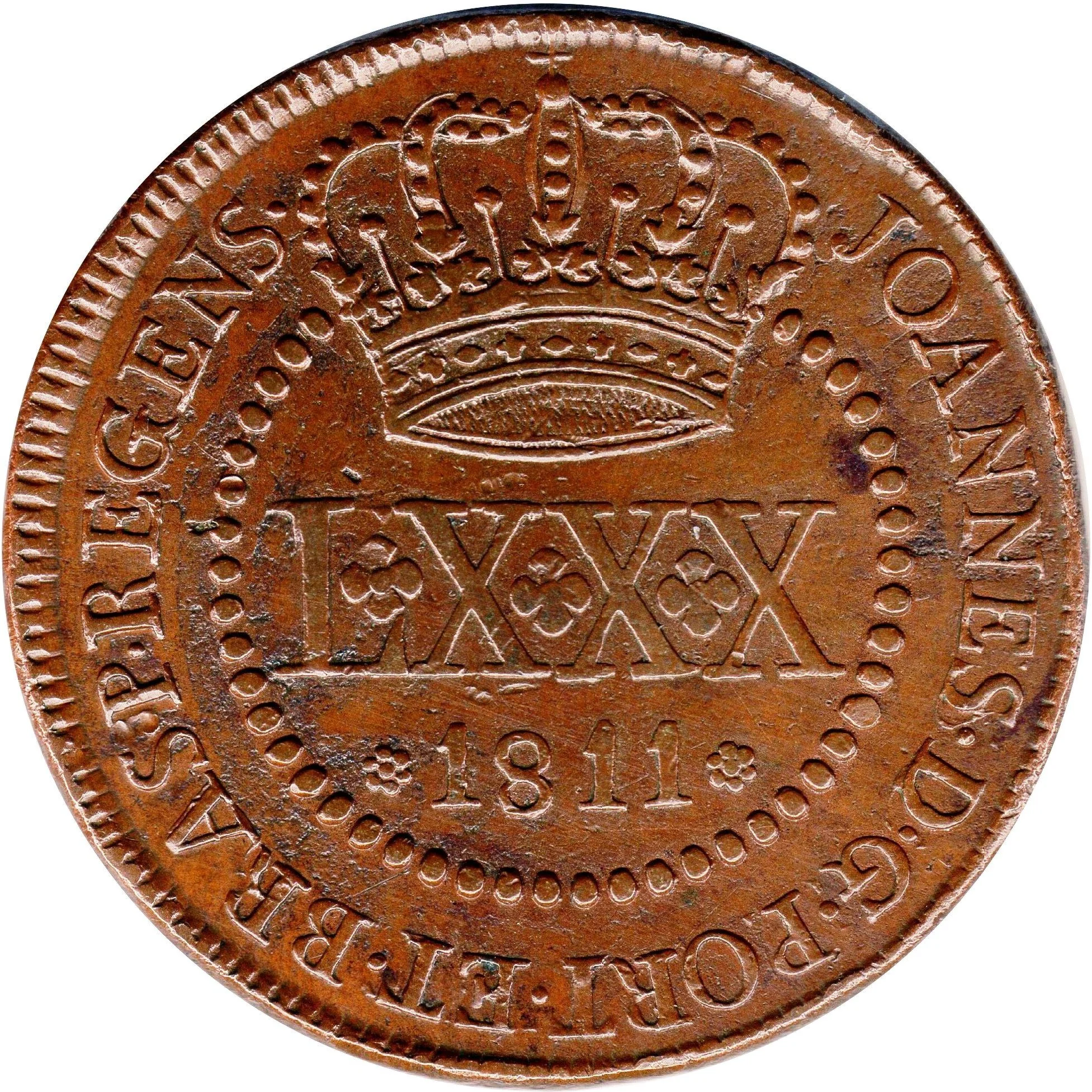
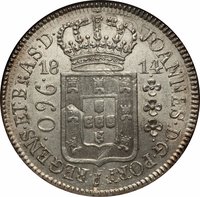
JOANNES·D·G·PORT·ET·BRAS·P·REGENS· LXXX ·1811·
Inscription:
John for the Grace of God Prince Regent of Portugal and Brazil
80
1811
80
1811
Translation:
John, by the Grace of God, Prince Regent of Portugal and Brazil
80
1811
80
1811
Script: Latin
Languages: Portuguese, English
Reverse
Edge
Plain
Mints
| Name | Mark |
|---|---|
| Casa da Moeda do Brasil | R |
Historical background
In 1811, Brazil's currency situation was complex and strained, reflecting its unique political status within the Portuguese Empire. Since 1808, the Portuguese royal court had been residing in Rio de Janeiro, fleeing Napoleon's invasion. This sudden arrival of the monarchy, along with thousands of courtiers and administrators, injected a large, state-driven demand for goods and services into the local economy. To finance the expanded court, government bureaucracy, and military expenditures, the Prince Regent Dom João (future João VI) significantly increased the money supply. This was primarily done through the issuance of paper money, backed not by gold or silver, but by the promise of future tax revenues, a relatively novel and inflationary practice for the colony.
The primary currency in circulation was the real (plural: réis), but the system was a chaotic mix of metallic and paper money. Copper and silver coins were in short supply, leading to widespread use of lower-quality locally minted coins and a proliferation of counterfeit currency. The Banco do Brasil, founded in 1808 as the first bank in the colony, was already struggling. It issued a flood of paper notes known as bilhetes de banco to cover government deficits, but these notes quickly began to depreciate against metallic currency. This created a classic bimetalic system where "good" metal coins were hoarded (following Gresham's Law), while depreciating paper notes were used for everyday transactions, eroding public trust.
Consequently, Brazil in 1811 was experiencing significant inflation and currency instability. The disconnect between the paper money supply and tangible assets, combined with the costs of ongoing military campaigns in the neighboring Banda Oriental (modern-day Uruguay), placed severe pressure on the financial system. This period laid the groundwork for a persistent cycle of debt, currency devaluation, and monetary experiments that would challenge the Brazilian economy long after it became an independent empire in 1822. The situation underscored the difficulties of managing a colonial economy suddenly transformed into the seat of a global empire.
The primary currency in circulation was the real (plural: réis), but the system was a chaotic mix of metallic and paper money. Copper and silver coins were in short supply, leading to widespread use of lower-quality locally minted coins and a proliferation of counterfeit currency. The Banco do Brasil, founded in 1808 as the first bank in the colony, was already struggling. It issued a flood of paper notes known as bilhetes de banco to cover government deficits, but these notes quickly began to depreciate against metallic currency. This created a classic bimetalic system where "good" metal coins were hoarded (following Gresham's Law), while depreciating paper notes were used for everyday transactions, eroding public trust.
Consequently, Brazil in 1811 was experiencing significant inflation and currency instability. The disconnect between the paper money supply and tangible assets, combined with the costs of ongoing military campaigns in the neighboring Banda Oriental (modern-day Uruguay), placed severe pressure on the financial system. This period laid the groundwork for a persistent cycle of debt, currency devaluation, and monetary experiments that would challenge the Brazilian economy long after it became an independent empire in 1822. The situation underscored the difficulties of managing a colonial economy suddenly transformed into the seat of a global empire.
✨ Legendary