

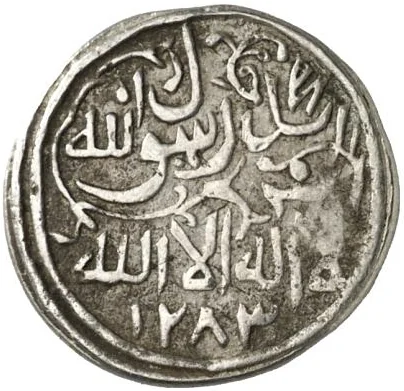
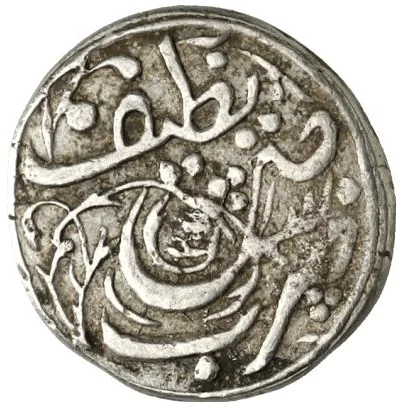
1 Tenga – Turkestan Khanate
China
Context
Year: 1867
Islamic (Hijri) Year: 1283
Country: China 
Issuer: Turkestan Khanate
Ruler: Rashidin Khan Khoja
Currency:
(1864—1867)
Subdivision: 1 Tenga = 25 Cash
Demonetized: Yes
Material
References
Numista: #296763
Obverse
Reverse
Edge
Plain
Mintings
| Year | Mint Mark | Mintage | Quality | Collection |
|---|---|---|---|---|
| 1867 | — | — |
Historical background
In 1867, the currency situation in the Turkestan Khanate—a term often used for the Khanate of Kokand, which was the major independent state in the region at the time—was one of profound instability and transition. The Khanate’s economy relied on a complex and debased coinage system, primarily producing small silver tangas and copper puls. However, years of political weakness, extravagant court expenditure, and costly wars against the Emirate of Bukhara and expanding Russian forces led to severe currency depreciation. Rulers frequently reduced the silver content in coins to finance the state, causing inflation, a loss of public trust, and the circulation of many irregular and counterfeit issues alongside older, purer coins.
This monetary chaos was exacerbated by intense geopolitical pressure. By 1867, the Russian Empire had already captured Tashkent (1865) and established the Turkestan Governor-Generalship, placing the Khanate of Kokand under direct military threat. Russian rubles and kopecks began circulating in occupied areas, creating a dual-currency zone that further undermined the Khanate's already fragile monetary authority. Trade routes, once a source of wealth, were disrupted by conflict, and the government in Kokand struggled to assert economic sovereignty as its territory and revenues shrank.
Ultimately, the currency crisis of 1867 was a direct symptom of the Khanate’s impending collapse. The debased and unreliable coinage reflected a failing state apparatus unable to manage its finances or defend its borders. Within a few years, in 1876, the Khanate would be fully annexed by Russia, which would subsequently abolish the local coinage and impose a unified ruble-based monetary system across all of Russian Turkestan, definitively ending the region’s era of independent currency.
This monetary chaos was exacerbated by intense geopolitical pressure. By 1867, the Russian Empire had already captured Tashkent (1865) and established the Turkestan Governor-Generalship, placing the Khanate of Kokand under direct military threat. Russian rubles and kopecks began circulating in occupied areas, creating a dual-currency zone that further undermined the Khanate's already fragile monetary authority. Trade routes, once a source of wealth, were disrupted by conflict, and the government in Kokand struggled to assert economic sovereignty as its territory and revenues shrank.
Ultimately, the currency crisis of 1867 was a direct symptom of the Khanate’s impending collapse. The debased and unreliable coinage reflected a failing state apparatus unable to manage its finances or defend its borders. Within a few years, in 1876, the Khanate would be fully annexed by Russia, which would subsequently abolish the local coinage and impose a unified ruble-based monetary system across all of Russian Turkestan, definitively ending the region’s era of independent currency.
✨ Legendary