

2 Hryvni (Ukrainian Medical Association) – Ukraine
Non-circulating coins
Commemoration: 100th Anniversary of the Ukrainian Medical Association
Ukraine
Context
Year: 2010
Issuer: Ukraine 
Issuing organization: National Bank of Ukraine
Period:
(since 1991)
Currency:
(since 1996)
Total mintage: 35,000
Material
Diameter: 31 mm
Weight: 12.8 g
Shape: Round
Composition: Nickel brass
Magnetic: No
Technique: Milled
Alignment: Medal alignment
flip
References
KM: #Click to copy to clipboard608
Numista: #29610
Value
Exchange value: 2 UAH
Obverse
Description:
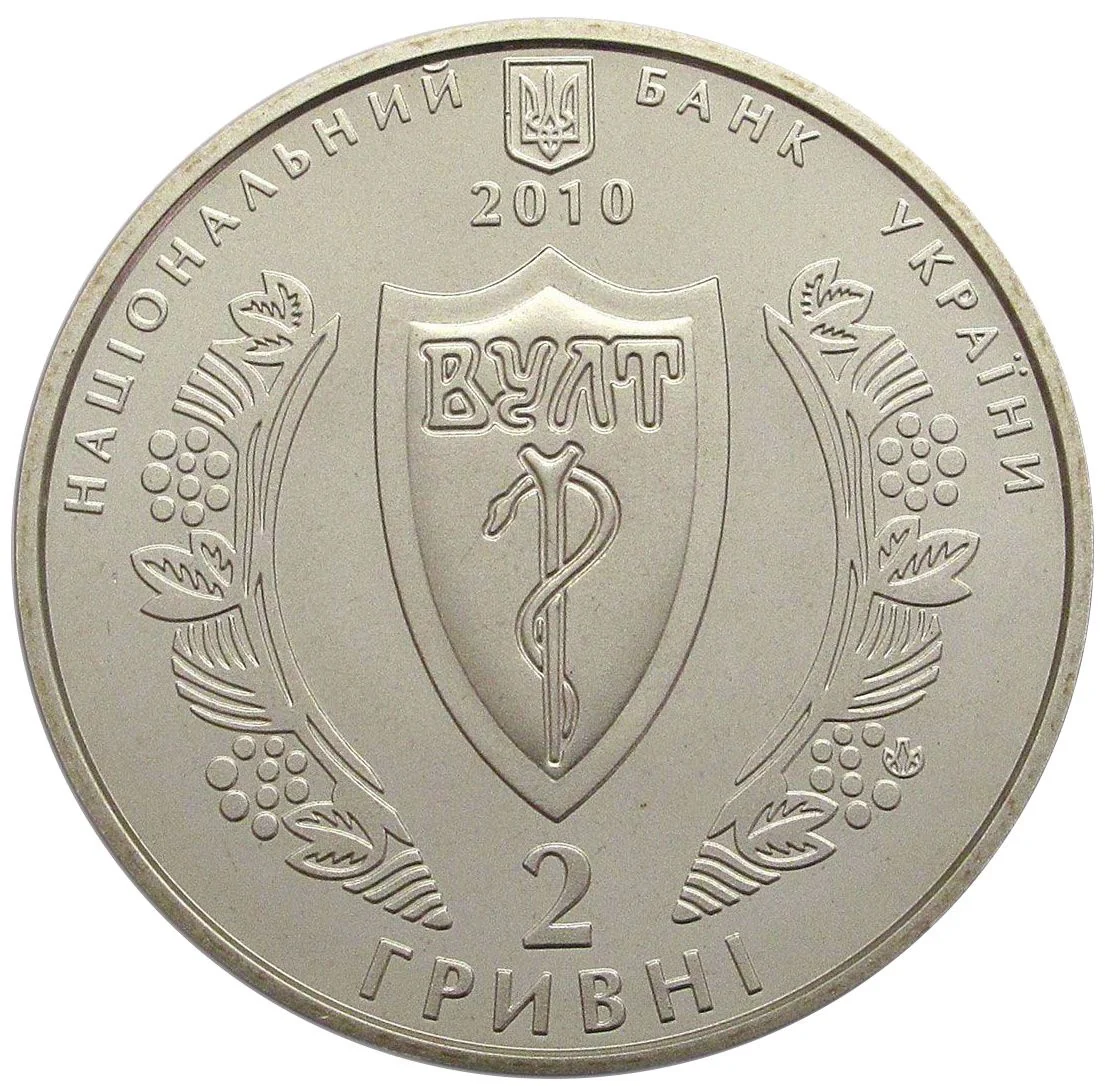
The obverse features Ukraine's Small Coat of Arms, the year 2010, and the inscription "National Bank of Ukraine." The center shows the All-Ukrainian Medical Association logo within a stylized plant ornament. Below are the face value "2 hryvnias" and the Mint's logo.
Inscription:
НАЦІОНАЛЬНИЙ БАНК УКРАЇНИ
2010
2 ГРИВНІ
2010
2 ГРИВНІ
Translation:
NATIONAL BANK OF UKRAINE
2010
2 HRYVNIAS
2010
2 HRYVNIAS
Script: Cyrillic
Language: Ukrainian
Engravers: Anatolii Demianenko, Volodymyr Atamanchuk
Reverse
Description:
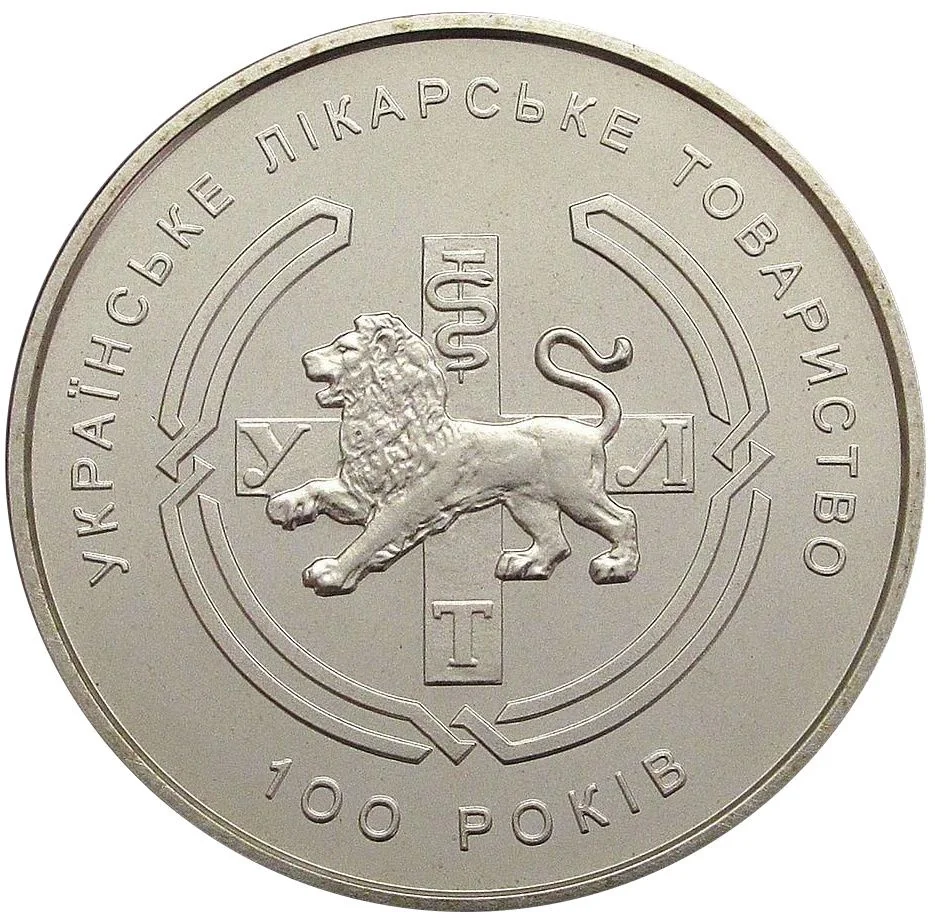
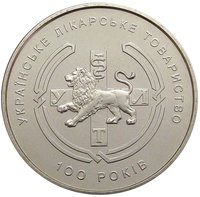
The emblem of the Ukrainian Medical Association in Lviv, featuring the semicircular inscriptions "УКРАЇНСЬКЕ ЛІКАРСЬКЕ ТОВАРИСТВО" above and "100 РОКІВ" below.
Inscription:
УКРАЇНСЬКЕ ЛІКАРСЬКЕ ТОВАРИСТВО
100 РОКІВ
100 РОКІВ
Translation:
UKRAINIAN MEDICAL SOCIETY
100 YEARS
100 YEARS
Script: Cyrillic
Language: Ukrainian
Engravers: Anatolii Demianenko, Volodymyr Atamanchuk
Designer: Volodymyr Atamanchuk
Edge
Reeded
Mints
| Name | Mark |
|---|---|
| National Bank of Ukraine Banknote Printing and Minting Works | — |
Mintings
| Year | Mint Mark | Mintage | Quality | Collection |
|---|---|---|---|---|
| 2010 | — | 35,000 | Special Uncirculated |
Historical background
In 2010, Ukraine's currency, the hryvnia (UAH), was in a period of relative but fragile stability following the severe shocks of the Global Financial Crisis. The crisis had forced the National Bank of Ukraine (NBU) to enact a drastic devaluation in late 2008, abandoning its peg to the US dollar after spending nearly a third of its reserves in a failed defense. By 2010, the hryvnia had settled at a new, weaker exchange rate of approximately 8 UAH/USD, a level maintained through heavy administrative interventions and restrictions by the NBU. This stability was largely artificial, propped up by a $15.4 billion Stand-By Arrangement with the International Monetary Fund (IMF), which provided crucial foreign exchange reserves but came with strict conditions for economic reform.
The underlying economic fundamentals, however, remained weak and posed significant threats to the currency's long-term health. President Viktor Yanukovych, who took office in February 2010, pursued policies that increased fiscal pressure, including raising social spending and reinstating energy subsidies that inflated the budget deficit. Furthermore, the country ran a persistent and large current account deficit, meaning it was importing far more than it exported, creating constant downward pressure on the hryvnia. Corruption, a lack of structural reforms, and an over-reliance on steel and chemical exports left the economy vulnerable to external commodity price swings.
Consequently, the stability of 2010 was seen by most economists as a temporary calm. The IMF program was suspended in early 2011 due to the government's failure to meet conditions on gas tariff hikes, cutting off a key source of support. This set the stage for the gradual depletion of reserves and mounting pressures that would eventually lead to a new currency crisis in 2014, following the political upheaval of the Euromaidan Revolution and the outbreak of conflict in the Donbas region. Thus, the currency situation in 2010 was one of managed stability masking deep-seated vulnerabilities.
The underlying economic fundamentals, however, remained weak and posed significant threats to the currency's long-term health. President Viktor Yanukovych, who took office in February 2010, pursued policies that increased fiscal pressure, including raising social spending and reinstating energy subsidies that inflated the budget deficit. Furthermore, the country ran a persistent and large current account deficit, meaning it was importing far more than it exported, creating constant downward pressure on the hryvnia. Corruption, a lack of structural reforms, and an over-reliance on steel and chemical exports left the economy vulnerable to external commodity price swings.
Consequently, the stability of 2010 was seen by most economists as a temporary calm. The IMF program was suspended in early 2011 due to the government's failure to meet conditions on gas tariff hikes, cutting off a key source of support. This set the stage for the gradual depletion of reserves and mounting pressures that would eventually lead to a new currency crisis in 2014, following the political upheaval of the Euromaidan Revolution and the outbreak of conflict in the Donbas region. Thus, the currency situation in 2010 was one of managed stability masking deep-seated vulnerabilities.
🌟 Limited