

5 Francs – Switzerland
Switzerland
Context
Years: 1985–1993
Issuer: Switzerland 
Period:
(since 1848)
Currency:
(since 1850)
Demonetization: 1 January 2004
Total mintage: 36,428,550
Material

References
KM: #Click to copy to clipboard40a.3
Numista: #294830
Value
Exchange value: 5 CHF = $6.46
Inflation-adjusted value: 8.23 CHF
Obverse
Description:
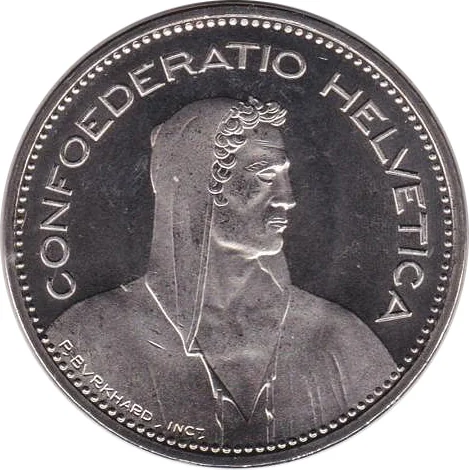
Bust of a curly-haired herdsman in a hooded shirt, facing right; commonly misidentified as William Tell.
Inscription:
CONFOEDERATIO HELVETICA
P , BVRKHARD , INCᵀ,
P , BVRKHARD , INCᵀ,
Translation:
Swiss Confederation
P. Burkhard, Inc.
P. Burkhard, Inc.
Script: Latin
Designer: Paul Burkhard
Reverse
Description:
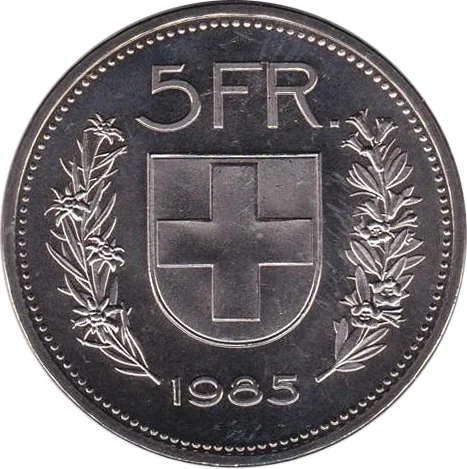
Swiss coat of arms on a square shield, with an edelweiss to the left and an alpenrose to the right.
Inscription:
5 FR.
1985
1985
Script: Latin
Designer: Paul Burkhard
Edge
Incuse lettering.
Legend:
DOMINUS PROVIDEBIT ★★★★★★★★★★★★★
Translation:
The Lord will provide ★★★★★★★★★★★★★
Language: Latin
Mints
| Name | Mark |
|---|---|
| Bern | B |
Mintings
| Year | Mint Mark | Mintage | Quality | Collection |
|---|---|---|---|---|
| 1985 | — | 4,050,000 | ||
| 1985 | — | 12,000 | Proof | |
| 1986 | B | 7,083,000 | ||
| 1986 | B | 10,000 | Proof | |
| 1987 | B | 7,028,000 | ||
| 1987 | B | 8,800 | Proof | |
| 1988 | B | 7,029,000 | ||
| 1988 | B | 9,000 | Proof | |
| 1989 | B | 8,800 | Proof | |
| 1989 | B | 5,031,000 | ||
| 1990 | B | 1,049,000 | ||
| 1990 | B | 8,900 | Proof | |
| 1991 | B | 26,100 | In sets | |
| 1991 | B | 9,900 | Proof | |
| 1992 | B | 5,035,000 | ||
| 1992 | B | 7,450 | Proof | |
| 1993 | B | 16,400 | ||
| 1993 | B | 6,200 | Proof |
Historical background
In 1985, the Swiss franc was a currency defined by its traditional strengths: stability, low inflation, and safe-haven status. This reputation was built on Switzerland's political neutrality, robust banking sector, and a conservative monetary policy historically anchored by gold reserves. However, the decade's early years presented challenges. The global recession of the early 1980s and a significant appreciation of the franc in the late 1970s had hurt Swiss export competitiveness, leading to economic stagnation and rising unemployment. The Swiss National Bank (SNB) faced the difficult task of balancing its core mandate of price stability with the need to support the domestic economy.
Monetary policy during this period was in a transitional phase. The SNB had officially abandoned a fixed exchange rate regime in 1973, but it still actively managed the franc's value through foreign exchange interventions and interest rate adjustments. The primary monetary target was the growth of the monetary aggregate M1 (central bank money). In 1985, the SNB was cautiously easing its policy; it reduced its discount rate in March and again in September, aiming to stimulate lending and economic activity. Inflation was minimal, hovering around 1%, which provided room for these accommodative measures without threatening price stability.
The year 1985 set the stage for a significant shift that would follow. While the immediate focus was on combating economic weakness, the strong franc's persistent pressure on exporters highlighted a structural tension that would define Swiss monetary policy for decades to come. This period reinforced the understanding that the franc's safe-haven appeal could lead to damaging overvaluation during times of international uncertainty, a dilemma that would eventually lead to more explicit exchange rate management, most notably the temporary peg to the euro introduced in 2011. Thus, 1985 represents a point where traditional Swiss monetary orthodoxy began to grapple with the increasing forces of financial globalization.
Monetary policy during this period was in a transitional phase. The SNB had officially abandoned a fixed exchange rate regime in 1973, but it still actively managed the franc's value through foreign exchange interventions and interest rate adjustments. The primary monetary target was the growth of the monetary aggregate M1 (central bank money). In 1985, the SNB was cautiously easing its policy; it reduced its discount rate in March and again in September, aiming to stimulate lending and economic activity. Inflation was minimal, hovering around 1%, which provided room for these accommodative measures without threatening price stability.
The year 1985 set the stage for a significant shift that would follow. While the immediate focus was on combating economic weakness, the strong franc's persistent pressure on exporters highlighted a structural tension that would define Swiss monetary policy for decades to come. This period reinforced the understanding that the franc's safe-haven appeal could lead to damaging overvaluation during times of international uncertainty, a dilemma that would eventually lead to more explicit exchange rate management, most notably the temporary peg to the euro introduced in 2011. Thus, 1985 represents a point where traditional Swiss monetary orthodoxy began to grapple with the increasing forces of financial globalization.

🌱 Very Common