

1 Rupia – Portuguese India
India
Context
Year: 1952
Country: India 
Issuer: Portuguese India
Period:
(1910—1961)
Currency:
(1880—1958)
Subdivision: 1 Rupia = 16 Tangas = 192 Réis
Demonetization: 1958
Total mintage: 1,000,000
Material
Diameter: 30.3 mm
Weight: 12.03 g
Thickness: 2.3 mm
Shape: Round
Composition: Copper-nickel
Technique: Milled
Alignment: Coin alignment
flip
References
KM: #Click to copy to clipboard29
Numista: #29425
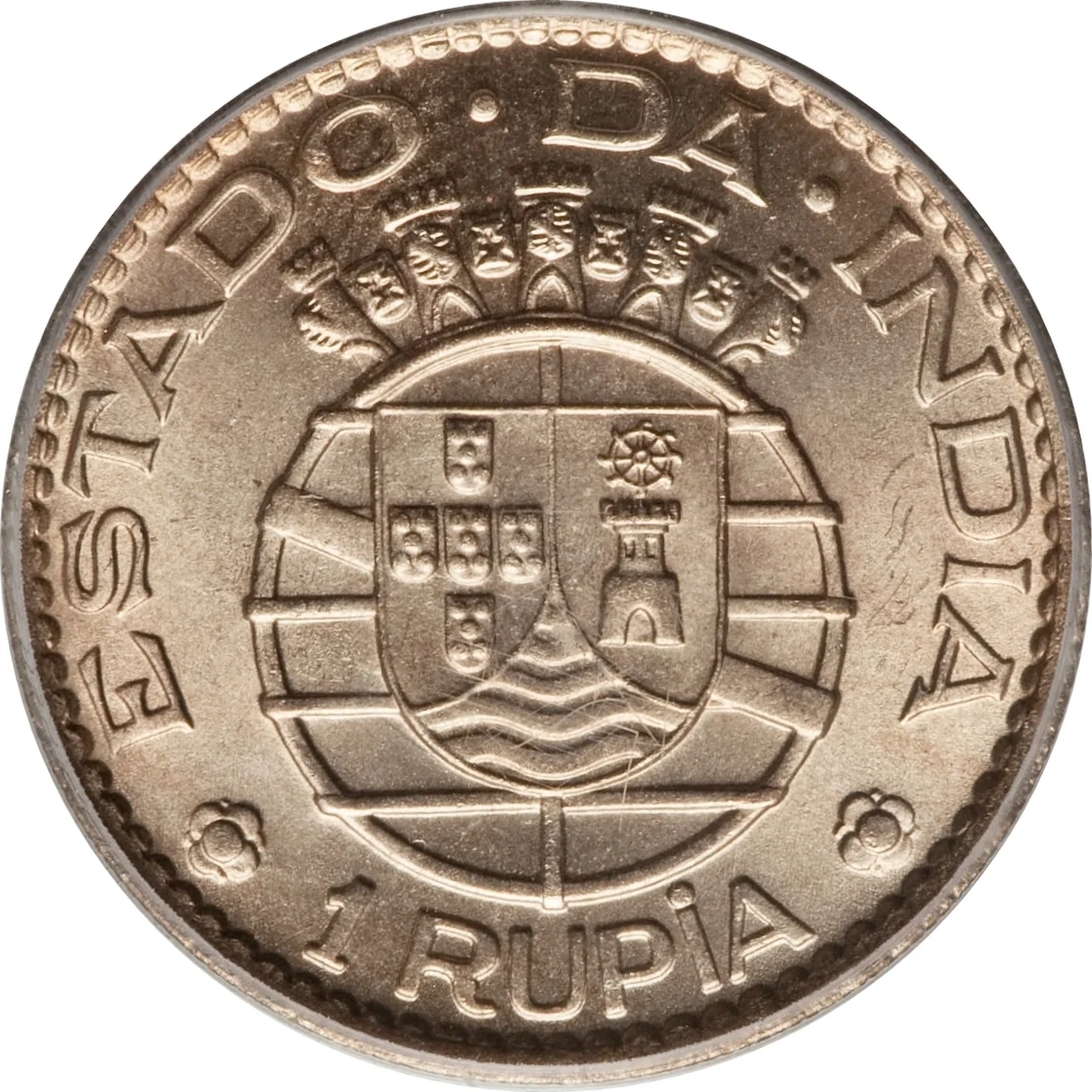
Obverse
Description:
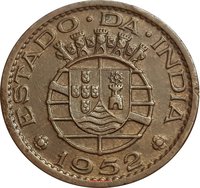
Tiny towers and shields atop a circular line.
Inscription:
ESTADO DA INDIA
1 RUPIA
1 RUPIA
Translation:
STATE OF INDIA
1 RUPIA
1 RUPIA
Script: Latin
Language: Portuguese
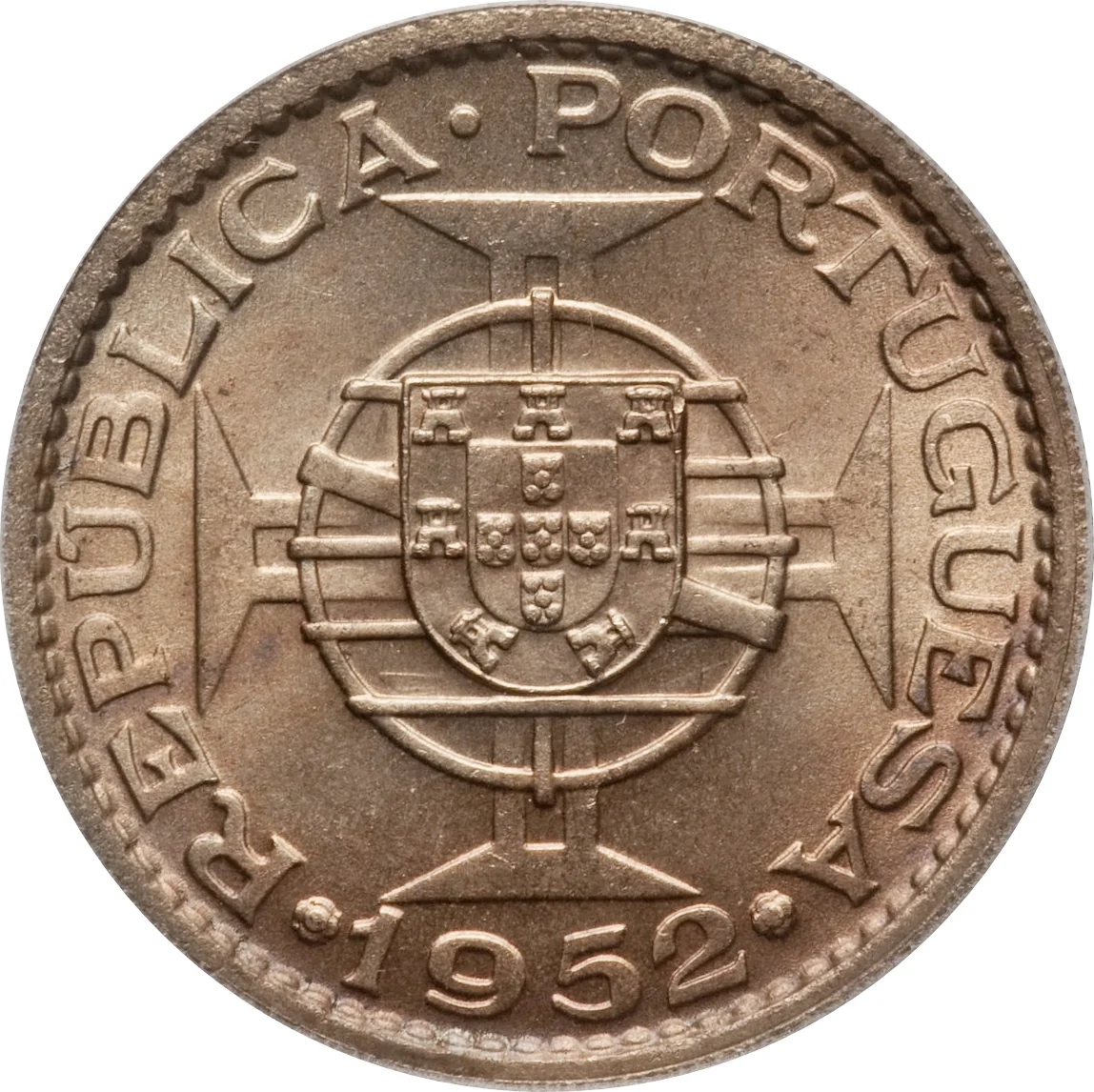
Reverse
Description:
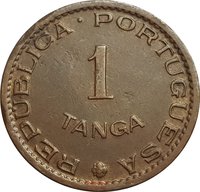
Shield centered on a Maltese Cross.
Inscription:
REPUBLICA· PORTUGUESA
·1952·
·1952·
Translation:
PORTUGUESE REPUBLIC
·1952·
·1952·
Script: Latin
Language: Portuguese
Edge
Reeded
Mints
| Name | Mark |
|---|---|
| Imprensa Nacional - Casa da Moeda | — |
Mintings
| Year | Mint Mark | Mintage | Quality | Collection |
|---|---|---|---|---|
| 1952 | — | 1,000,000 |
Historical background
In 1952, the currency situation in Portuguese India (comprising Goa, Daman, and Diu) was a complex and hybrid system, directly reflecting its status as a colonial enclave surrounded by the newly independent Republic of India. The official currency was the Portuguese Indian rupia (INPR), which was pegged to and backed by the Portuguese escudo, not the Indian rupee. However, due to deep-rooted economic and cultural ties with surrounding Indian territory, the Indian rupee (INR) circulated widely and was accepted for everyday transactions, especially in border markets and for trade with India. This created a de facto dual-currency economy where both monetary systems operated in parallel, with exchange rates subject to market fluctuations and administrative controls.
The Portuguese authorities maintained strict regulations to uphold the primacy of their currency, requiring official transactions, government salaries, and foreign trade to be conducted in Portuguese Indian rupias. The Banco Nacional Ultramarino (BNU) held the exclusive right of note issue for the colony. However, the practical realities of geography and economics made it impossible to exclude the Indian rupee, which was often preferred by the local population for its stability and utility in regional commerce. This led to periodic tensions, as Portuguese efforts to restrict the flow of Indian currency clashed with the daily needs of the populace and the smuggling of goods across the borders.
By 1952, this monetary duality had become a symbolic and economic point of contention. For India, the circulation of its rupee within Portuguese territories was seen as a manifestation of its natural economic sphere of influence. For Portugal, maintaining its separate currency was an assertion of sovereignty and colonial control. The situation was inherently unstable, underpinned by India's growing economic pressure and trade restrictions aimed at integrating the enclaves, which would culminate a decade later in their military annexation by India in 1961. The currency landscape of 1952 thus encapsulated the broader political struggle over the territory's future.
The Portuguese authorities maintained strict regulations to uphold the primacy of their currency, requiring official transactions, government salaries, and foreign trade to be conducted in Portuguese Indian rupias. The Banco Nacional Ultramarino (BNU) held the exclusive right of note issue for the colony. However, the practical realities of geography and economics made it impossible to exclude the Indian rupee, which was often preferred by the local population for its stability and utility in regional commerce. This led to periodic tensions, as Portuguese efforts to restrict the flow of Indian currency clashed with the daily needs of the populace and the smuggling of goods across the borders.
By 1952, this monetary duality had become a symbolic and economic point of contention. For India, the circulation of its rupee within Portuguese territories was seen as a manifestation of its natural economic sphere of influence. For Portugal, maintaining its separate currency was an assertion of sovereignty and colonial control. The situation was inherently unstable, underpinned by India's growing economic pressure and trade restrictions aimed at integrating the enclaves, which would culminate a decade later in their military annexation by India in 1961. The currency landscape of 1952 thus encapsulated the broader political struggle over the territory's future.
🌟 Limited