

5 Cents – Netherlands Antilles
Netherlands
Context
Years: 1971–1985
Country: Netherlands 
Issuer: Netherlands Antilles
Ruler: Juliana
Currency:
(since 1828)
Demonetized: Yes
Total mintage: 17,637,998
Material
Weight: 4.5 g
Thickness: 1.8 mm
Shape: Square with rounded corners
Technique: Milled
Alignment: Coin alignment
flip
References
KM: #Click to copy to clipboard13
Numista: #2935
Value
Exchange value: 0.05 ANG
Inflation-adjusted value: 0.28 ANG
Obverse
Description:
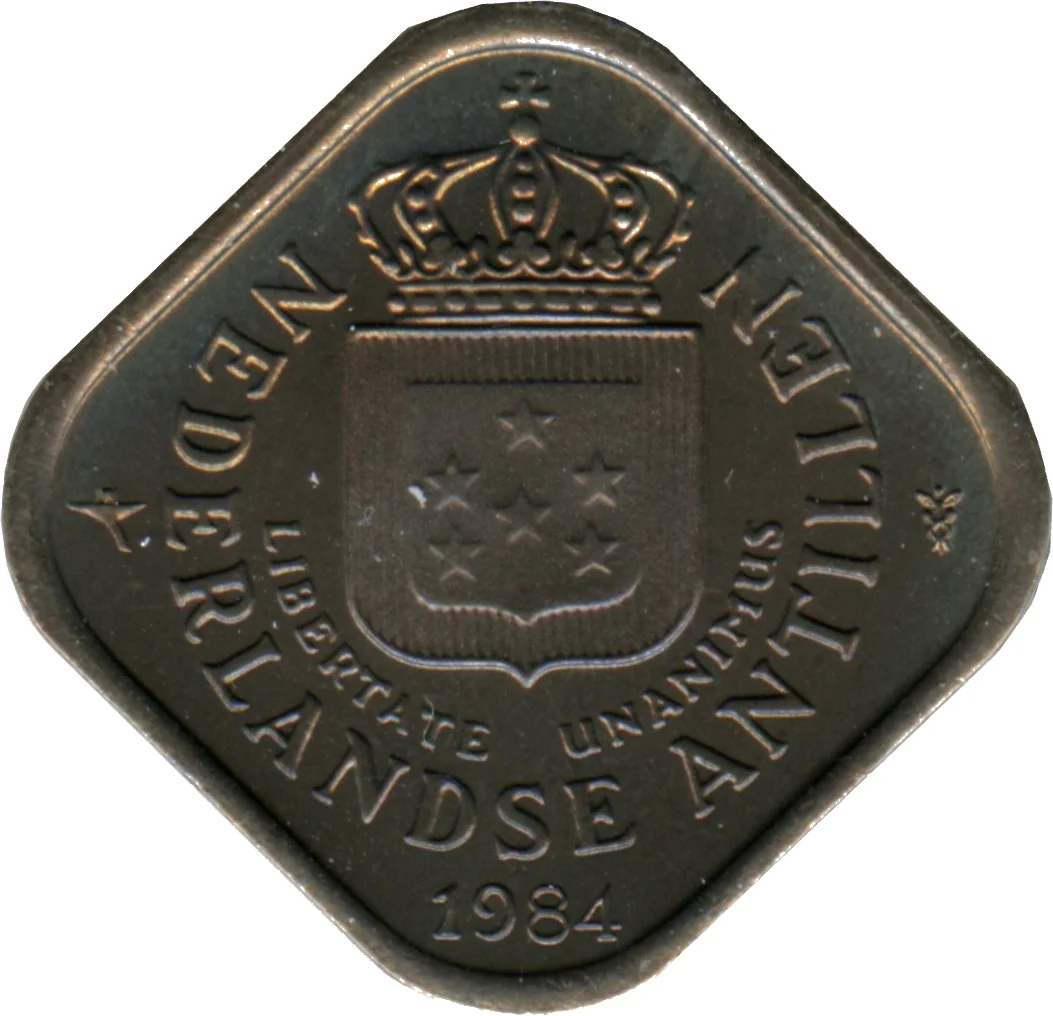
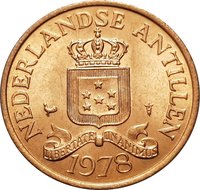
Netherlands Antilles coat of arms and Latin motto.
Inscription:
NEDERLANDSE ANTILLEN
LIBERTATE UNANIMUS
1984
LIBERTATE UNANIMUS
1984
Translation:
United in Freedom
1984
1984
Script: Latin
Engraver: Geurt Brinkgreve
Reverse
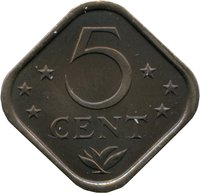
Description:
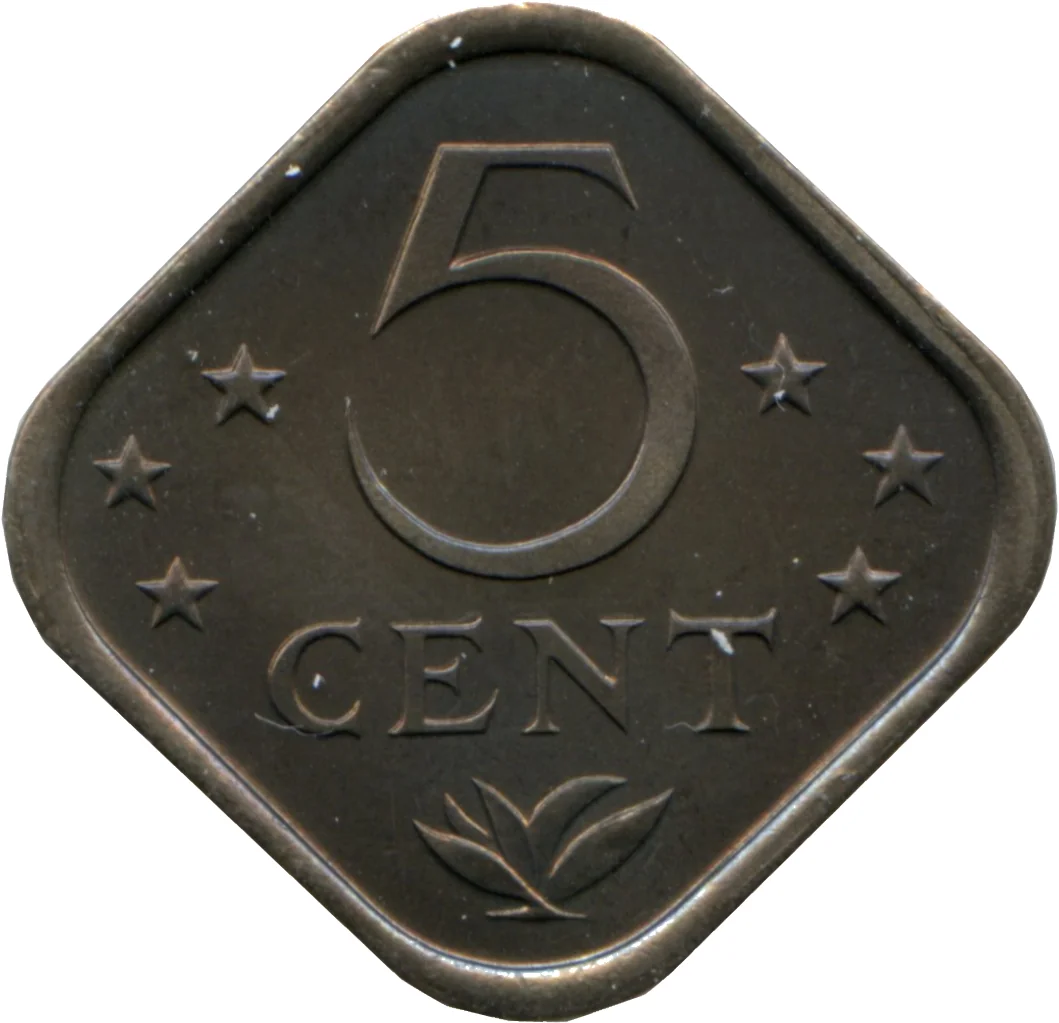
Face value encircled by six stars for the nation's islands, with agave leaves beneath.
Inscription:
5
CENT
CENT
Script: Latin
Engraver: Geurt Brinkgreve
Edge
Plain
Categories
| Symbols> Coat of Arms |
Mints
| Name | Mark |
|---|---|
| Royal Dutch Mint | — |
Mintings
| Year | Mint Mark | Mintage | Quality | Collection |
|---|---|---|---|---|
| 1971 | — | — | Proof | |
| 1971 | — | 2,000,000 | ||
| 1974 | — | — | Proof | |
| 1974 | — | 500,000 | ||
| 1975 | — | — | Proof | |
| 1975 | — | 2,000,000 | ||
| 1976 | — | 1,500,000 | ||
| 1977 | — | 1,000,000 | ||
| 1978 | — | — | Proof | |
| 1978 | — | 1,500,000 | ||
| 1979 | — | — | Proof | |
| 1979 | — | 1,512,000 | ||
| 1980 | — | 1,518,000 | ||
| 1981 | — | 1,022,999 | ||
| 1981 | — | — | Proof | |
| 1982 | — | 1,010,000 | ||
| 1983 | — | 1,024,999 | ||
| 1984 | — | 1,526,000 | ||
| 1985 | — | 1,524,000 |
Historical background
In 1971, the Netherlands Antilles found itself navigating a complex currency situation, deeply intertwined with its political status and the global monetary upheaval of the era. As a constituent country within the Kingdom of the Netherlands, its official currency was the Netherlands Antillean guilder (ANG), which had been peged to the US dollar at a fixed rate of 1.79 ANG to 1 USD since 1971. This dollar peg was a strategic choice for the islands' tourism and oil-refining economies, providing stability and aligning its primary trade and investment relationships, particularly with the United States and Venezuela.
This monetary arrangement existed within a unique constitutional framework. The Netherlands Antilles, alongside Suriname, was part of the "Monetary Union of the Netherlands Antilles and Suriname," established in 1962. However, Suriname's imminent independence in 1975 was already casting a shadow, foreshadowing the eventual dissolution of this union and necessitating future monetary reforms for the Antilles alone. Furthermore, the islands' currency was issued by the Bank van de Nederlandse Antillen (Central Bank of the Netherlands Antilles), established in 1828, which operated with considerable autonomy but within policies coordinated with the Dutch central bank in Amsterdam.
The year 1971 was also marked by external shockwaves from the collapse of the Bretton Woods system. When US President Richard Nixon suspended the dollar's convertibility to gold in August, triggering global currency instability, the Antilles' direct peg to the US dollar provided a buffer. While European currencies fluctuated wildly, the Antillean guilder's value moved in lockstep with the dollar. This insulated the islands from immediate turbulence but also permanently anchored their monetary policy to the decisions of the US Federal Reserve, a defining characteristic that would persist for decades.
This monetary arrangement existed within a unique constitutional framework. The Netherlands Antilles, alongside Suriname, was part of the "Monetary Union of the Netherlands Antilles and Suriname," established in 1962. However, Suriname's imminent independence in 1975 was already casting a shadow, foreshadowing the eventual dissolution of this union and necessitating future monetary reforms for the Antilles alone. Furthermore, the islands' currency was issued by the Bank van de Nederlandse Antillen (Central Bank of the Netherlands Antilles), established in 1828, which operated with considerable autonomy but within policies coordinated with the Dutch central bank in Amsterdam.
The year 1971 was also marked by external shockwaves from the collapse of the Bretton Woods system. When US President Richard Nixon suspended the dollar's convertibility to gold in August, triggering global currency instability, the Antilles' direct peg to the US dollar provided a buffer. While European currencies fluctuated wildly, the Antillean guilder's value moved in lockstep with the dollar. This insulated the islands from immediate turbulence but also permanently anchored their monetary policy to the decisions of the US Federal Reserve, a defining characteristic that would persist for decades.
🌱 Very Common