

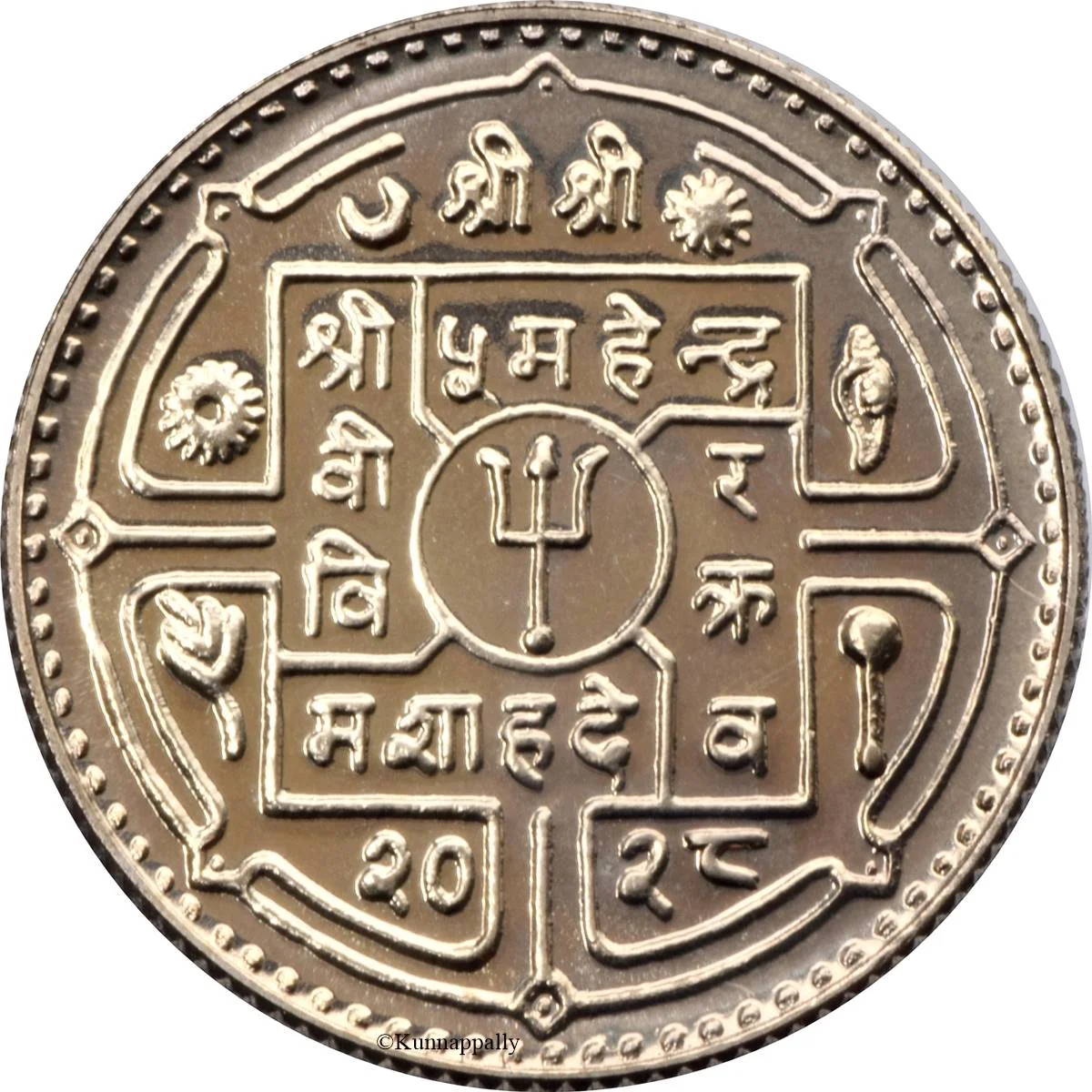
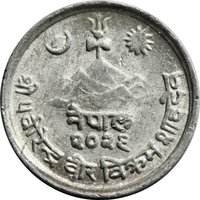
Obverse
Description:
Shah dynasty above trident.
Script: Devanagari
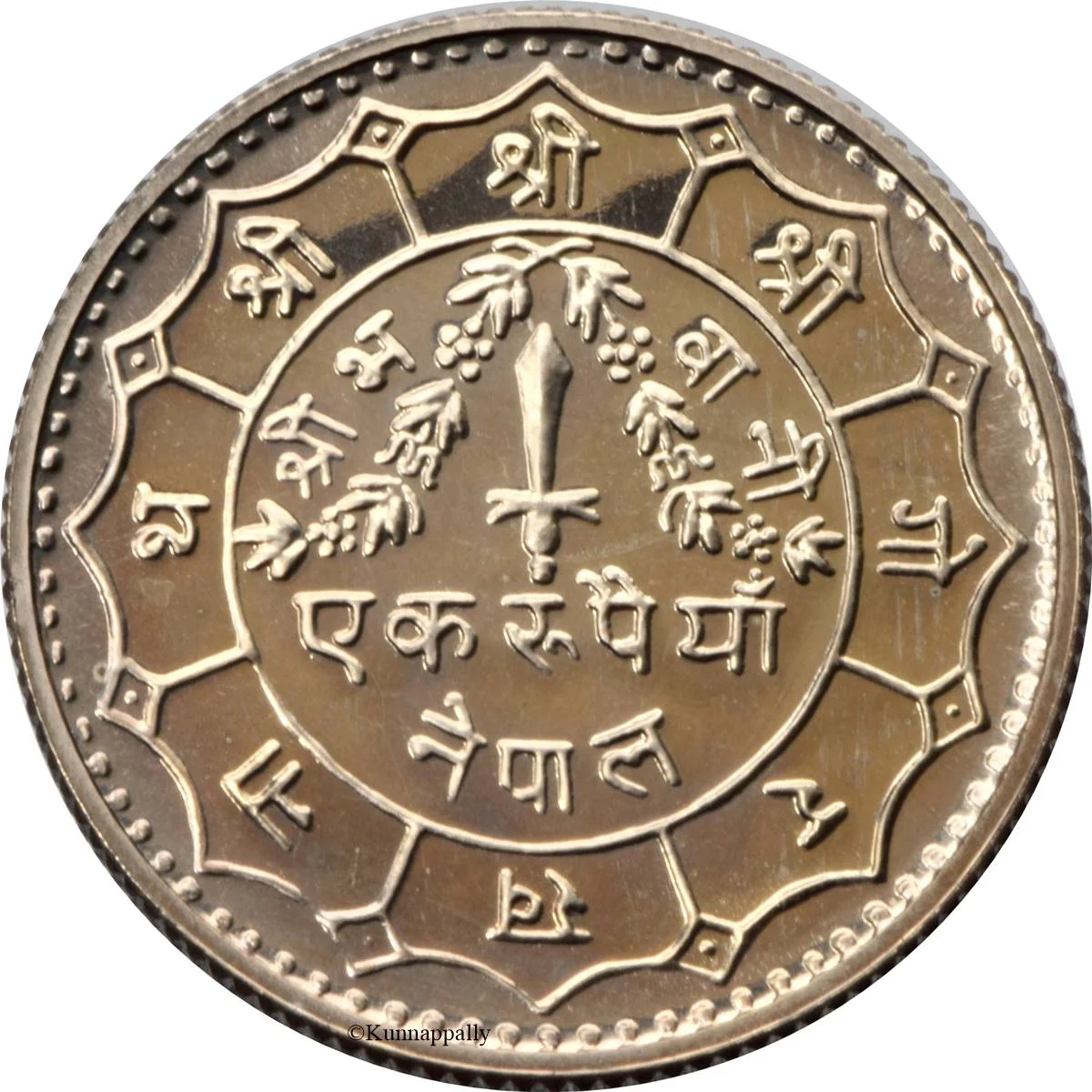
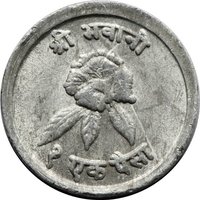
Reverse
Description:
Dagger between hanging garlands.
Script: Devanagari
Edge
Milled
Mints
| Name | Mark |
|---|---|
| United States Mint of San Francisco | — |
Mintings
| Year | Mint Mark | Mintage | Quality | Collection |
|---|---|---|---|---|
| 1968 | — | — | ||
| 1969 | — | — | ||
| 1970 | — | 2,187 | Proof | |
| 1971 | — | 2,380 | Proof |
Historical background
In 1968, Nepal's currency situation was defined by its relationship with India and the ongoing process of establishing a distinct national monetary identity. The Nepalese rupee (NPR) remained pegged to the Indian rupee (INR) at a fixed rate of 1:1.5, a parity established in 1960. This close linkage facilitated extensive cross-border trade but also meant that Nepal's monetary policy was heavily influenced by India's economic decisions, limiting autonomous control over inflation and money supply. The Indian rupee continued to circulate widely within Nepal, especially in the southern Terai region, underscoring the deep economic integration between the two countries.
This period fell within the early years of the Nepal Rastra Bank (NRB) Act of 1955, as the central bank was still developing its capacity to manage the nation's currency independently. A significant background factor was the 1966 devaluation of the Indian rupee by 36.5% following the rupee's devaluation against major currencies. Nepal, maintaining its peg, was forced to devalue its own currency in tandem, which had mixed effects: it made Nepalese exports more competitive but increased the cost of imports not sourced from India. This event highlighted the vulnerabilities of the fixed peg system.
Furthermore, 1968 was part of a transitional era where Nepal was gradually moving away from a dual-currency system. While the Nepalese rupee was the official currency, the use of Indian notes was still prevalent. The government and the Nepal Rastra Bank were in the process of asserting greater sovereign control, a journey that would lead to the demonetization of the Indian rupee in Nepal in the mid-1970s. Thus, the currency situation in 1968 was one of managed dependency, characterized by a stable but externally influenced exchange rate and institutional efforts to build a more independent monetary framework.
This period fell within the early years of the Nepal Rastra Bank (NRB) Act of 1955, as the central bank was still developing its capacity to manage the nation's currency independently. A significant background factor was the 1966 devaluation of the Indian rupee by 36.5% following the rupee's devaluation against major currencies. Nepal, maintaining its peg, was forced to devalue its own currency in tandem, which had mixed effects: it made Nepalese exports more competitive but increased the cost of imports not sourced from India. This event highlighted the vulnerabilities of the fixed peg system.
Furthermore, 1968 was part of a transitional era where Nepal was gradually moving away from a dual-currency system. While the Nepalese rupee was the official currency, the use of Indian notes was still prevalent. The government and the Nepal Rastra Bank were in the process of asserting greater sovereign control, a journey that would lead to the demonetization of the Indian rupee in Nepal in the mid-1970s. Thus, the currency situation in 1968 was one of managed dependency, characterized by a stable but externally influenced exchange rate and institutional efforts to build a more independent monetary framework.
⭐ Somewhat Rare