

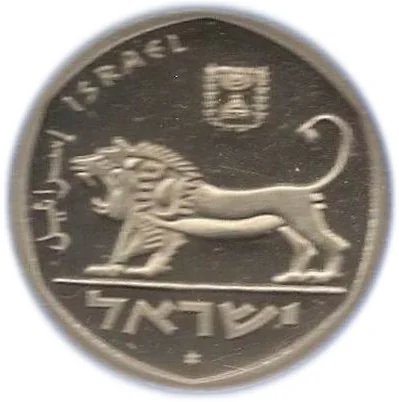
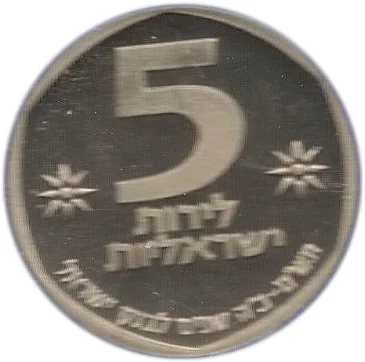
5 Israeli Pounds (Bank of Israel) – Israel
Non-circulating coins
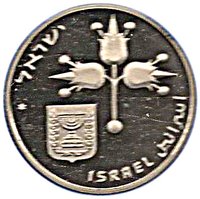
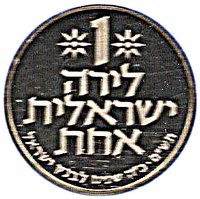
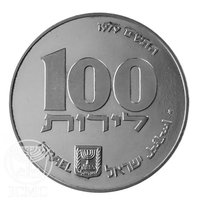
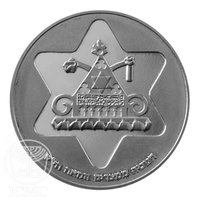
Commemoration: 25th Anniversary - Bank of Israel
Israel

Mints
| Name | Mark |
|---|---|
| Bern | — |
Mintings
| Year | Mint Mark | Mintage | Quality | Collection |
|---|---|---|---|---|
| 1980 | — | 35,000 | ||
| 1980 | ✡ | — |
Historical background
In 1980, Israel was grappling with severe and persistent hyperinflation, a crisis that had been building throughout the 1970s. The root causes were deeply structural: massive government deficits used to fund social programs, settlements, and defense, coupled with a highly indexed economy where wages and prices were automatically linked to the Consumer Price Index. This created a vicious cycle where government spending was financed by printing money, leading to price increases that triggered indexed raises, further fueling inflation. By the early 1980s, annual inflation rates were soaring into triple digits, eroding savings, distorting economic planning, and threatening social stability.
The official response in 1980 was a significant but ultimately insufficient monetary reform: the replacement of the Israeli pound (lira) with the shekel at a rate of 1 shekel to 10 pounds. This was largely a cosmetic change, lopping zeros off the currency without addressing the underlying fiscal drivers of inflation. The new shekel (denoted IS) began its life rapidly depreciating, losing value almost daily. The public largely treated it as the "old pound," and inflation continued to accelerate unchecked, peaking at nearly 450% in 1984. The economy operated in a climate of speculation, with dollars and physical assets preferred over the crumbling local currency.
Thus, the currency situation in 1980 represents the peak of a failed policy era, immediately preceding the necessary drastic measures. The introduction of the shekel was a symbolic acknowledgment of the problem but proved to be merely a prelude to the more profound Economic Stabilization Plan of 1985. That later plan, involving severe budget cuts, wage freezes, and a fixed exchange rate, would finally break the inflationary spiral and lead to the introduction of the new new shekel (NIS) in 1986, which remains Israel's stable currency today.
The official response in 1980 was a significant but ultimately insufficient monetary reform: the replacement of the Israeli pound (lira) with the shekel at a rate of 1 shekel to 10 pounds. This was largely a cosmetic change, lopping zeros off the currency without addressing the underlying fiscal drivers of inflation. The new shekel (denoted IS) began its life rapidly depreciating, losing value almost daily. The public largely treated it as the "old pound," and inflation continued to accelerate unchecked, peaking at nearly 450% in 1984. The economy operated in a climate of speculation, with dollars and physical assets preferred over the crumbling local currency.
Thus, the currency situation in 1980 represents the peak of a failed policy era, immediately preceding the necessary drastic measures. The introduction of the shekel was a symbolic acknowledgment of the problem but proved to be merely a prelude to the more profound Economic Stabilization Plan of 1985. That later plan, involving severe budget cuts, wage freezes, and a fixed exchange rate, would finally break the inflationary spiral and lead to the introduction of the new new shekel (NIS) in 1986, which remains Israel's stable currency today.
🌟 Uncommon