

1½ Euro (Japan-French Diplomatic Relations) – France
Non-circulating coins
Commemoration: 150th Anniversary of Japan-French Diplomatic Relations
France
Obverse
Description:
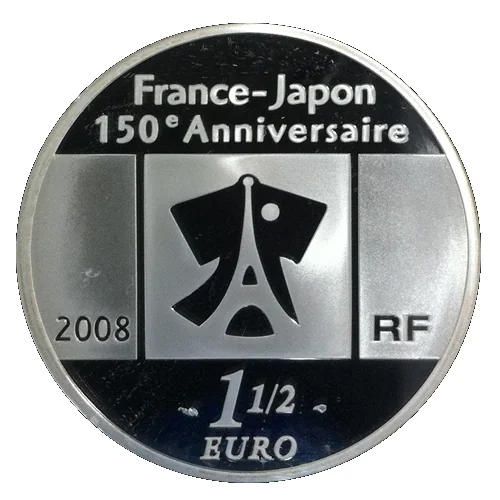
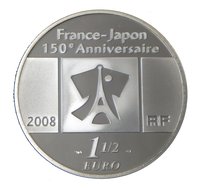
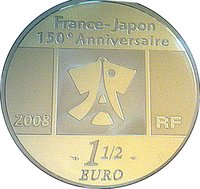
Central open kimono reveals the Eiffel Tower. Above, "France-Japan" and "150th Anniversary". Flanking the kimono: "2008" left, "RF" right. Below, face value "1 1/2 EURO" between currency symbols.
Inscription:
France-Japon
150e Anniversaire
2008
RF
1 1/2 EURO
150e Anniversaire
2008
RF
1 1/2 EURO
Translation:
France-Japan
150th Anniversary
2008
RF
1 1/2 EURO
150th Anniversary
2008
RF
1 1/2 EURO
Language: French
Reverse
Description:
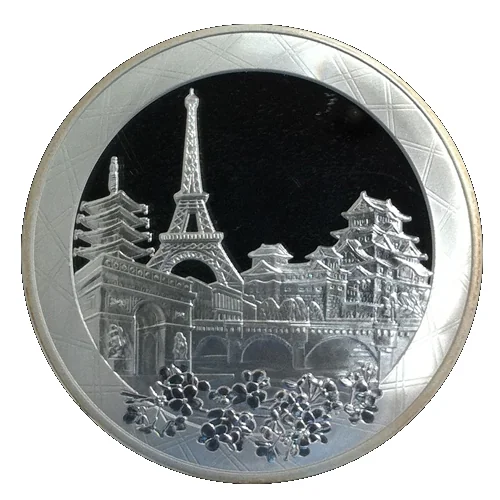
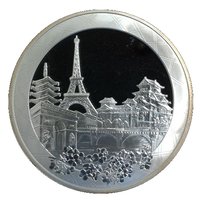
The design features Parisian landmarks—the Arc de Triomphe, Eiffel Tower, Pont-Neuf, and Monnaie de Paris—alongside Tokyo's Sensoji temple and Edo Castle. Three lines under the Pont-Neuf arch represent the castle's moat, connecting the capitals by water. Cherry blossoms adorn the bottom.
Edge
Plain
Mints
| Name | Mark |
|---|---|
| Monnaie de Paris | — |
Mintings
| Year | Mint Mark | Mintage | Quality | Collection |
|---|---|---|---|---|
| 2008 | — | 48,914 | Proof |
Historical background
In 2008, France entered the global financial crisis as a member of the Eurozone, having adopted the euro as its sole legal tender in 2002. This meant it did not have an independent national currency to devalue or a central bank with the unilateral power to set interest rates, which were instead controlled by the European Central Bank (ECB) in Frankfurt. The French economy was already experiencing sluggish growth and high public debt, and the crisis exposed structural rigidities in its labor and product markets. As the crisis intensified following the collapse of Lehman Brothers, the primary concern shifted from inflation to a severe liquidity crunch and the threat of a deep recession, placing pressure on the ECB for a coordinated monetary response.
The French government, under President Nicolas Sarkozy, responded with aggressive fiscal policy, unveiling a €26 billion stimulus plan in December 2008. This "Plan de Relance" focused on direct state investment in infrastructure, support for the automotive industry, and aid to small and medium-sized enterprises. Crucially, this fiscal action was possible because France, unlike some Eurozone members, retained strong borrowing credibility on international markets, allowing it to finance the deficit spending. However, the situation also highlighted the constraints of the Eurozone's one-size-fits-all monetary policy, as the ECB's rates were a compromise between the needs of booming economies like Germany and struggling ones on the periphery, with France positioned somewhere in between.
By the end of 2008, the currency situation was stable in the sense that the euro itself remained strong, but France faced the paradox of being shielded from currency speculation while lacking monetary tools to directly stimulate its economy. The crisis underscored France's commitment to the euro as a protective shield, but also fueled ongoing domestic debate about the need for greater Eurozone economic governance and coordination—a push led forcefully by Sarkozy—to complement the single currency. The stage was thus set for the subsequent European sovereign debt crises, where the stability of the entire Eurozone project would be tested.
The French government, under President Nicolas Sarkozy, responded with aggressive fiscal policy, unveiling a €26 billion stimulus plan in December 2008. This "Plan de Relance" focused on direct state investment in infrastructure, support for the automotive industry, and aid to small and medium-sized enterprises. Crucially, this fiscal action was possible because France, unlike some Eurozone members, retained strong borrowing credibility on international markets, allowing it to finance the deficit spending. However, the situation also highlighted the constraints of the Eurozone's one-size-fits-all monetary policy, as the ECB's rates were a compromise between the needs of booming economies like Germany and struggling ones on the periphery, with France positioned somewhere in between.
By the end of 2008, the currency situation was stable in the sense that the euro itself remained strong, but France faced the paradox of being shielded from currency speculation while lacking monetary tools to directly stimulate its economy. The crisis underscored France's commitment to the euro as a protective shield, but also fueled ongoing domestic debate about the need for greater Eurozone economic governance and coordination—a push led forcefully by Sarkozy—to complement the single currency. The stage was thus set for the subsequent European sovereign debt crises, where the stability of the entire Eurozone project would be tested.
💎 Very Rare