

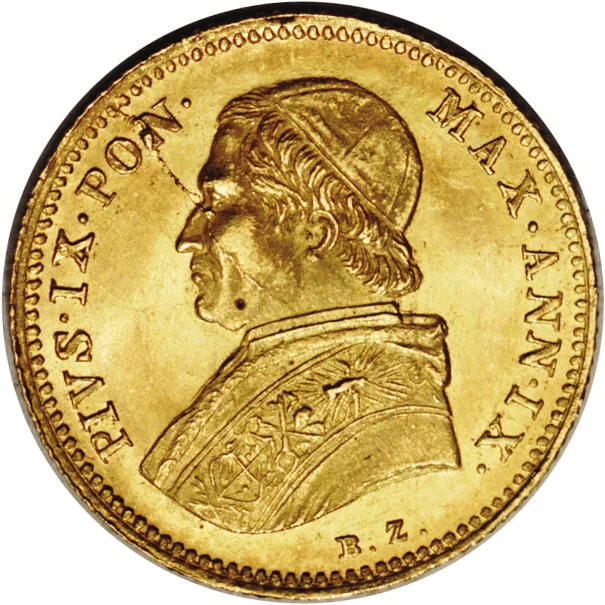
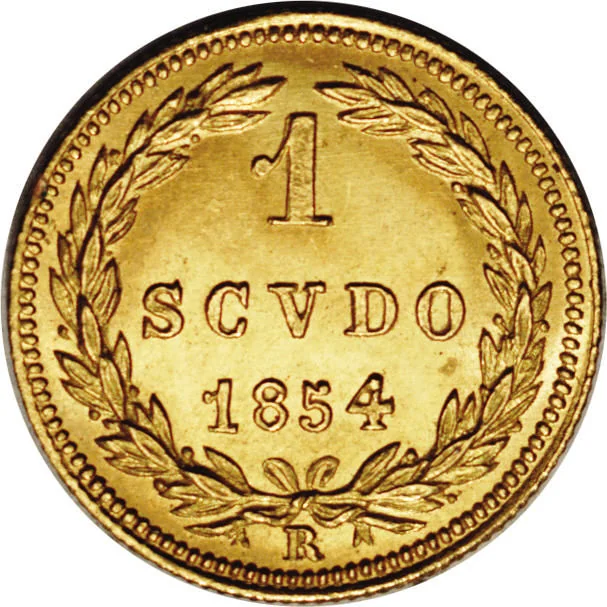
1 scudo d'oro – Papal States
Add to wishlist
Vatican City
Context
Years: 1853–1857
Country: Vatican City
Issuer: Papal States
Ruler: Pius IX
Currency:
(1835—1866)
Subdivision: 1 scudo d'oro = 160 Baiocchi
Demonetized: Yes
Total mintage: 330,845
Material
References
KM: #
Numista: #29196
Value
Bullion value: $238.57
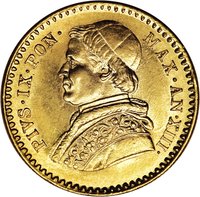
Obverse
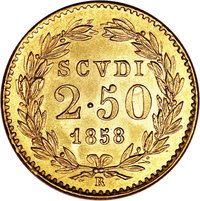
Reverse
Edge
Mintings
| Year | Mint Mark | Mintage | Quality | Collection |
|---|---|---|---|---|
| 1853 | R | 209,000 | ||
| 1853 | B | 3,306 | ||
| 1854 | B | 5,539 | ||
| 1854 | R | 97,000 | ||
| 1857 | R | 16,000 |
Historical background
In 1853, the Papal States found itself in a complex and precarious monetary situation, characteristic of the pre-unification Italian peninsula. The territory lacked a unified, modern currency system. Instead, circulation was a chaotic mix of coins from various issuing authorities: the papal mint in Rome, other Italian states like the Kingdom of Sardinia and the Two Sicilies, and even foreign currencies like French francs and Austrian lire. This multiplicity created significant challenges for commerce, as exchange rates fluctuated and the value of metal content often differed from the face value, leading to confusion and facilitating fraud.
The primary papal currency was the scudo (divided into 100 baiocchi), but its value and credibility were under severe strain. Years of budgetary deficits, driven by the costs of maintaining civil administration and a small army, had led the government to repeatedly debase the coinage. By reducing the silver content in coins while maintaining their nominal value, the treasury sought short-term revenue, but this eroded public trust and sparked inflation. Consequently, older coins with higher silver content were often hoarded or melted down (Gresham's Law in action), leaving the poorer, newer coins in common circulation.
This unstable monetary environment reflected the broader political and economic fragility of the Papal States under Pope Pius IX. Following the revolutions of 1848, the restored papal government was financially weakened and increasingly reliant on French military support for its survival. The currency disorder hampered economic development and was a point of contention for both the populace and foreign merchants. It underscored the administrative difficulties of a theocratic state struggling to function within the emerging modern European economic order, a weakness that would be fully exposed in the coming decades leading to Italian unification.
The primary papal currency was the scudo (divided into 100 baiocchi), but its value and credibility were under severe strain. Years of budgetary deficits, driven by the costs of maintaining civil administration and a small army, had led the government to repeatedly debase the coinage. By reducing the silver content in coins while maintaining their nominal value, the treasury sought short-term revenue, but this eroded public trust and sparked inflation. Consequently, older coins with higher silver content were often hoarded or melted down (Gresham's Law in action), leaving the poorer, newer coins in common circulation.
This unstable monetary environment reflected the broader political and economic fragility of the Papal States under Pope Pius IX. Following the revolutions of 1848, the restored papal government was financially weakened and increasingly reliant on French military support for its survival. The currency disorder hampered economic development and was a point of contention for both the populace and foreign merchants. It underscored the administrative difficulties of a theocratic state struggling to function within the emerging modern European economic order, a weakness that would be fully exposed in the coming decades leading to Italian unification.
✨ Legendary