

100 Euro (Škofja Loka Passion) – Slovenia
Non-circulating coins
Commemoration: 300th anniversary of Škofja Loka Passion
Slovenia
Context
Material
References
KM: #Click to copy to clipboard151
Numista: #291397
Value
Exchange value: 100 EUR = $118.14
Bullion value: $1050.42
Inflation-adjusted value: 126.67 EUR
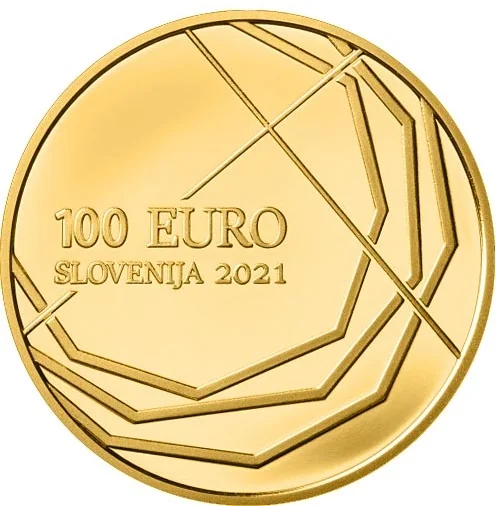
Obverse
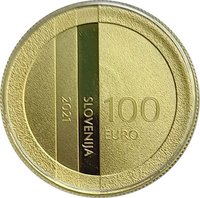
Inscription:
100 EURO
SLOVENIJA 2021
SLOVENIJA 2021
Translation:
100 EURO
SLOVENIA 2021
SLOVENIA 2021
Script: Latin
Designer: Matej Štanta
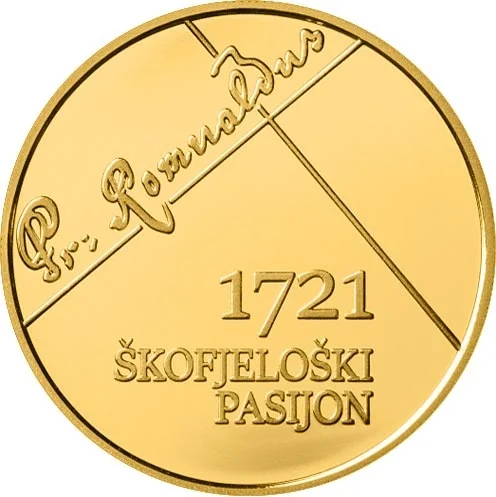
Reverse
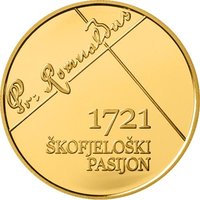
Inscription:
Pr; Romualdus
1721
ŠKOFJELOŠKI
PASIJON
1721
ŠKOFJELOŠKI
PASIJON
Translation:
Bishop of Škofja Loka
1721
The Škofja Loka Passion
1721
The Škofja Loka Passion
Script: Latin
Designer: Matej Štanta
Edge
Reeded
Categories
| Art> Literature |
Mints
| Name | Mark |
|---|---|
| Kremnica | — |
Mintings
| Year | Mint Mark | Mintage | Quality | Collection |
|---|---|---|---|---|
| 2021 | — | 500 | Proof |
Historical background
In 2021, Slovenia continued to use the euro as its sole legal tender, a status it had held since joining the Eurozone on 1 January 2007. As a small, open, and export-oriented economy, the common European currency provided Slovenia with monetary stability, eliminated exchange rate risk with its main trading partners, and anchored low inflation. This integration into the Eurozone's monetary policy framework, set by the European Central Bank (ECB), meant that Slovenia's interest rates and broader monetary policy were aligned with the Eurozone's needs rather than being set domestically.
The year was characterized by the ongoing economic repercussions of the COVID-19 pandemic. In response, the ECB maintained its expansive monetary policy, including historically low interest rates and large-scale asset purchase programs. This environment facilitated favorable borrowing conditions for the Slovenian government, which implemented significant fiscal packages to support businesses and households. Consequently, public debt rose, but the cost of servicing that debt remained manageable due to the low-rate environment provided by the common currency framework.
Looking ahead, a key financial topic in Slovenia during 2021 was its preparation to join the Eurozone's banking union. The country had officially entered the Single Supervisory Mechanism in 2020 and was on a path toward entering the Single Resolution Mechanism. This process, aimed at further strengthening financial stability and integrating the banking sector with the wider Eurozone, was a point of continued technical and political discussion throughout the year. Thus, while the day-to-day currency situation was stable, Slovenia was actively deepening its institutional ties to the Eurozone's financial architecture.
The year was characterized by the ongoing economic repercussions of the COVID-19 pandemic. In response, the ECB maintained its expansive monetary policy, including historically low interest rates and large-scale asset purchase programs. This environment facilitated favorable borrowing conditions for the Slovenian government, which implemented significant fiscal packages to support businesses and households. Consequently, public debt rose, but the cost of servicing that debt remained manageable due to the low-rate environment provided by the common currency framework.
Looking ahead, a key financial topic in Slovenia during 2021 was its preparation to join the Eurozone's banking union. The country had officially entered the Single Supervisory Mechanism in 2020 and was on a path toward entering the Single Resolution Mechanism. This process, aimed at further strengthening financial stability and integrating the banking sector with the wider Eurozone, was a point of continued technical and political discussion throughout the year. Thus, while the day-to-day currency situation was stable, Slovenia was actively deepening its institutional ties to the Eurozone's financial architecture.
✨ Legendary