

50 rubles – Russian Federation
Add to wishlist
Non-circulating coins
Commemoration: UEFA Euro 2020
Russia
Context
Year: 2021
Country: Russia
Issuer: Russian Federation
Period:
(since 1991)
Currency:
(since 1998)
Total mintage: 2,400
Material
Diameter: 22.6 mm
Weight: 7.89 g
Gold Weight:: 7.88 g
Thickness: 1.6 mm
Shape: Round
Composition: 99.9% Gold
Standard: Silver quarter ounce
Magnetic: No
Technique: Milled
Alignment: Medal alignment
flip
References
Value
Exchange value: 50 RUB
Bullion value: $1213.35
Inflation-adjusted value: 85.07 RUB
Obverse
Description:
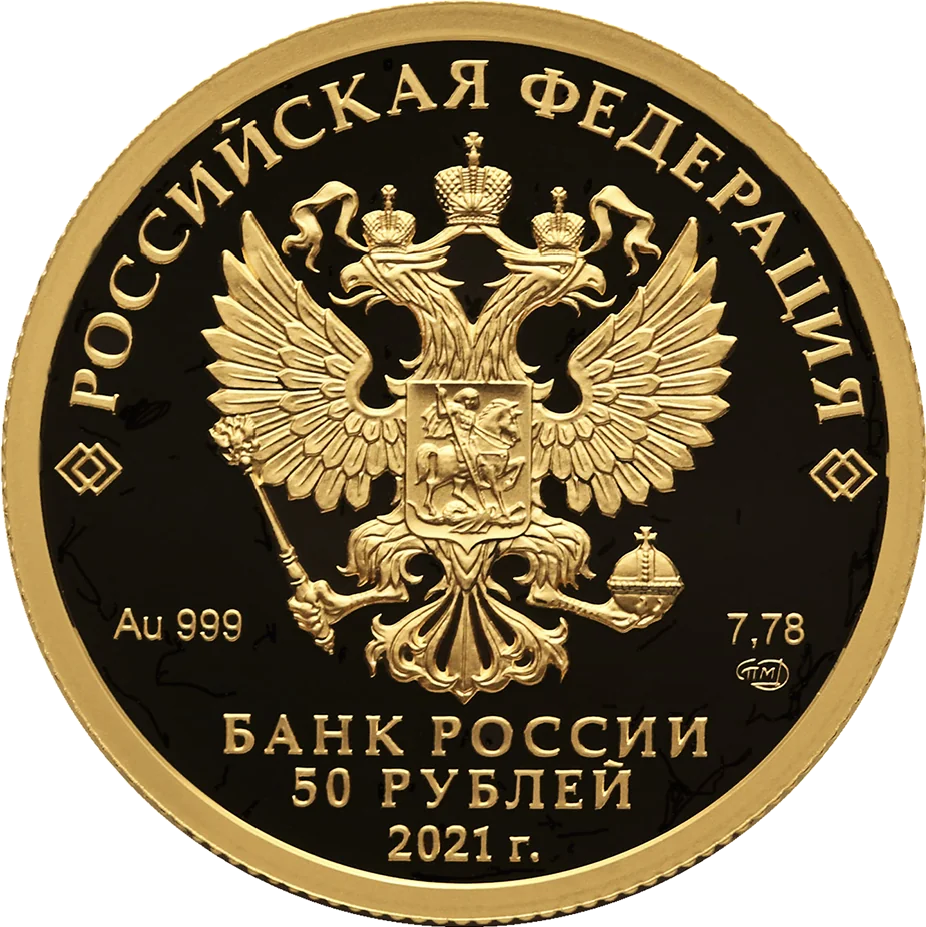
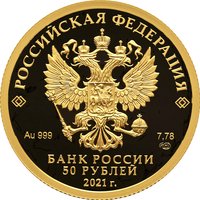
A relief of the Russian Federation coat of arms, above it the semicircular inscription "РОССИЙСКАЯ ФЕДЕРАЦИЯ" flanked by doubled rhombuses. Below, the metal specification and fineness are on the left, the fine metal content and mint mark on the right. Centered at the bottom are "БАНК РОССИИ", "50 РУБЛЕЙ", and "2021 г."
Inscription:
РОССИЙСКАЯ ФЕДЕРАЦИЯ
Au 999 7,78
СПМД
БАНК РОССИИ
50 РУБЛЕЙ
2021 г.
Au 999 7,78
СПМД
БАНК РОССИИ
50 РУБЛЕЙ
2021 г.
Translation:
RUSSIAN FEDERATION
Au 999 7.78
SPMD
BANK OF RUSSIA
50 ROUBLES
2021
Au 999 7.78
SPMD
BANK OF RUSSIA
50 ROUBLES
2021
Language: Russian
Engraver: Alexandra Arsenyevna Dolgopolova
Designer: Elena Viktorovna Kramskaya
Reverse
Description:
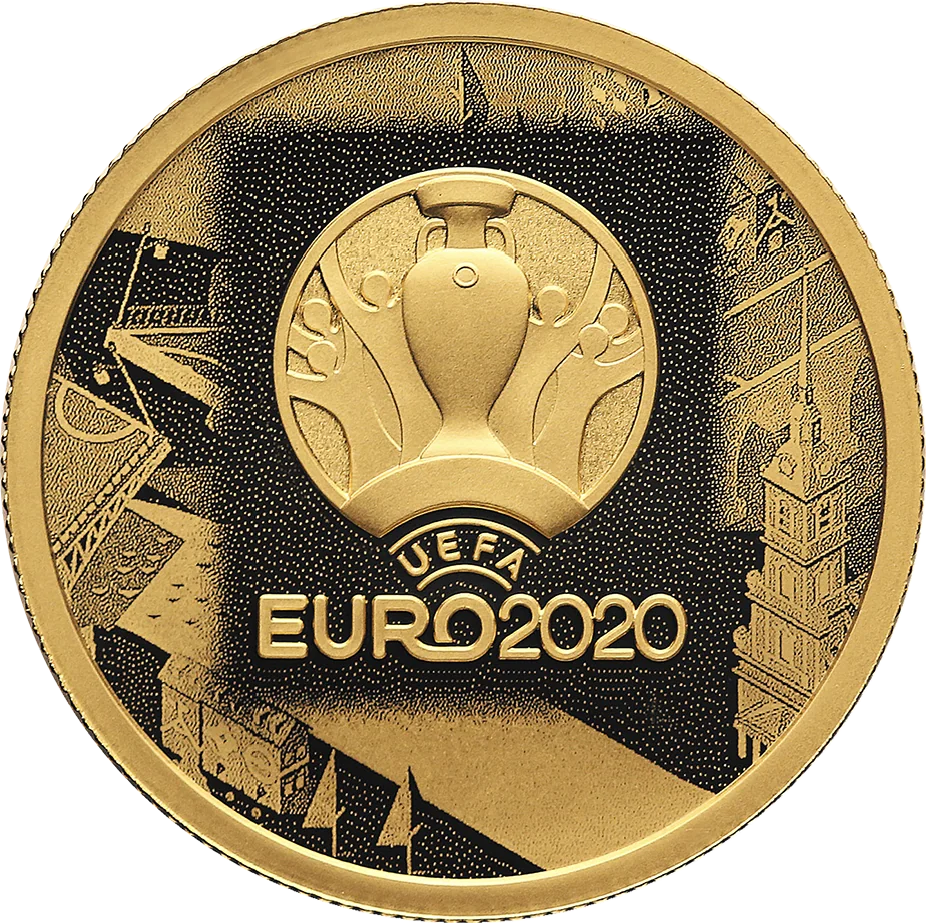
Championship emblem relief with Saint Petersburg symbols.
Inscription:
UEFA
EURO 2020
EURO 2020
Script: Latin
Designer: Anton Dmitrievich Schablykin
Edge
134 corrugations
Mints
| Name | Mark |
|---|---|
| Saint Petersburg | (СПМД) |
Mintings
| Year | Mint Mark | Mintage | Quality | Collection |
|---|---|---|---|---|
| 2021 | СПМД | 2,400 | Proof |
Historical background
In 2021, the Russian ruble demonstrated a notable recovery and stability, rebounding from the significant volatility and depreciation experienced during the initial shock of the COVID-19 pandemic in 2020. This strength was primarily driven by a sharp recovery in global oil and gas prices, which are critical to Russia's export revenues and fiscal stability. Furthermore, the Central Bank of the Russian Federation (CBR) maintained a consistently hawkish monetary policy, raising its key interest rate from 4.25% at the start of the year to 7.5% by December to combat rising inflation, which bolstered the currency's attractiveness for carry trades and capital inflows.
Underpinning this stability were robust macroeconomic indicators, including a current account surplus exceeding $120 billion for the year, record-high international reserves approaching $630 billion, and a relatively low level of government debt. The government's fiscal rule, which mandates the conversion of excess oil revenues into foreign currency assets for the National Wealth Fund, also acted as a built-in stabilizer, insulating the domestic economy from commodity price swings and preventing excessive ruble appreciation that could hurt other export sectors.
However, the year ended with emerging pressures that signaled future challenges. Inflation accelerated to over 8% by year-end, significantly above the CBR's 4% target, driven by strong consumer demand, global supply chain issues, and rising food prices. Geopolitical tensions also began to weigh on investor sentiment, with markets growing increasingly nervous about the potential for Western sanctions in response to Russia's military buildup near Ukraine. Consequently, while the ruble's 2021 performance was strong, these domestic and external inflationary and geopolitical risks created a backdrop of uncertainty moving into 2022.
Underpinning this stability were robust macroeconomic indicators, including a current account surplus exceeding $120 billion for the year, record-high international reserves approaching $630 billion, and a relatively low level of government debt. The government's fiscal rule, which mandates the conversion of excess oil revenues into foreign currency assets for the National Wealth Fund, also acted as a built-in stabilizer, insulating the domestic economy from commodity price swings and preventing excessive ruble appreciation that could hurt other export sectors.
However, the year ended with emerging pressures that signaled future challenges. Inflation accelerated to over 8% by year-end, significantly above the CBR's 4% target, driven by strong consumer demand, global supply chain issues, and rising food prices. Geopolitical tensions also began to weigh on investor sentiment, with markets growing increasingly nervous about the potential for Western sanctions in response to Russia's military buildup near Ukraine. Consequently, while the ruble's 2021 performance was strong, these domestic and external inflationary and geopolitical risks created a backdrop of uncertainty moving into 2022.
✨ Legendary