

1 Rand – South Africa
Circulating commemorative coins
Commemoration: The end of Nicolaas Johannes Diederichs' presidency
South Africa
Context
Year: 1979
Issuer: South Africa 
Period:
(since 1961)
Currency:
(since 1961)
Total mintage: 13,466,005
Material
References
KM: #Click to copy to clipboard104
Numista: #2910
Value
Exchange value: 1 ZAR = $0.06
Inflation-adjusted value: 40.95 ZAR
Obverse
Description:
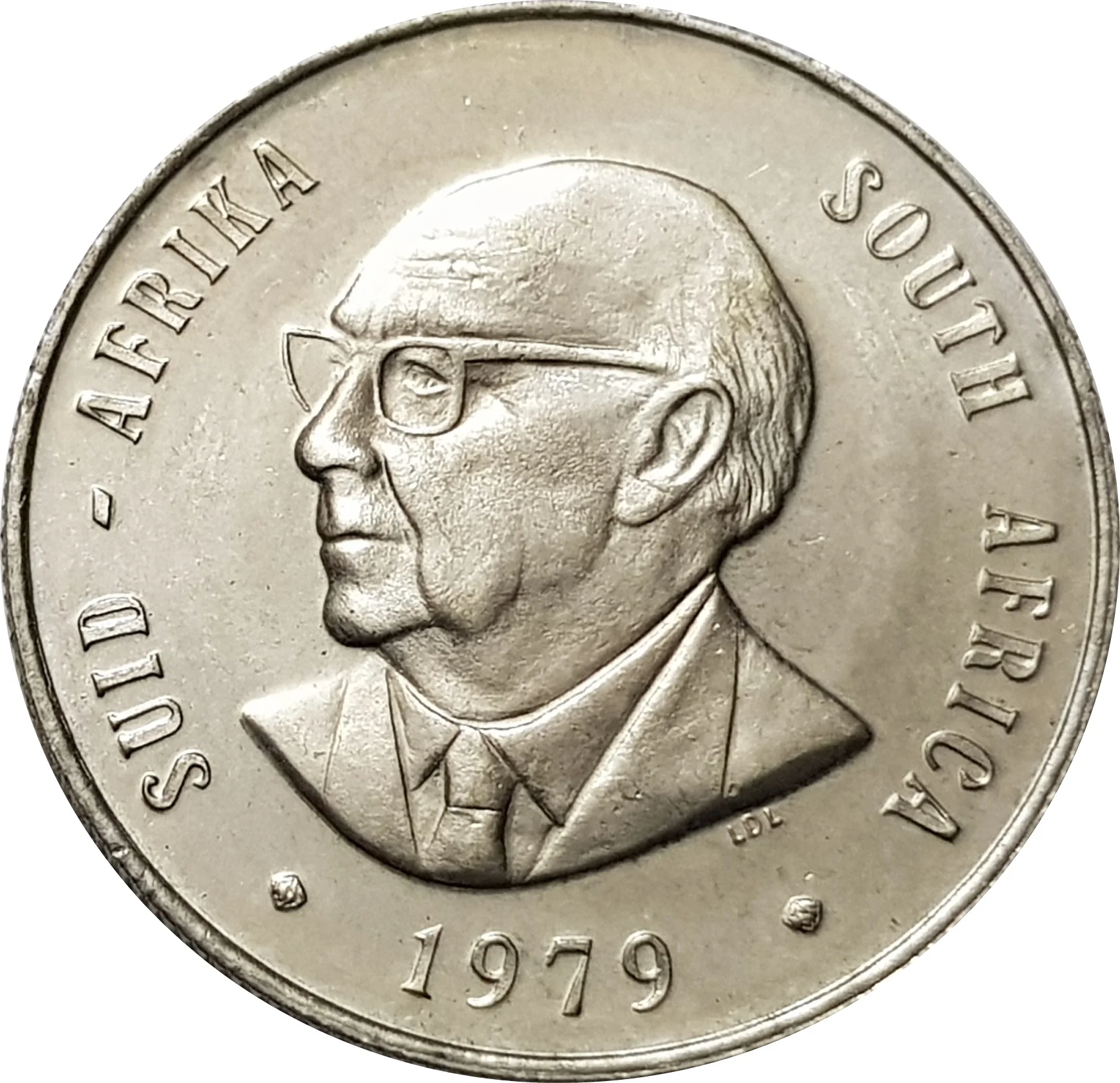
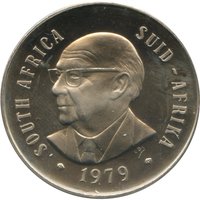
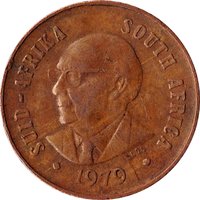
Portrait of Nicolaas Johannes Diederichs (1903-1978), South African President, 1975-1978.
Inscription:
SUID - AFRIKA SOUTH AFRICA
LDL
1979
LDL
1979
Script: Latin
Engraver: Lourens de Lange
Reverse
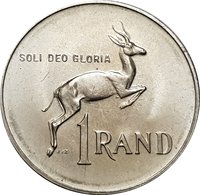
Description:
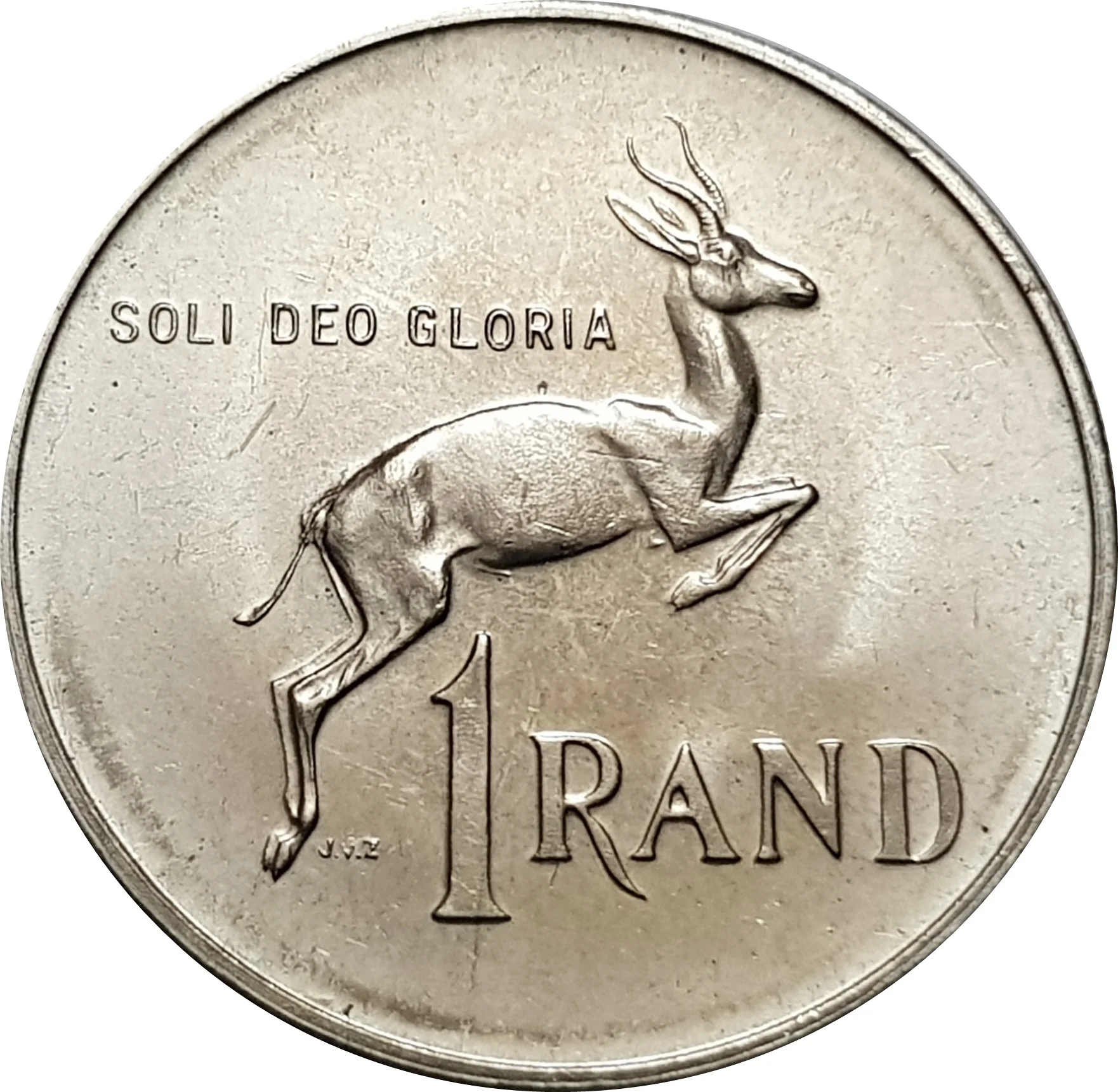
“Soli Deo gloria,” meaning “Glory to God alone,” is one of the five core beliefs of the Protestant Reformation.
Inscription:
SOLI DEO GLORIA
J.v.Z 1 RAND
J.v.Z 1 RAND
Script: Latin
Engraver: Jan van Zyl
Edge
Reeded
Categories
| Animal> Cow |
| Person> Politician |
Mintings
| Year | Mint Mark | Mintage | Quality | Collection |
|---|---|---|---|---|
| 1979 | — | 13,466,000 | ||
| 1979 | — | 5 | Proof |
Historical background
In 1979, South Africa's currency situation was characterised by the dual pressures of international isolation and domestic economic strain. The country operated under a system of financial rand and commercial rand, a dual-currency mechanism designed to insulate the domestic economy from capital flight and to manage the economic consequences of apartheid-era sanctions. The financial rand, used for non-resident investment, traded at a significant discount to the commercial rand, reflecting the political risk premium and capital controls imposed by the government to stem outflows.
Economically, the late 1970s were a period of stagnation following the post-1976 Soweto Uprising capital flight and soaring oil prices. High inflation, exceeding 13% annually, eroded the rand's domestic purchasing power, while the currency faced persistent downward pressure on foreign exchange markets. The government and the South African Reserve Bank (SARB) prioritised defending the exchange rate, utilising the country's substantial gold reserves—bolstered by a period of high gold prices—to support the currency and maintain import capacity for crucial goods, including oil.
Ultimately, the currency dynamics of 1979 were a financial mirror of the country's political crisis. The rand's value and the complex system governing it were directly shaped by the need to finance the apartheid state amidst growing internal unrest and a tightening noose of international disinvestment. This precarious balancing act sought to maintain economic functionality, but the underlying structural weaknesses and political unsustainability foreshadowed the deeper economic challenges of the 1980s.
Economically, the late 1970s were a period of stagnation following the post-1976 Soweto Uprising capital flight and soaring oil prices. High inflation, exceeding 13% annually, eroded the rand's domestic purchasing power, while the currency faced persistent downward pressure on foreign exchange markets. The government and the South African Reserve Bank (SARB) prioritised defending the exchange rate, utilising the country's substantial gold reserves—bolstered by a period of high gold prices—to support the currency and maintain import capacity for crucial goods, including oil.
Ultimately, the currency dynamics of 1979 were a financial mirror of the country's political crisis. The rand's value and the complex system governing it were directly shaped by the need to finance the apartheid state amidst growing internal unrest and a tightening noose of international disinvestment. This precarious balancing act sought to maintain economic functionality, but the underlying structural weaknesses and political unsustainability foreshadowed the deeper economic challenges of the 1980s.
🌱 Common