

20 Euro (Constitution of 3 May and Mutual Pledge of the Commonwealth of the Two Nations) – Lithuania
Non-circulating coins
Commemoration: 230th anniversary of the Constitution of 3 May and Mutual Pledge of the Commonwealth of the Two Nations
Lithuania
Context

Material
References
KM: #Click to copy to clipboard270
Numista: #289893
Value
Exchange value: 20 EUR = $23.63
Bullion value: $73.33
Inflation-adjusted value: 27.73 EUR
Obverse
Description:
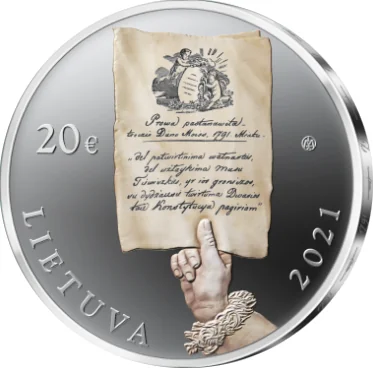
The reverse shows a Constitution preamble fragment and a motif from Matejko's "Adoption of the Constitution," along with LIETUVA, €20, 2021, and the mintmark.
Inscription:
20€ LMK
LIETUVA 2021
LIETUVA 2021
Translation:
20 Euro
Lithuania 2021
Lithuania 2021
Script: Latin
Language: Lithuanian
Designer: Giedrius Paulauskis
Reverse
Description:
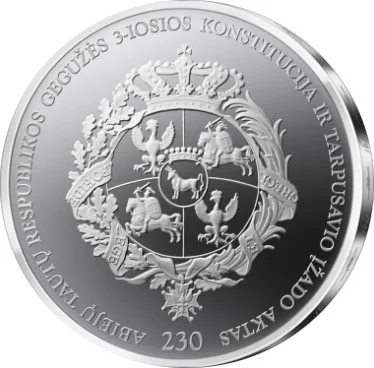
The obverse depicts the quartered coat of arms of the Polish-Lithuanian Commonwealth from a Stanisław August Poniatowski thaler, encircled by the inscription: "ABIEJŲ TAUTŲ RESPUBLIKOS GEGUŽĖS 3-IOSIOS KONSTITUCIJA IR TARPUSAVIO ĮŽADO AKTAS" and "230."
Inscription:
ABIEJŲ TAUTŲ RESPUBLIKOS GEGUŽĖS 3-IOSIOS KONSTITUCIJA IR TARPUSAVIO ĮŽADO AKTAS
230
230
Translation:
Constitution of the Republic of Both Nations of May 3rd and Reciprocal Pledge Act
Script: Latin
Language: Lithuanian
Designer: Giedrius Paulauskis
Edge
Smooth with inscription
Legend:
1971
Categories
| Animal> Bird> Eagle |
| Animal> Horse |
| Object> Cold weapons |
| Symbols> Coat of Arms |
| Symbol> Crown |
Mints
| Name | Mark |
|---|---|
| Lithuanian Mint | (LMK) |
Mintings
| Year | Mint Mark | Mintage | Quality | Collection |
|---|---|---|---|---|
| 2021 | LMK | 2,500 | Proof |
Historical background
In 2021, Lithuania's currency situation was defined by its full and established integration into the Eurozone. Having adopted the euro on 1 January 2015, the country had long since replaced its former national currency, the litas, which was irrevocably fixed at a rate of 3.45280 LTL to 1 EUR. Therefore, 2021 was not a year of monetary transition but one of operating within the framework of the single European currency. As a member of the Eurosystem, Lithuania's monetary policy was set by the European Central Bank (ECB), focusing on euro-area-wide price stability, with the Bank of Lithuania participating in its implementation.
The primary domestic monetary focus for Lithuania in 2021 was on fostering financial innovation and the digital finance sector, rather than traditional currency management. Most notably, July 2021 marked the pivotal launch of the first euro-denominated digital collectible coin by the Bank of Lithuania: the LBCOIN. This blockchain-based project, while not a central bank digital currency (CBDC) for general public use, served as an exploratory testbed for digital currency technology and cemented Lithuania's reputation as a forward-looking fintech hub within the EU.
Economically, the use of the euro in 2021 provided Lithuania with stability amid global uncertainty, shielding it from potential exchange rate volatility during the ongoing COVID-19 pandemic and supply chain disruptions. It facilitated seamless trade and investment flows within the single market. However, as with all Eurozone members, Lithuania had no autonomous monetary policy tools to address local economic conditions, relying instead on national fiscal policy and EU-level recovery funds. The year concluded with high inflation emerging across the Eurozone, a challenge that would dominate the ECB's policy agenda heading into 2022, directly impacting Lithuania's economic landscape.
The primary domestic monetary focus for Lithuania in 2021 was on fostering financial innovation and the digital finance sector, rather than traditional currency management. Most notably, July 2021 marked the pivotal launch of the first euro-denominated digital collectible coin by the Bank of Lithuania: the LBCOIN. This blockchain-based project, while not a central bank digital currency (CBDC) for general public use, served as an exploratory testbed for digital currency technology and cemented Lithuania's reputation as a forward-looking fintech hub within the EU.
Economically, the use of the euro in 2021 provided Lithuania with stability amid global uncertainty, shielding it from potential exchange rate volatility during the ongoing COVID-19 pandemic and supply chain disruptions. It facilitated seamless trade and investment flows within the single market. However, as with all Eurozone members, Lithuania had no autonomous monetary policy tools to address local economic conditions, relying instead on national fiscal policy and EU-level recovery funds. The year concluded with high inflation emerging across the Eurozone, a challenge that would dominate the ECB's policy agenda heading into 2022, directly impacting Lithuania's economic landscape.
💎 Extremely Rare