

Obverse
Description:
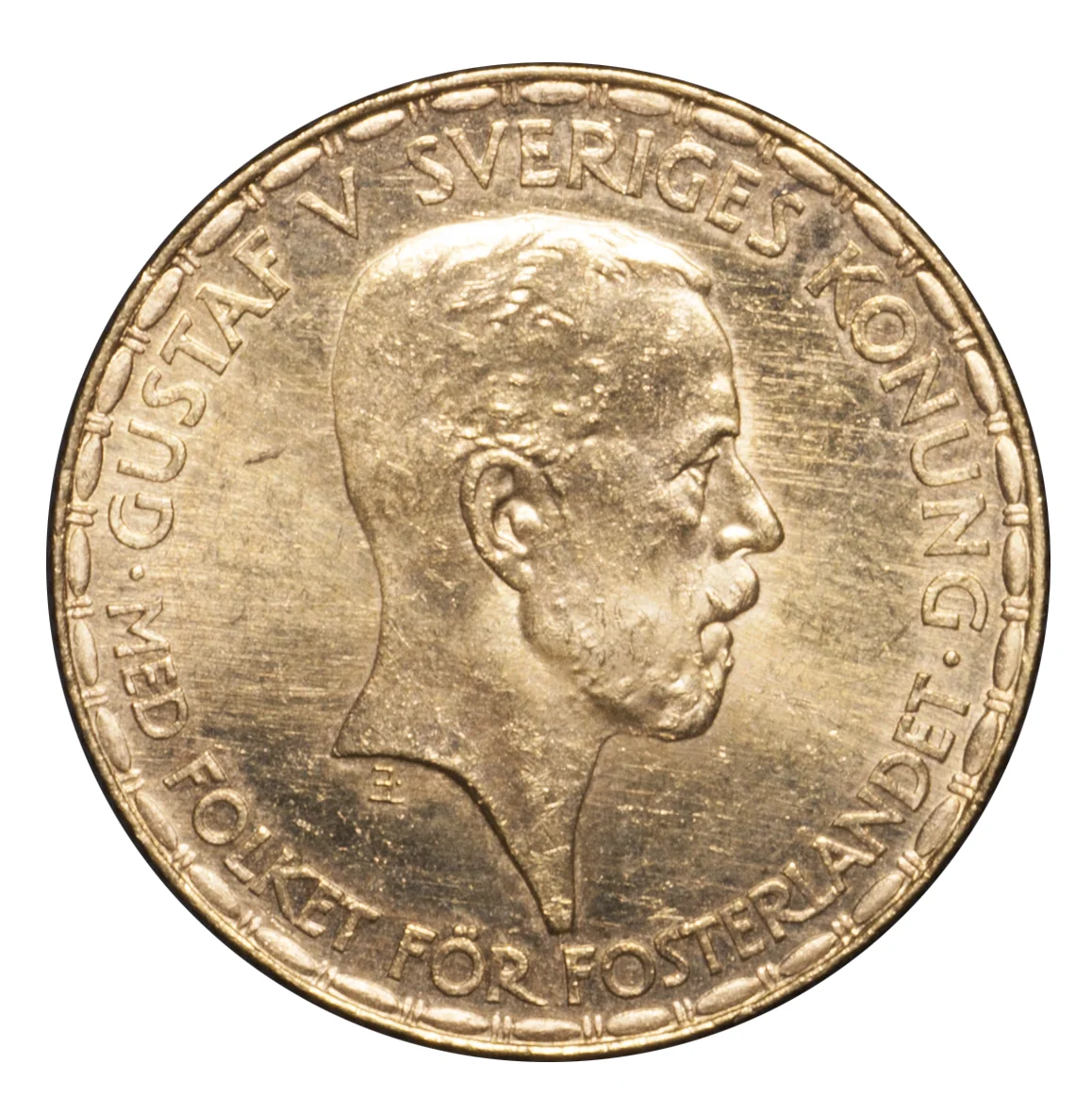
King Gustaf V bust facing right, encircled by inscription.
Inscription:
·GUSTAF V SVERIGES KONUNG·
EL·
MED FOLKET FÖR FOSTERLANDET
EL·
MED FOLKET FÖR FOSTERLANDET
Translation:
GUSTAF V SWEDEN'S KING
EL
WITH THE PEOPLE FOR THE FATHERLAND
EL
WITH THE PEOPLE FOR THE FATHERLAND
Script: Latin
Language: Swedish
Engraver: Erik Lindberg
Reverse
Description:
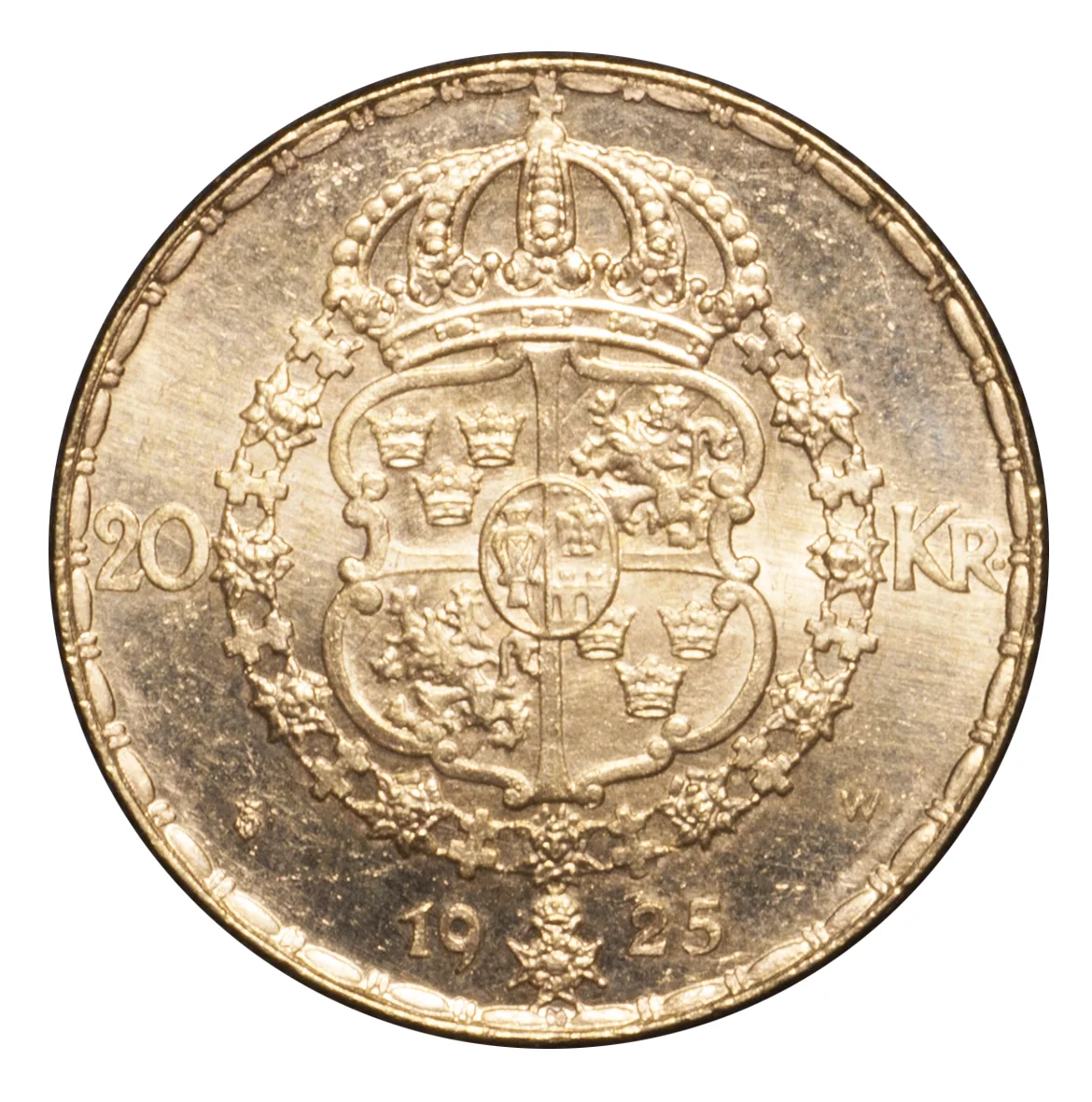
Crowned coat of arms divides the value, flanked by mintmarks, with the Seraphim chain and date below.
Inscription:
20 KR·
W
19 25
W
19 25
Script: Latin
Engraver: Erik Lindberg
Edge
Mints
| Name | Mark |
|---|---|
| Kungliga Myntet | — |
Mintings
| Year | Mint Mark | Mintage | Quality | Collection |
|---|---|---|---|---|
| 1925 | — | 387,257 |
Historical background
In 1925, Sweden stood at a pivotal moment in its monetary history, having navigated the turbulent economic waters following the First World War. Like many nations, it had abandoned the classical gold standard during the war, leading to a period of floating exchange rates and significant inflation. The immediate post-war years were marked by debate and uncertainty, but by the early 1920s, a strong political and economic consensus emerged to return to gold, seen as the bedrock of monetary stability, credibility, and international trade. The Riksbank, Sweden's central bank, had already taken decisive steps by raising interest rates and tightening monetary policy to bring down inflation and strengthen the Swedish krona, effectively shadowing the gold standard in preparation for a formal return.
The critical decision was made in April 1924, when the Swedish parliament voted to reinstate the gold standard at the pre-war parity of 2,480 kronor per kilogram of fine gold. This meant that the krona would be pegged to gold at its 1914 value, a choice driven by a desire to restore confidence and honour pre-war obligations. The formal return occurred on April 1, 1925, making Sweden one of the first European countries to re-establish a fully functioning gold standard, preceding even the United Kingdom's return in May of that year. This move was celebrated domestically as a triumph of sound finance and a return to normalcy after a decade of disruption.
However, the 1925 restoration at the pre-war parity has been criticized by later economists for setting the krona at an arguably overvalued level. This overvaluation made Swedish exports more expensive on the world market, placing pressure on key industries and contributing to deflationary tendencies and higher unemployment in the late 1920s. While successful in achieving price stability and international credibility in the short term, Sweden's commitment to this rigid standard would soon be tested by the global economic shocks that culminated in the Great Depression, ultimately forcing the country to abandon gold once again in 1931.
The critical decision was made in April 1924, when the Swedish parliament voted to reinstate the gold standard at the pre-war parity of 2,480 kronor per kilogram of fine gold. This meant that the krona would be pegged to gold at its 1914 value, a choice driven by a desire to restore confidence and honour pre-war obligations. The formal return occurred on April 1, 1925, making Sweden one of the first European countries to re-establish a fully functioning gold standard, preceding even the United Kingdom's return in May of that year. This move was celebrated domestically as a triumph of sound finance and a return to normalcy after a decade of disruption.
However, the 1925 restoration at the pre-war parity has been criticized by later economists for setting the krona at an arguably overvalued level. This overvaluation made Swedish exports more expensive on the world market, placing pressure on key industries and contributing to deflationary tendencies and higher unemployment in the late 1920s. While successful in achieving price stability and international credibility in the short term, Sweden's commitment to this rigid standard would soon be tested by the global economic shocks that culminated in the Great Depression, ultimately forcing the country to abandon gold once again in 1931.
💎 Extremely Rare