

3 lari – Georgia
Add to wishlist
Non-circulating coins
Commemoration: Launch of Baku-Tbilisi-Ceyhan Oil Pipeline
Georgia
Context
Material
Diameter: 31.1 mm
Weight: 13.3 g
Thickness: 2.4 mm
Shape: Round
Composition: Copper-nickel
Technique: Milled
Alignment: Medal alignment
flip
References
KM: #
Numista: #28876
Value
Exchange value: 3 GEL
Obverse
Description:
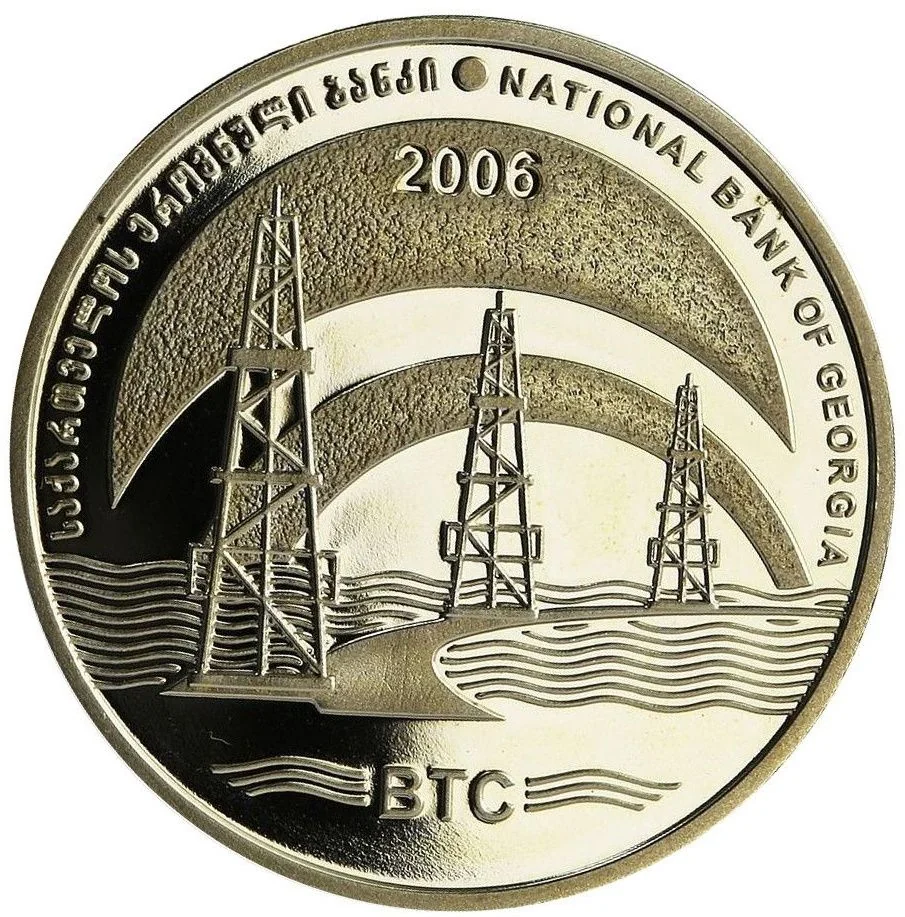
A relief of three Caspian Sea oil wells forms the circular center, with wavy lines for the sea. Mirrored textures create a rising sun, engraved with 2006. The top bears a bilingual legend: "საქართველოს ეროვნული ბანკი / NATIONAL BANK OF GEORGIA". The bottom features the BTC abbreviation and stylized wings.
Inscription:
საქართველოს ეროვნული ბანკი NATIONAL BANK OF GEORGIA
2006
BTC
2006
BTC
Translation:
National Bank of Georgia NATIONAL BANK OF GEORGIA
2006
BTC
2006
BTC
Scripts: Georgian (Mkhedruli), Latin
Engraver: Mamuka Gongadze
Reverse
Description:
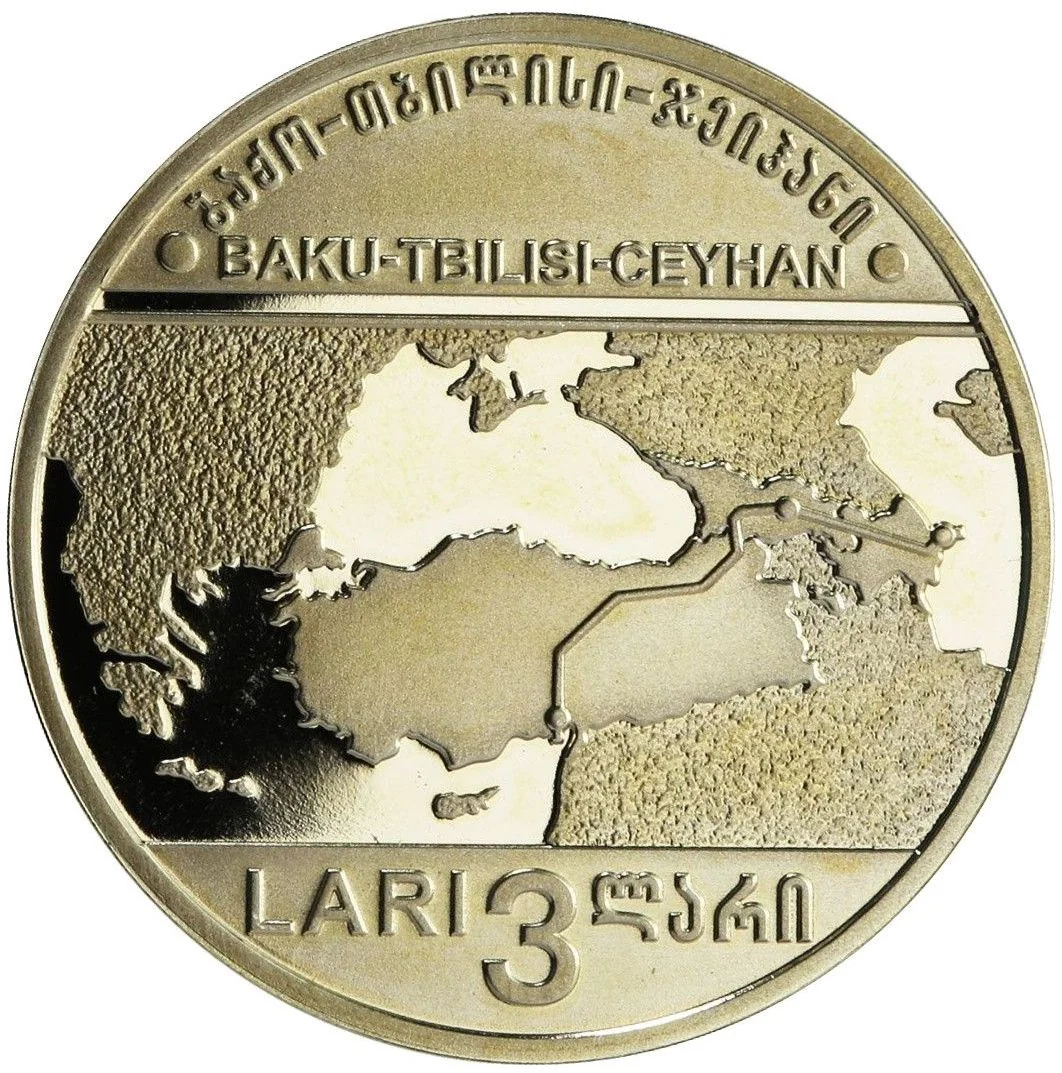
A central map of Georgia, Azerbaijan, and Turkey with a matte finish and borders. Embossed lines trace pipelines between the raised circles marking Baku, Tbilisi, and Ceyhan. The top features the bilingual legend "BAKU-TBILISI-CEYHAN." Below is the denomination "3" with the bilingual text "LARI."
Inscription:
"ბაქო-თბილისი-ჯეიჰანი" “BAKU-TBILISI-CEYHAN”
LARI 3 ლარი
LARI 3 ლარი
Translation:
Baku-Tbilisi-Ceyhan
3 Lari
3 Lari
Scripts: Georgian (Mkhedruli), Latin
Engraver: Mamuka Gongadze
Mints
| Name | Mark |
|---|---|
| Mint of Poland | — |
Mintings
| Year | Mint Mark | Mintage | Quality | Collection |
|---|---|---|---|---|
| 2006 | — | 3,000 |
Historical background
In 2006, Georgia's currency landscape was characterized by a period of remarkable stability and growing confidence under the governance of President Mikheil Saakashvili, who had come to power following the 2003 Rose Revolution. The national currency, the lari (GEL), operated under a floating exchange rate regime managed by the National Bank of Georgia (NBG). After a period of volatility and depreciation in the late 1990s and early 2000s, the lari had stabilized significantly, bolstered by substantial inflows of foreign aid and investment, as well as a crackdown on corruption that improved fiscal discipline. This stability was a key indicator of the broader economic reforms and pro-Western orientation pursued by the Saakashvili administration.
The economic backdrop for the currency was largely positive, driven by strong GDP growth (reaching 9.4% in 2006) and a surge in foreign direct investment, particularly in banking, construction, and transportation sectors like the Baku-Tbilisi-Ceyhan pipeline. The NBG maintained a policy of inflation targeting, with a focus on price stability, which helped anchor expectations. Remittances from Georgians working abroad, especially in Russia, also constituted a significant source of foreign currency, further supporting the lari's stability. However, this reliance on external flows highlighted underlying vulnerabilities.
Despite the overall calm, potential risks lingered on the horizon. Georgia's relationship with Russia, a major trade partner at the time, was deteriorating politically, culminating in a diplomatic crisis in late 2006 that included the expulsion of migrants and an embargo on key Georgian exports like wine and mineral water. This tension threatened the important flow of remittances and trade, posing a future risk to currency stability. Furthermore, the country was running a substantial current account deficit, financed by capital inflows, indicating an economy whose external position was dependent on continued investor confidence and foreign capital—a situation that would be severely tested just two years later during the August 2008 Russo-Georgian War.
The economic backdrop for the currency was largely positive, driven by strong GDP growth (reaching 9.4% in 2006) and a surge in foreign direct investment, particularly in banking, construction, and transportation sectors like the Baku-Tbilisi-Ceyhan pipeline. The NBG maintained a policy of inflation targeting, with a focus on price stability, which helped anchor expectations. Remittances from Georgians working abroad, especially in Russia, also constituted a significant source of foreign currency, further supporting the lari's stability. However, this reliance on external flows highlighted underlying vulnerabilities.
Despite the overall calm, potential risks lingered on the horizon. Georgia's relationship with Russia, a major trade partner at the time, was deteriorating politically, culminating in a diplomatic crisis in late 2006 that included the expulsion of migrants and an embargo on key Georgian exports like wine and mineral water. This tension threatened the important flow of remittances and trade, posing a future risk to currency stability. Furthermore, the country was running a substantial current account deficit, financed by capital inflows, indicating an economy whose external position was dependent on continued investor confidence and foreign capital—a situation that would be severely tested just two years later during the August 2008 Russo-Georgian War.
⭐ Rare