

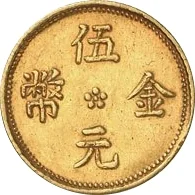
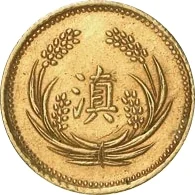
5 yuan – Yunnan Province
Add to wishlist
China
Context
Year: 1925
Country: China
Issuer: Yunnan Province
Period:
(1912—1949)
Currency:
(1908—1949)
Demonetized: Yes
Material
References
Numista: #288263
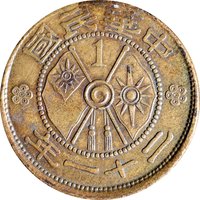
Obverse
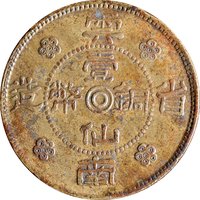
Reverse
Edge
Plain
Mintings
| Year | Mint Mark | Mintage | Quality | Collection |
|---|---|---|---|---|
| 1925 | — | — |
Historical background
In 1925, Yunnan Province operated within a complex and fragmented monetary system, a direct legacy of the late Qing dynasty's collapse and the ensuing Warlord Era. The province, under the semi-autonomous rule of military governor Tang Jiyao, issued its own currency to fund its administration and military. The primary unit was the Yunnan Silver Dollar (Yunnan Yinyuan), but its circulation and value were inconsistent. More critically, a vast amount of the money in daily use consisted of banknotes issued by the provincial government and local banks, notably the Yunnan Provincial Bank (Yunnan Sheng Yinhang). These notes were often inadequately backed by silver reserves, leading to frequent depreciation and fluctuating exchange rates against other regional currencies.
This instability was exacerbated by the continued circulation of older forms of money, including full-weight silver sycee ingots, debased copper coins, and even French Indochinese piastres in the southern border regions due to the Haiphong-Kunming railway trade. The simultaneous use of metallic and paper currencies created a chaotic environment where merchants and the public struggled with daily conversions and uncertainty. The provincial government's frequent over-issuance of paper notes to cover fiscal shortfalls fueled inflation, eroding public trust in the paper currency and driving a preference for silver coinage whenever possible.
Therefore, the currency situation in mid-1920s Yunnan was characterized by localized issuance, severe fragmentation, and chronic instability. It was a system designed more for the fiscal survival of the provincial authority than for facilitating a stable regional economy. This financial disarray mirrored Yunnan's political reality—formally part of the Republic of China but functionally autonomous, with its monetary sovereignty underscoring the fractured nature of the Chinese state during the warlord period.
This instability was exacerbated by the continued circulation of older forms of money, including full-weight silver sycee ingots, debased copper coins, and even French Indochinese piastres in the southern border regions due to the Haiphong-Kunming railway trade. The simultaneous use of metallic and paper currencies created a chaotic environment where merchants and the public struggled with daily conversions and uncertainty. The provincial government's frequent over-issuance of paper notes to cover fiscal shortfalls fueled inflation, eroding public trust in the paper currency and driving a preference for silver coinage whenever possible.
Therefore, the currency situation in mid-1920s Yunnan was characterized by localized issuance, severe fragmentation, and chronic instability. It was a system designed more for the fiscal survival of the provincial authority than for facilitating a stable regional economy. This financial disarray mirrored Yunnan's political reality—formally part of the Republic of China but functionally autonomous, with its monetary sovereignty underscoring the fractured nature of the Chinese state during the warlord period.
✨ Legendary