

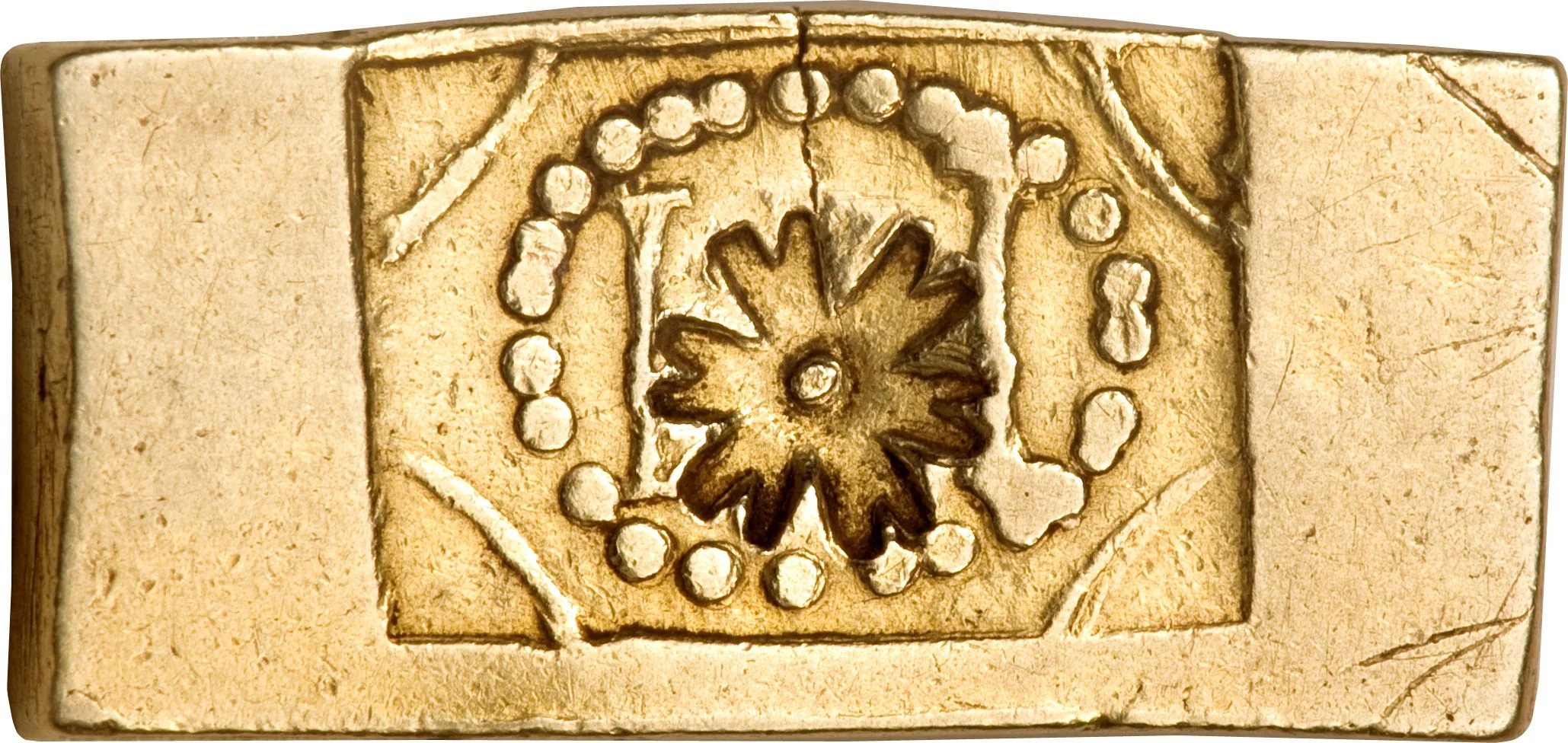
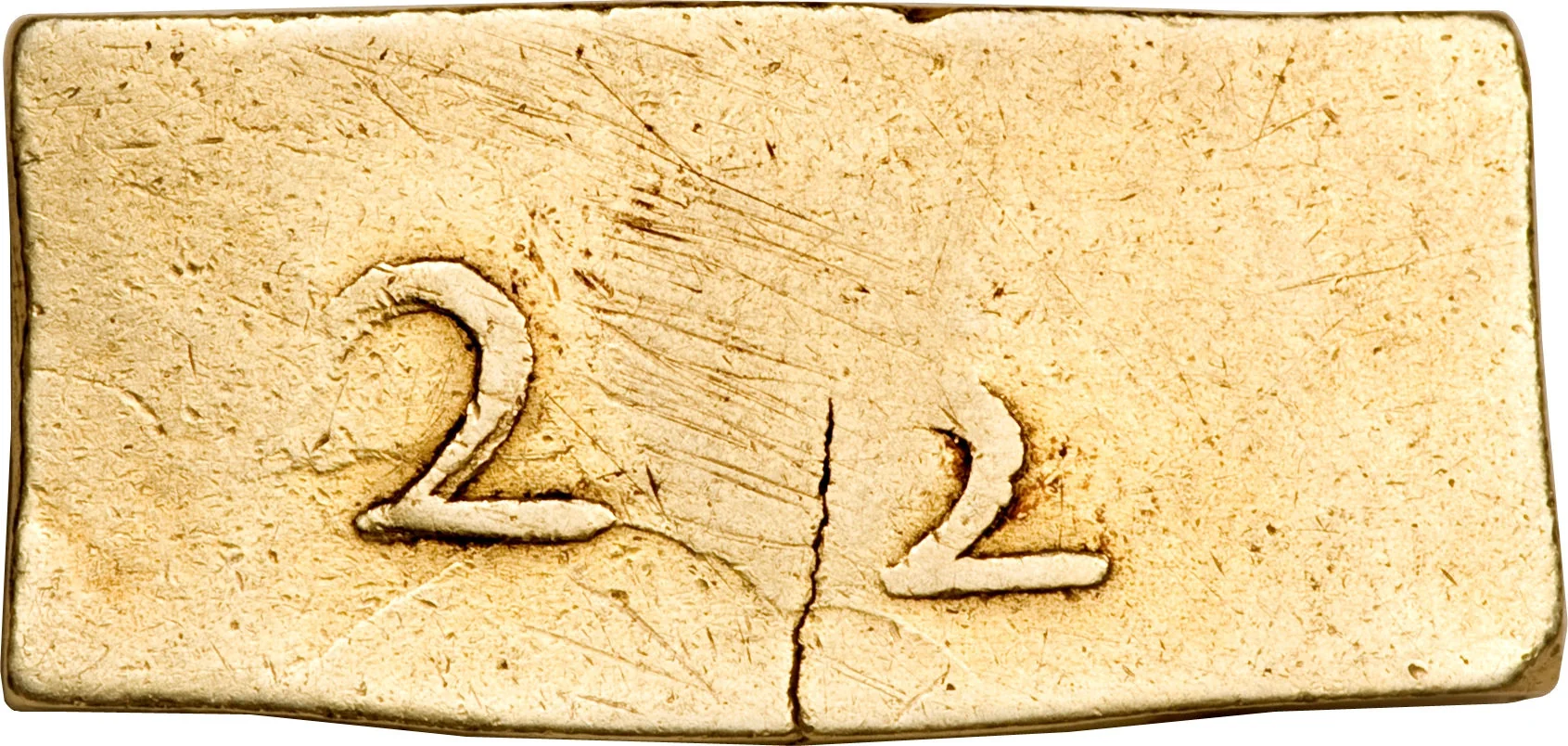
2½ maticais – Mozambique
Add to wishlist
Mozambique
Context
Year: 1851
Issuer: Mozambique
Ruler: Mary II
Currency:
(1706—1910)
Subdivision: 2½ maticais = 6500 Réis
Demonetized: Yes
Material
Weight: 14.5 g
Gold Weight:: 11.60 g
Thickness: 4 mm
Shape: Irregular rectangular
Composition: 80% Gold
Magnetic: No
Alignment: Medal alignment
flip
References
KM: #
Numista: #28657
Value
Bullion value: $1789.33
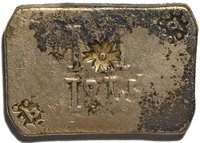
Obverse
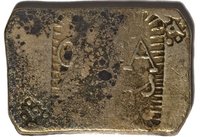
Reverse
Edge
Mintings
| Year | Mint Mark | Mintage | Quality | Collection |
|---|---|---|---|---|
| 1851 | — | — |
Historical background
In 1851, Mozambique was not a unified political or economic entity with a single currency. The territory was under Portuguese colonial influence, but effective control was largely limited to a handful of coastal prazo settlements (land grants) and trading ports like Ilha de Moçambique, Quelimane, and Sofala. The Portuguese colonial administration struggled with limited resources and authority, leaving vast interior regions under the control of independent African kingdoms and chieftaincies, such as the Gaza Empire, which had their own distinct economic systems.
The currency situation was consequently fragmented and pluralistic. Internationally, the primary medium for high-value trade, particularly the export of enslaved people and ivory, was the Indian rupee and Maria Theresa thalers. These silver coins were universally accepted along the Indian Ocean rim. Within local and regional African economies, transactions were conducted using traditional currencies. These included mitakos (strings of cowrie shells, imported from the Maldives), brass and copper manillas (ornamental bracelets used as currency), and woven cloth. Barter for goods like salt, grain, and livestock also remained widespread, especially away from the coast.
Portuguese attempts to impose their own currency, the real, were largely ineffective beyond administrative outposts. The colonial economy was too weak, and the preferred currencies of long-standing Swahili, Arab, and Indian Ocean trade networks held greater trust and utility. Therefore, 1851 represents a period of competing monetary zones: a coastal mercantile economy operating on silver thalers and rupees, an interior African economy using commodity monies, and a feeble colonial system attempting, with little success, to assert its own fiscal order over this complex landscape.
The currency situation was consequently fragmented and pluralistic. Internationally, the primary medium for high-value trade, particularly the export of enslaved people and ivory, was the Indian rupee and Maria Theresa thalers. These silver coins were universally accepted along the Indian Ocean rim. Within local and regional African economies, transactions were conducted using traditional currencies. These included mitakos (strings of cowrie shells, imported from the Maldives), brass and copper manillas (ornamental bracelets used as currency), and woven cloth. Barter for goods like salt, grain, and livestock also remained widespread, especially away from the coast.
Portuguese attempts to impose their own currency, the real, were largely ineffective beyond administrative outposts. The colonial economy was too weak, and the preferred currencies of long-standing Swahili, Arab, and Indian Ocean trade networks held greater trust and utility. Therefore, 1851 represents a period of competing monetary zones: a coastal mercantile economy operating on silver thalers and rupees, an interior African economy using commodity monies, and a feeble colonial system attempting, with little success, to assert its own fiscal order over this complex landscape.
✨ Legendary