

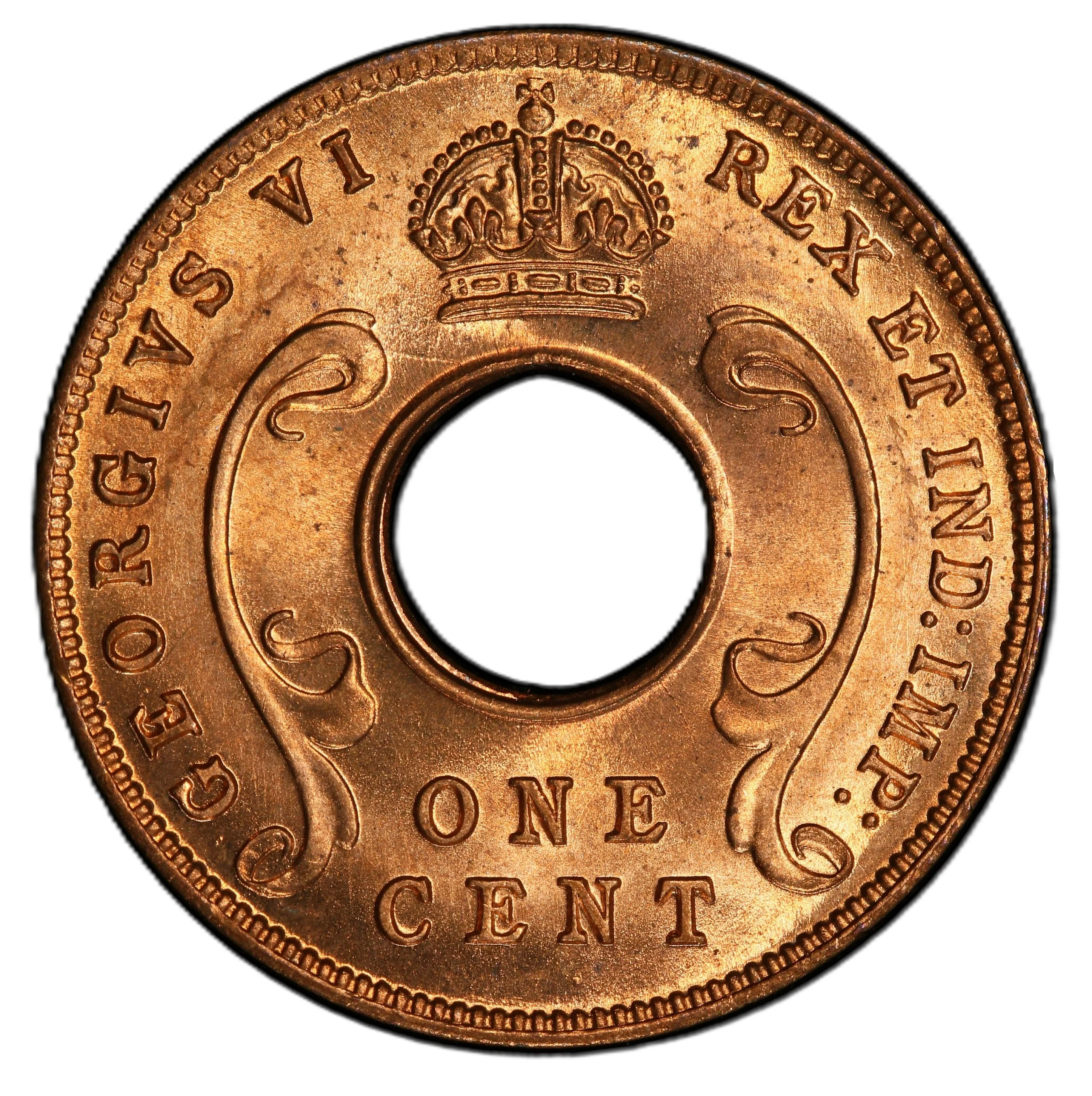
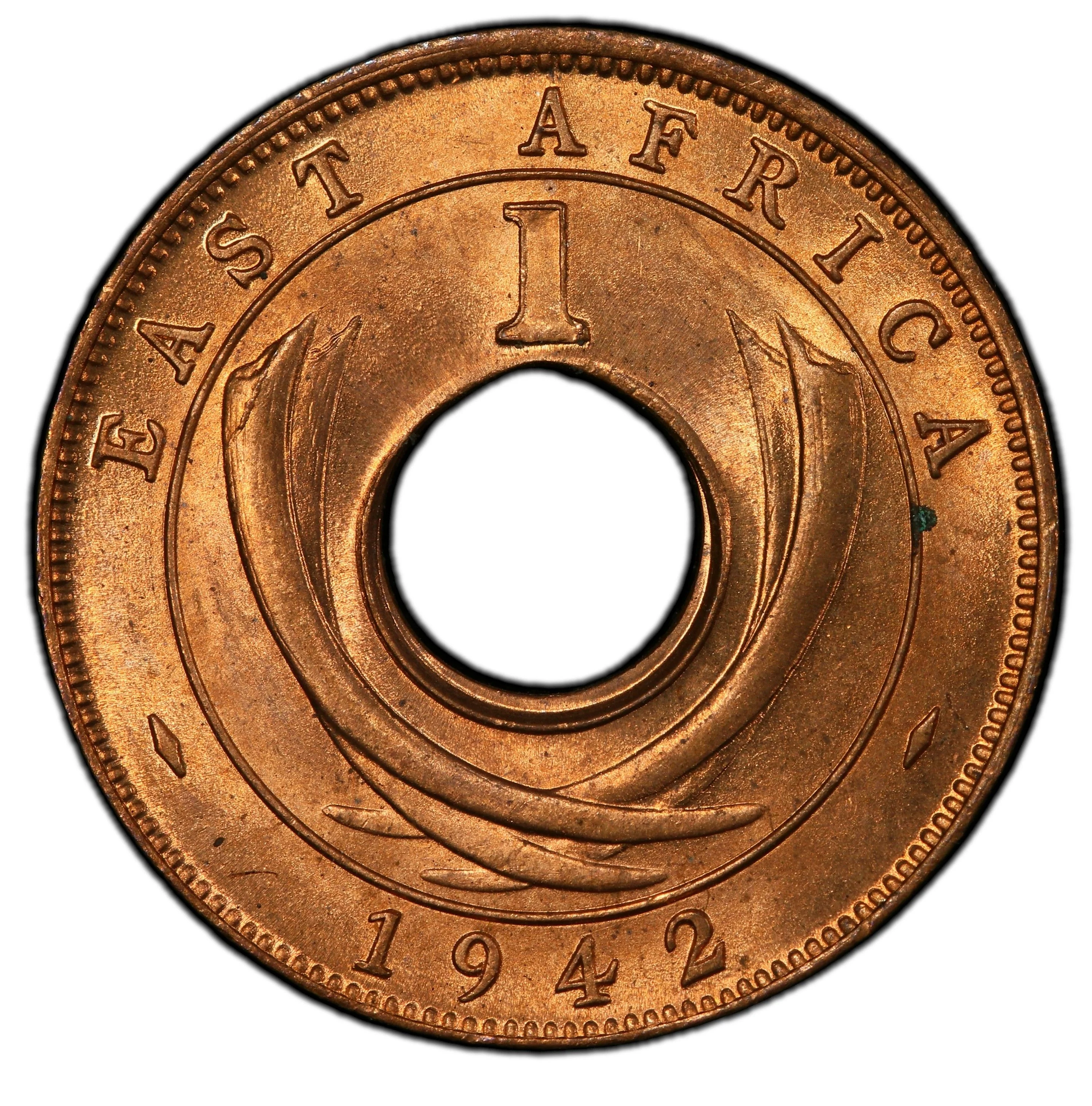
1 Cent – East Africa
Context
Year: 1942
Issuer: East Africa
Ruler: George VI
Currency:
(1921—1967)
Demonetized: Yes
Total mintage: 40,000,000
Material
Diameter: 20.3 mm
Weight: 1.94 g
Thickness: 1 mm
Shape: Round with a round hole
Composition: Bronze
Magnetic: No
Technique: Milled
Alignment: Medal alignment
flip
References
KM: #Click to copy to clipboard29
Numista: #2861
Obverse
Reverse
Edge
Plain
Mints
| Name | Mark |
|---|---|
| Royal Mint (Tower Hill) | — |
| Mumbai / Bombay | I |
Mintings
| Year | Mint Mark | Mintage | Quality | Collection |
|---|---|---|---|---|
| 1942 | — | 25,000,000 | ||
| 1942 | I | 15,000,000 |
Historical background
In 1942, East Africa's currency situation was fundamentally a wartime system controlled by the British Empire. Following the Allied defeat of Italian forces in the region by 1941, the British Military Administration (BMA) took direct control of former Italian Somaliland, Eritrea, and the re-conquered Ethiopian territories. The primary circulating currency became the East African Shilling, issued by the East African Currency Board (EACB) in Nairobi. This was a stable, sterling-backed currency used across British-controlled Kenya, Uganda, Tanganyika, Zanzibar, and now the occupied territories, simplifying military and supply transactions across the war theatre.
The system was, however, complex and fragmented. In Ethiopia, Emperor Haile Selassie's restored government, under British oversight, reintroduced the Ethiopian birr (or dollar), but the East African Shilling also circulated widely, especially around military bases. Former Italian colonies saw a chaotic mix of the East African Shilling, lingering Italian lira notes (often stamped by the BMA to validate them), and in Somaliland, the Indian Rupee, which had historically been used in the protectorate. This multi-currency environment facilitated black markets and exchange difficulties, complicating administration and local trade.
Underpinning this was the region's total integration into the British sterling area and wartime economic controls. All foreign exchange was strictly regulated, and currency issuance was tied to sterling reserves held in London, primarily to finance the Allied war effort and procure essential supplies. The priority was not local economic development but ensuring financial stability to support the North African and Middle Eastern campaigns. This centralized, extractive system would shape post-war monetary policies and lay the groundwork for future regional currency debates.
The system was, however, complex and fragmented. In Ethiopia, Emperor Haile Selassie's restored government, under British oversight, reintroduced the Ethiopian birr (or dollar), but the East African Shilling also circulated widely, especially around military bases. Former Italian colonies saw a chaotic mix of the East African Shilling, lingering Italian lira notes (often stamped by the BMA to validate them), and in Somaliland, the Indian Rupee, which had historically been used in the protectorate. This multi-currency environment facilitated black markets and exchange difficulties, complicating administration and local trade.
Underpinning this was the region's total integration into the British sterling area and wartime economic controls. All foreign exchange was strictly regulated, and currency issuance was tied to sterling reserves held in London, primarily to finance the Allied war effort and procure essential supplies. The priority was not local economic development but ensuring financial stability to support the North African and Middle Eastern campaigns. This centralized, extractive system would shape post-war monetary policies and lay the groundwork for future regional currency debates.
🌱 Common