

20 centavos – Cuba
Add to wishlist
Cuba
Obverse
Description:
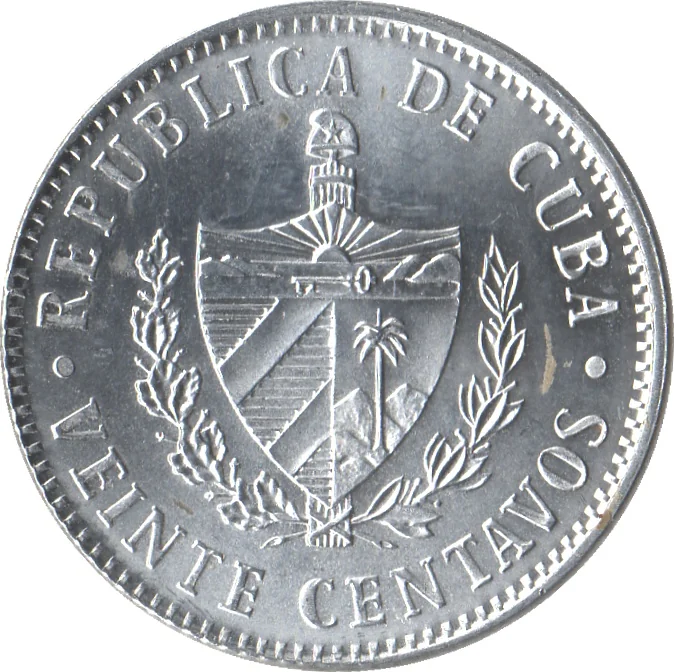
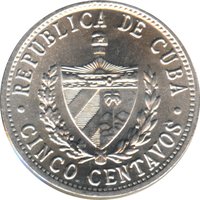
Cuban coat of arms with curved country name above, face value below, and a denticled rim.
Inscription:
REPUBLICA DE CUBA
• VEINTE CENTAVOS •
• VEINTE CENTAVOS •
Translation:
REPUBLIC OF CUBA
• TWENTY CENTS •
• TWENTY CENTS •
Script: Latin
Language: Spanish
Engraver: Charles Edward Barber
Reverse
Description:
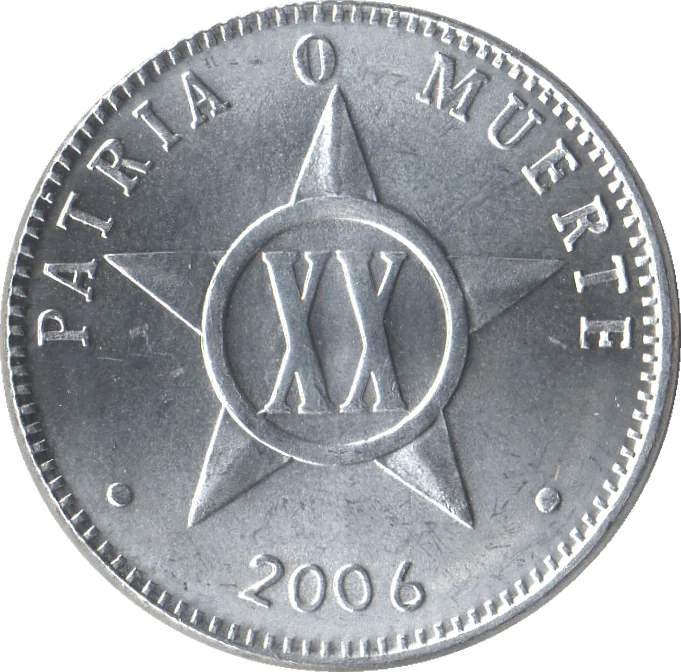
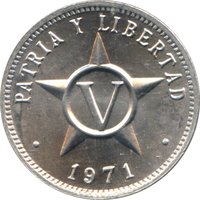
Roman numeral in circled star, "Fatherland or Death" above, date below, denticled rim.
Inscription:
PATRIA O MUERTE
XX
• 2006 •
XX
• 2006 •
Translation:
Fatherland or Death
XX
• 2006 •
XX
• 2006 •
Script: Latin
Language: Spanish
Engraver: Charles Edward Barber
Edge
Plain
Categories
| Symbols> Coat of Arms |
Mints
| Name | Mark |
|---|---|
| Empresa Cubana de Acuñaciones | — |
| Kremnica | — |
Mintings
| Year | Mint Mark | Mintage | Quality | Collection |
|---|---|---|---|---|
| 1969 | — | 25,000,000 | ||
| 1971 | — | 29,560,000 | ||
| 1972 | — | 25,000,000 | ||
| 2002 | — | — | ||
| 2005 | — | — | ||
| 2007 | — | — | ||
| 2009 | — | — | ||
| 2010 | — | — | ||
| 2018 | — | — | ||
| — | — | — | ||
| 2003 | — | — | ||
| 2006 | — | — | ||
| 2008 | — | — | ||
| 2016 | — | — | ||
| 2017 | — | — | ||
| 2019 | — | — | ||
| 2020 | — | — | ||
| 2021 | — | — |
Historical background
In 1969, Cuba's currency situation was defined by the revolutionary government's ongoing efforts to consolidate a centrally planned socialist economy and break from its capitalist past. The country operated with a dual-currency system, though not in the form it would later take. The official and sole legal tender was the Cuban Peso (CUP), which had replaced the old peso at par in 1961. However, a separate "exchange peso" or "certificado" was used for foreign trade accounting, pegged at 1:1 to the U.S. dollar, reflecting the complex relationship with international markets. Domestically, the government had abolished almost all private commerce, meaning the peso's utility was largely for state-distributed wages and purchasing heavily subsidized goods in state-run stores, where shortages were common.
This monetary environment was heavily influenced by Cuba's integration into the Council for Mutual Economic Assistance (COMECON), the Soviet-led economic bloc. Trade and credit from the USSR provided essential lifelines, insulating the island from the worst effects of the ongoing U.S. economic embargo. The currency's stability and value were therefore not determined by open markets but were artificially maintained by Soviet subsidies and long-term trade agreements that often involved barter or non-convertible currency exchanges. Internally, the government emphasized moral over material incentives as part of Che Guevara's ideological legacy, attempting to downplay the role of money itself in favor of collective social goals.
The year 1969 fell within the period of the "Revolutionary Offensive," a push to completely eliminate remaining private sector activity. This further restricted the functional role of currency in daily life, as even small businesses like street vendors and artisan shops were nationalized. The focus of the state was on ambitious production targets, most notably the failed 10-million-ton sugar harvest of 1970, which diverted massive resources and labor. Consequently, the currency situation was characterized by stability in its official exchange rate due to Soviet backing, but also by growing distortions in the domestic economy, where money had limited power to acquire goods due to pervasive rationing and supply deficits, setting the stage for the economic challenges of the coming decade.
This monetary environment was heavily influenced by Cuba's integration into the Council for Mutual Economic Assistance (COMECON), the Soviet-led economic bloc. Trade and credit from the USSR provided essential lifelines, insulating the island from the worst effects of the ongoing U.S. economic embargo. The currency's stability and value were therefore not determined by open markets but were artificially maintained by Soviet subsidies and long-term trade agreements that often involved barter or non-convertible currency exchanges. Internally, the government emphasized moral over material incentives as part of Che Guevara's ideological legacy, attempting to downplay the role of money itself in favor of collective social goals.
The year 1969 fell within the period of the "Revolutionary Offensive," a push to completely eliminate remaining private sector activity. This further restricted the functional role of currency in daily life, as even small businesses like street vendors and artisan shops were nationalized. The focus of the state was on ambitious production targets, most notably the failed 10-million-ton sugar harvest of 1970, which diverted massive resources and labor. Consequently, the currency situation was characterized by stability in its official exchange rate due to Soviet backing, but also by growing distortions in the domestic economy, where money had limited power to acquire goods due to pervasive rationing and supply deficits, setting the stage for the economic challenges of the coming decade.
🌱 Very Common