

1 franc – French Equatorial Africa
Add to wishlist
Context
Year: 1948
Country: Central African States
Issuer: French Equatorial Africa
Period:
(1946—1958)
Currency:
(1945—1960)
Demonetized: Yes
Total mintage: 15,000,000
Material
References
KM: #
Numista: #2858
Value
Exchange value: 1 FCFA
Obverse
Description:
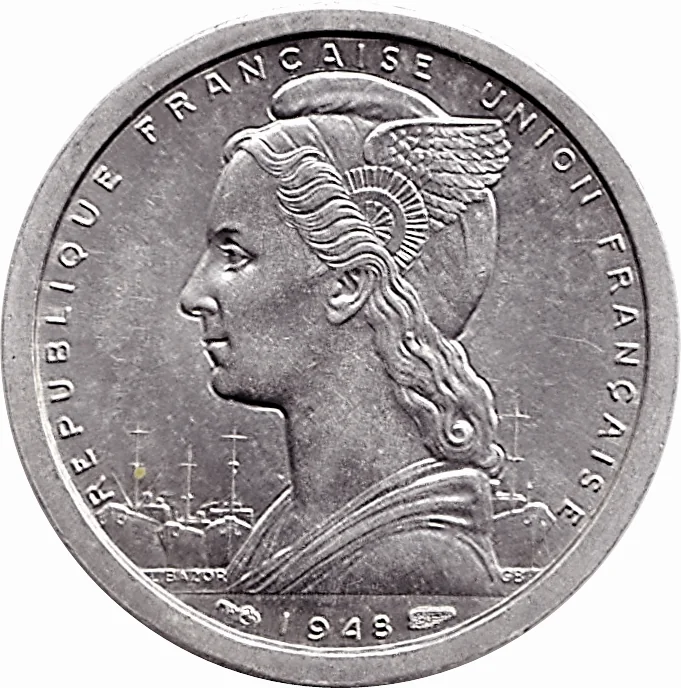
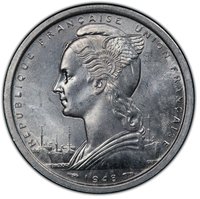
Marianne's profile with a Phrygian cap, a harbor with four ships, and the date below.
Inscription:
REPUBLIQUE FRANÇAISE UNION FRANÇAISE
L.BAZOR GB·
1948
L.BAZOR GB·
1948
Translation:
FRENCH REPUBLIC FRENCH UNION
Script: Latin
Language: French
Engraver: Lucien Georges Bazor
Reverse
Description:
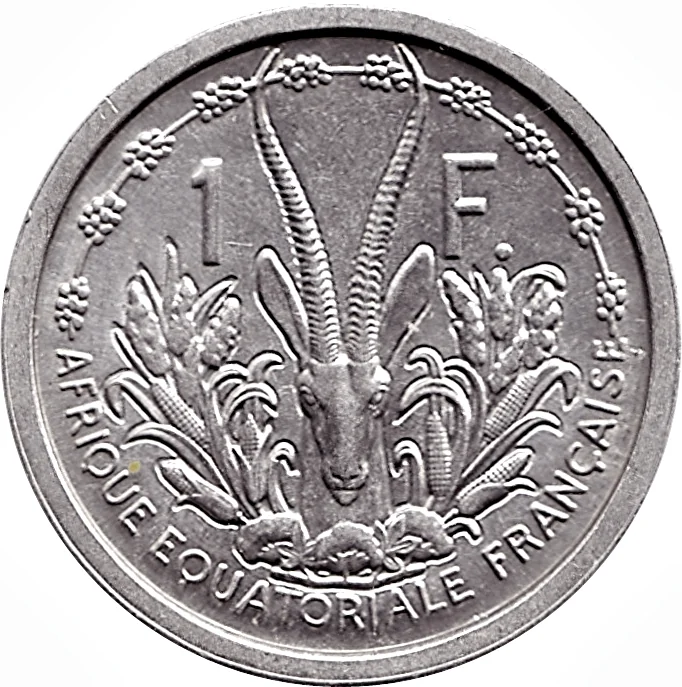
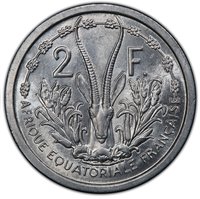
Leptoceros gazelle head divides crops and denomination.
Inscription:
1 F.
AFRIQUE EQUATORIALE FRANÇAISE
AFRIQUE EQUATORIALE FRANÇAISE
Translation:
French Equatorial Africa
Script: Latin
Language: French
Engraver: Lucien Georges Bazor
Edge
Plain
Categories
| Agriculture |
| Animal> Cow |
| Transportation> Watercraft |
Mints
| Name | Mark |
|---|---|
| Monnaie de Paris | — |
Mintings
| Year | Mint Mark | Mintage | Quality | Collection |
|---|---|---|---|---|
| 1948 | — | 15,000,000 |
Historical background
In 1948, the currency situation in French Equatorial Africa (AEF) was defined by its integration into the Franc Zone and the specific colonial monetary system of the Franc des Colonies Françaises d'Afrique (CFA franc), established just two years prior in 1945. This new currency was created to insulate France's colonial economies from the instability of the post-war French franc, which had been severely devalued. The CFA franc was pegged at a fixed and advantageous exchange rate of 1 CFA franc = 1.70 metropolitan French francs, a rate intended to guarantee the purchasing power of the colonial currency and facilitate the flow of goods and capital within the French Union.
Economically, this system served French interests by ensuring AEF's resources and markets remained tightly bound to the metropole. The fixed parity and guaranteed convertibility, backed by the French Treasury, provided monetary stability for the administration and French commercial companies operating in the region. However, it also structurally oriented the economies of its constituent territories (Gabon, Middle Congo, Ubangi-Shari, and Chad) toward exporting raw materials (like timber, cotton, and minerals) and importing manufactured goods from France, discouraging regional industrial development and locking the federation into a dependent economic relationship.
Socially and politically, the currency regime reinforced colonial control. The issuance of currency was centrally managed by the Caisse Centrale de la France d'Outre-Mer, with no local monetary authority, symbolizing the lack of economic sovereignty. For the African population, many of whom operated in subsistence or informal economies, the CFA franc was a tool of integration into the cash-based colonial economy, primarily through the payment of taxes and the purchase of imported goods. Thus, in 1948, the currency situation was not merely a financial framework but a cornerstone of the ongoing colonial project in French Equatorial Africa.
Economically, this system served French interests by ensuring AEF's resources and markets remained tightly bound to the metropole. The fixed parity and guaranteed convertibility, backed by the French Treasury, provided monetary stability for the administration and French commercial companies operating in the region. However, it also structurally oriented the economies of its constituent territories (Gabon, Middle Congo, Ubangi-Shari, and Chad) toward exporting raw materials (like timber, cotton, and minerals) and importing manufactured goods from France, discouraging regional industrial development and locking the federation into a dependent economic relationship.
Socially and politically, the currency regime reinforced colonial control. The issuance of currency was centrally managed by the Caisse Centrale de la France d'Outre-Mer, with no local monetary authority, symbolizing the lack of economic sovereignty. For the African population, many of whom operated in subsistence or informal economies, the CFA franc was a tool of integration into the cash-based colonial economy, primarily through the payment of taxes and the purchase of imported goods. Thus, in 1948, the currency situation was not merely a financial framework but a cornerstone of the ongoing colonial project in French Equatorial Africa.
🌱 Very Common