

150 Dollars – The Bahamas
Non-circulating coins
Commemoration: Bahamas Independence
Bahamas
Context
Years: 1973–1977
Country: Bahamas 
Issuer: The Bahamas
Ruler: Elizabeth II
Currency:
(since 1966)
Total mintage: 18,319
Material
References
KM: #Click to copy to clipboard51
Numista: #285405
Value
Exchange value: 150 BSD
Bullion value: $1253.76
Obverse
Description:
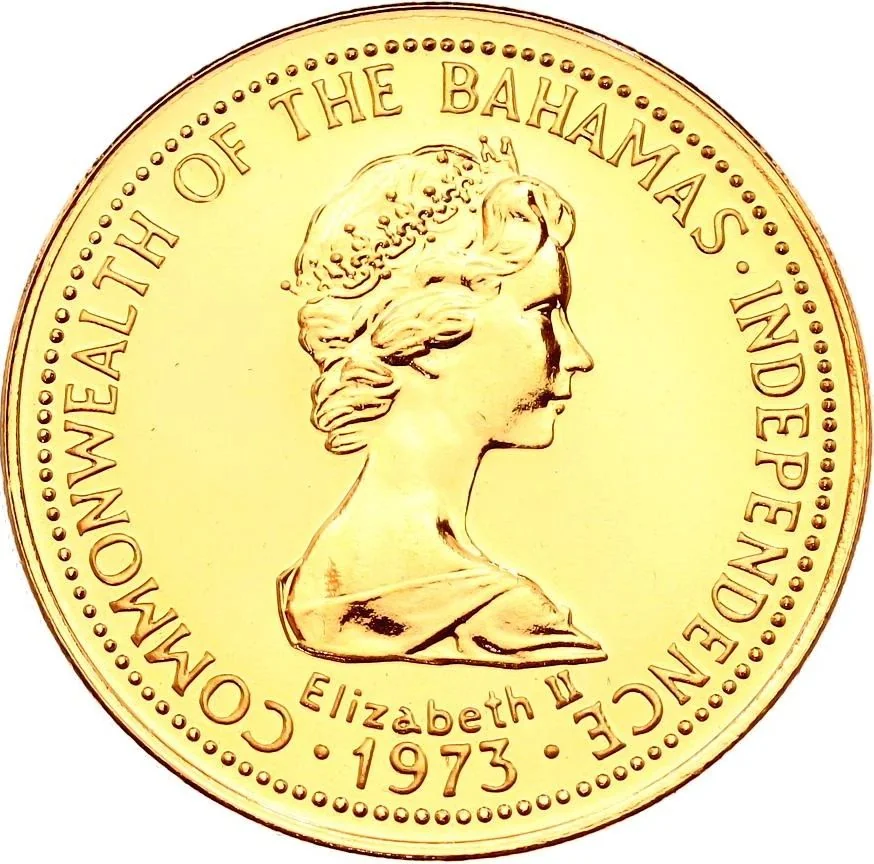
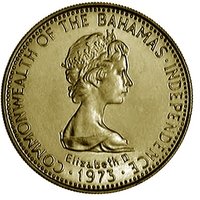
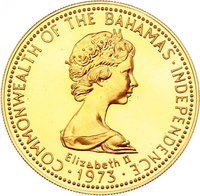
Right-facing bust of Queen Elizabeth, encircled by legend.
Inscription:
COMMONWEALTH OF THE BAHAMAS - INDEPENDENCE - 1973
Elizabeth II
Elizabeth II
Translation:
COMMONWEALTH OF THE BAHAMAS - INDEPENDENCE - 1973
Elizabeth II
Elizabeth II
Script: Latin
Language: English
Engraver: Arnold Machin
Reverse
Description:
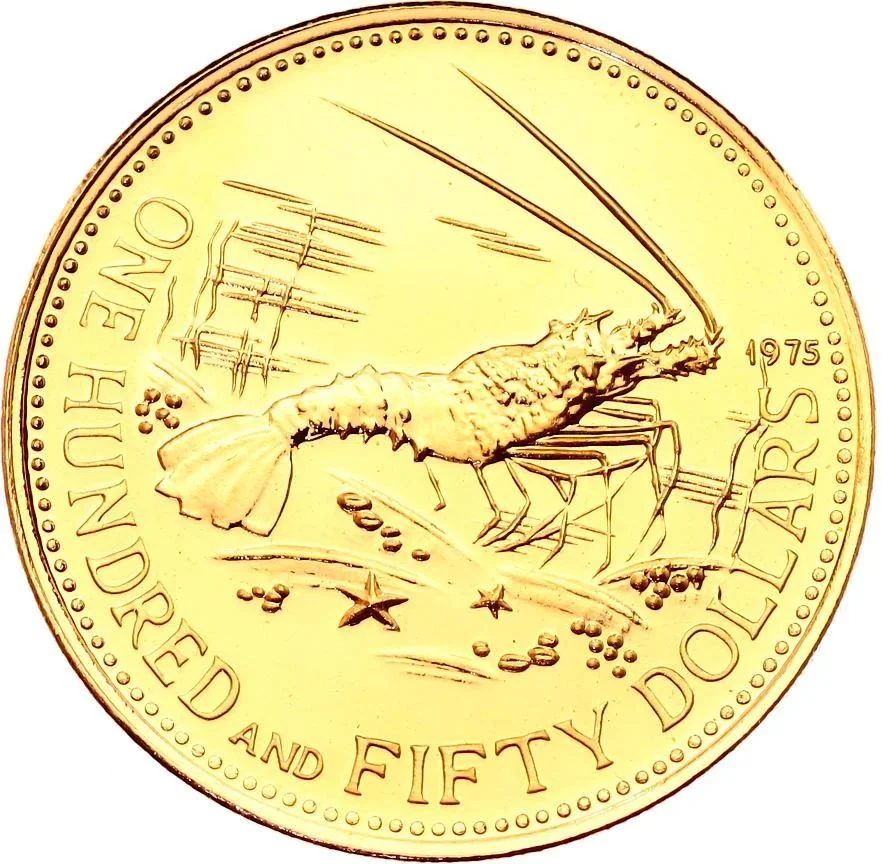
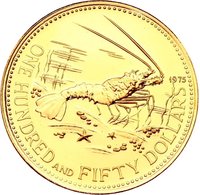
Lobster, below face value.
Inscription:
ONE HUNDRED AND FIFTY DOLLARS - 1975
Script: Latin
Edge
Reeded
Categories
| Person> Monarch |
| Geography> Sea |
| Symbol> Crown |
| Animal> Crustacean |
| Animal> Marine invertebrate |
| Event> Independence |
Mints
| Name | Mark |
|---|---|
| Royal Canadian Mint of Ottawa | — |
| Valcambi | — |
Mintings
| Year | Mint Mark | Mintage | Quality | Collection |
|---|---|---|---|---|
| 1973 | — | — | ||
| 1973 | — | — | Proof | |
| 1974 | — | 7,128 | ||
| 1974 | — | 4,785 | Proof | |
| 1975 | — | 3,141 | ||
| 1975 | — | 2,770 | Proof | |
| 1976 | — | 168 | Proof | |
| 1977 | — | 327 | Proof |
Historical background
In 1973, The Bahamas stood on the cusp of a transformative moment in its monetary history, transitioning from a colonial currency system to a symbol of newly won sovereignty. Since 1966, the official currency had been the Bahamian dollar, which was pegged at par to the U.S. dollar and issued by the Bahamas Monetary Authority (BMA). This move had already replaced the British pound sterling as the official currency, reflecting the nation's shifting economic ties and the growing influence of tourism and financial services, sectors heavily linked to the United States. However, the BMA operated under the constraints of the Sterling Area, and full control over monetary policy remained limited.
The pivotal change came on June 12, 1973, when The Bahamas achieved full political independence from the United Kingdom. This sovereignty necessitated and empowered the creation of a truly national central bank. Consequently, the Central Bank of The Bahamas was formally established later that year, on June 1, 1974, with its enabling legislation passed in 1973. The core mandate was to assume responsibility for issuing currency, managing foreign reserves, and guiding monetary policy to foster economic stability and development for the new nation.
Thus, the currency situation in 1973 was one of deliberate preparation and institutional foundation. The existing Bahamian dollar, stable due to its U.S. dollar peg, provided continuity, while the political developments of the year set the stage for the Central Bank to take control. This transition ensured that the nation's currency would become a direct instrument of national policy, managed by a Bahamian institution for Bahamian interests, marking a definitive step in the country's post-colonial economic identity.
The pivotal change came on June 12, 1973, when The Bahamas achieved full political independence from the United Kingdom. This sovereignty necessitated and empowered the creation of a truly national central bank. Consequently, the Central Bank of The Bahamas was formally established later that year, on June 1, 1974, with its enabling legislation passed in 1973. The core mandate was to assume responsibility for issuing currency, managing foreign reserves, and guiding monetary policy to foster economic stability and development for the new nation.
Thus, the currency situation in 1973 was one of deliberate preparation and institutional foundation. The existing Bahamian dollar, stable due to its U.S. dollar peg, provided continuity, while the political developments of the year set the stage for the Central Bank to take control. This transition ensured that the nation's currency would become a direct instrument of national policy, managed by a Bahamian institution for Bahamian interests, marking a definitive step in the country's post-colonial economic identity.
✨ Legendary