

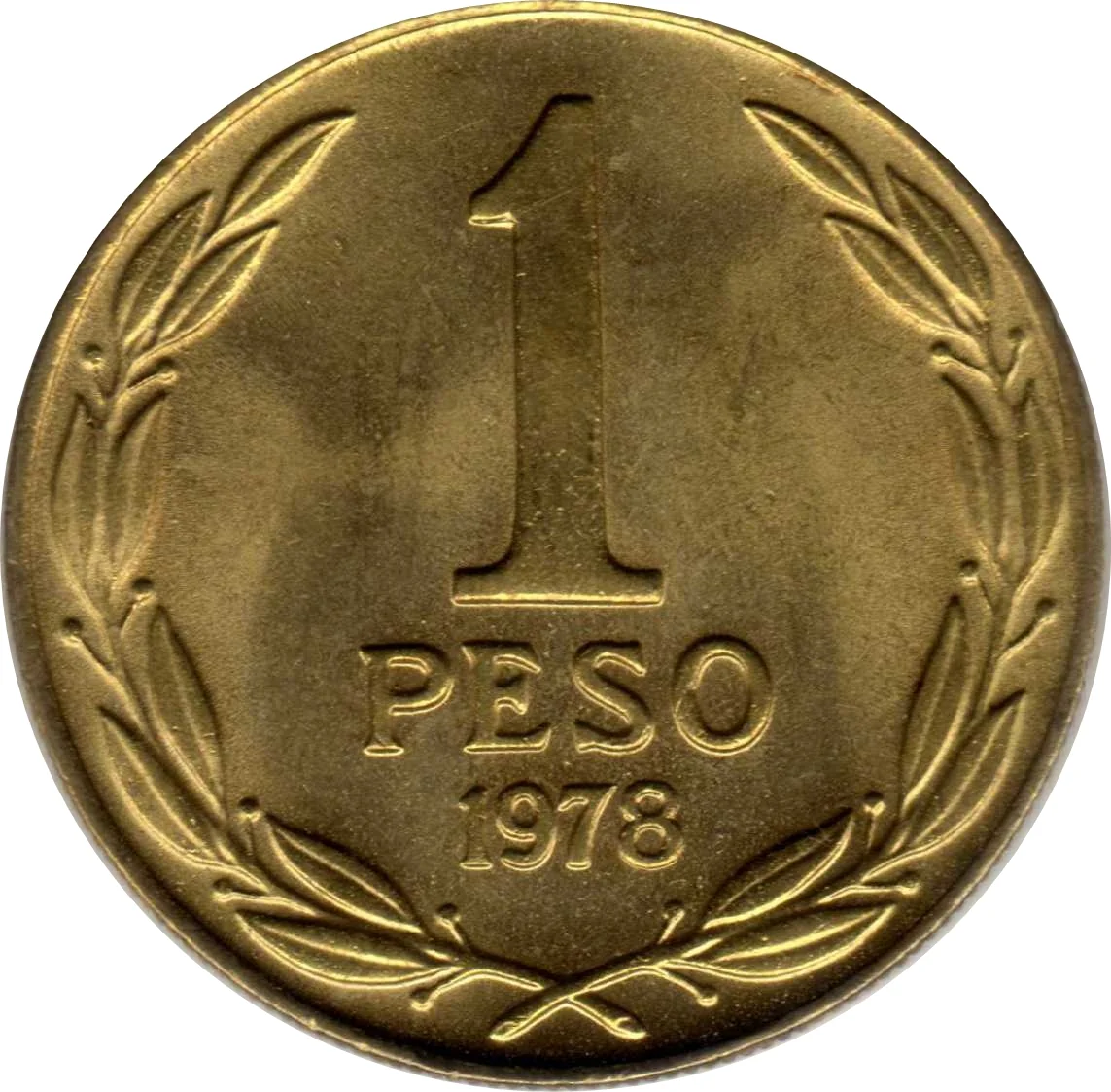


Obverse
Description:
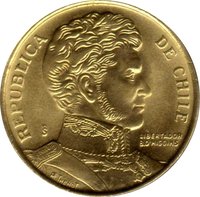
Portrait of Bernardo O'Higgins facing right.
Inscription:
REPUBLICA DE CHILE
So
LIBERTADOR
B. O'HIGGINS
R.THENOT
So
LIBERTADOR
B. O'HIGGINS
R.THENOT
Translation:
REPUBLIC OF CHILE
So
LIBERATOR
B. O'HIGGINS
R. THENOT
So
LIBERATOR
B. O'HIGGINS
R. THENOT
Script: Latin
Language: Spanish
Engraver: René Thénot
Reverse
Edge
Reeded
Categories
| Person> Military leader |
| Person> Politician |
| Symbol> Wreath |
Mints
| Name | Mark |
|---|---|
| Casa de Moneda de Chile | (So) |
Mintings
| Year | Mint Mark | Mintage | Quality | Collection |
|---|---|---|---|---|
| 1978 | So | 39,706,000 | ||
| 1979 | So | 63,000,000 |
Historical background
In 1978, Chile's currency situation was defined by the implementation of a pre-announced, crawling peg exchange rate system, a cornerstone of the neoliberal economic reforms enacted by the military government of Augusto Pinochet. Advised by the "Chicago Boys," the regime had previously undertaken radical liberalization, including tariff reductions, privatization, and strict anti-inflation measures. To anchor inflation expectations and stabilize the economy after the severe 1975 recession, the authorities fixed the peso to the U.S. dollar at a rate of 39 pesos, with a pre-declared schedule of small, regular devaluations (the "tablita cambiaria") intended to be slightly below the projected inflation differential, thereby gradually appreciating the currency in real terms.
This policy initially succeeded in reducing inflation from over 600% in the mid-1970s to roughly 30% by 1978, while also attracting foreign capital due to the high domestic interest rates and perceived stability. However, the fixed nominal exchange rate, combined with continued high inflation, led to a significant and growing overvaluation of the peso. This made Chilean exports more expensive and imports cheaper, widening the trade deficit and undermining the country's industrial and agricultural sectors. The situation was exacerbated by the liberalization of the capital account, which allowed for large inflows of foreign credit that further fueled consumption and masked underlying economic imbalances.
Consequently, by the end of 1978, Chile's currency regime was becoming increasingly unsustainable. The real appreciation eroded competitiveness, setting the stage for a severe balance of payments crisis. The rigidity of the pre-announced peg left the economy vulnerable to external shocks, a vulnerability that would be brutally exposed in the early 1980s when a global recession, a spike in world interest rates, and a collapse in copper prices forced a major economic crisis, leading to a banking collapse, a massive devaluation, and a deep depression. Thus, 1978 represents a pivotal year where the short-term gains of stability gave way to the accumulation of profound structural vulnerabilities.
This policy initially succeeded in reducing inflation from over 600% in the mid-1970s to roughly 30% by 1978, while also attracting foreign capital due to the high domestic interest rates and perceived stability. However, the fixed nominal exchange rate, combined with continued high inflation, led to a significant and growing overvaluation of the peso. This made Chilean exports more expensive and imports cheaper, widening the trade deficit and undermining the country's industrial and agricultural sectors. The situation was exacerbated by the liberalization of the capital account, which allowed for large inflows of foreign credit that further fueled consumption and masked underlying economic imbalances.
Consequently, by the end of 1978, Chile's currency regime was becoming increasingly unsustainable. The real appreciation eroded competitiveness, setting the stage for a severe balance of payments crisis. The rigidity of the pre-announced peg left the economy vulnerable to external shocks, a vulnerability that would be brutally exposed in the early 1980s when a global recession, a spike in world interest rates, and a collapse in copper prices forced a major economic crisis, leading to a banking collapse, a massive devaluation, and a deep depression. Thus, 1978 represents a pivotal year where the short-term gains of stability gave way to the accumulation of profound structural vulnerabilities.
🌱 Very Common