

2 Pounds (Guy Fawkes' Gunpowder Plot) – United Kingdom
Circulating commemorative coins
Commemoration: 400th anniversary of Guy Fawkes' Gunpowder Plot
United Kingdom
Context
Year: 2005
Issuer: United Kingdom 
Ruler: Elizabeth II
Currency:
(since 1971)
Total mintage: 5,255,705
Material

References
KM: #Click to copy to clipboard1052
Numista: #13420
Value
Exchange value: 2 GBP = $2.71
Inflation-adjusted value: 3.92 GBP
Obverse
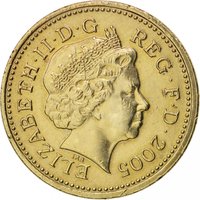
Description:
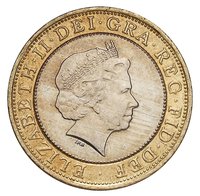
Queen Elizabeth IV facing right, wearing the Girls of Great Britain and Ireland tiara.
Inscription:
ELIZABETH·II·DEI·GRA·REG·FID·DEF ·
IRB
IRB
Translation:
Elizabeth II by the Grace of God Queen Defender of the Faith
Script: Latin
Language: Latin
Engraver: Ian Rank-Broadley
Reverse
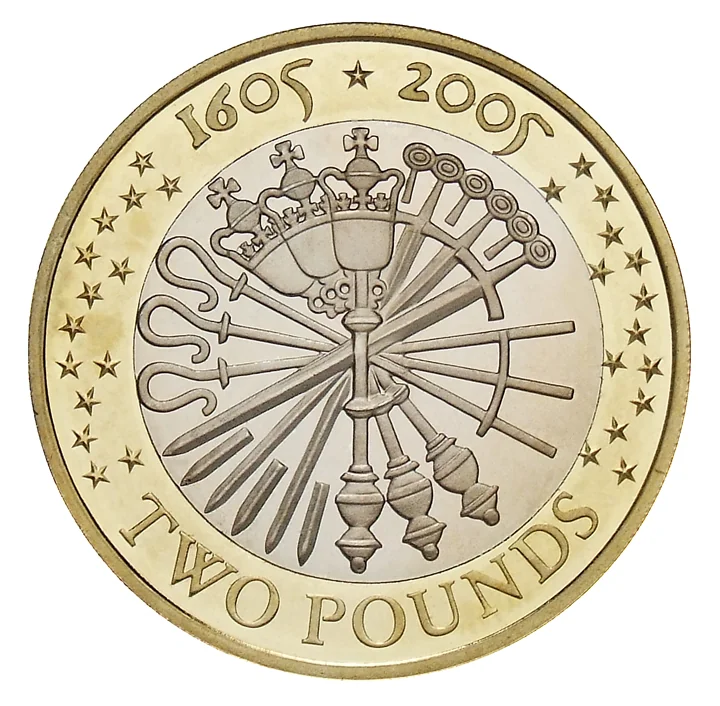
Description:
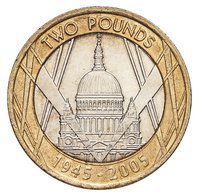
A circular arrangement of the state symbols—mace, crosier, and sword—with dates and denomination.
Inscription:
1605 * 2005
TWO POUNDS
TWO POUNDS
Script: Latin
Engraver: Peter Forster
Edge
Milled with incuse lettering
Legend:
REMEMBER REMEMBER THE FIFTH OF NOVEMBER ·
Mints
| Name | Mark |
|---|---|
| Royal Mint | — |
Mintings
| Year | Mint Mark | Mintage | Quality | Collection |
|---|---|---|---|---|
| 2005 | — | 5,140,500 | ||
| 2005 | — | 74,642 | BU | |
| 2005 | — | 40,563 | Proof |
Historical background
In 2005, the United Kingdom's currency situation was defined by the continued strength of the Pound Sterling (GBP) and the ongoing debate over potential Eurozone entry. The UK, having opted out of the single currency at the Maastricht Treaty, maintained the Pound as its sole legal tender. The Labour government, led by Prime Minister Tony Blair, was notionally in favour of joining the euro, but Chancellor Gordon Brown's famous "five economic tests" for entry, assessed in 2003, had concluded that the UK economy was not yet sufficiently converged with the Eurozone. This political stance, combined with strong public and media scepticism, effectively placed the issue on hold, ensuring sterling's dominance for the foreseeable future.
Economically, the Pound was robust, trading at an average of approximately £0.68 against the US Dollar and around £0.67 against the Euro throughout the year. This strength was underpinned by a stable and growing UK economy, relatively high interest rates set by the independent Bank of England (which had gained control of monetary policy in 1997), and a strong services sector, particularly in finance. However, this high exchange rate posed significant challenges for UK manufacturing and export-oriented industries, which found their goods becoming more expensive and less competitive in international markets.
The period was also one of relative stability for banknotes and coins, with the Bank of England continuing to issue its distinctive series of paper notes. The physical currency in circulation featured historical figures like Charles Darwin and Elizabeth Fry, with the issue of modern polymer notes still years away. In summary, 2005 was a year of sterling confidence and consolidation, marked by a deliberate political choice to retain monetary sovereignty, a strong but potentially problematic exchange rate, and a quiet period in the design of physical currency itself.
Economically, the Pound was robust, trading at an average of approximately £0.68 against the US Dollar and around £0.67 against the Euro throughout the year. This strength was underpinned by a stable and growing UK economy, relatively high interest rates set by the independent Bank of England (which had gained control of monetary policy in 1997), and a strong services sector, particularly in finance. However, this high exchange rate posed significant challenges for UK manufacturing and export-oriented industries, which found their goods becoming more expensive and less competitive in international markets.
The period was also one of relative stability for banknotes and coins, with the Bank of England continuing to issue its distinctive series of paper notes. The physical currency in circulation featured historical figures like Charles Darwin and Elizabeth Fry, with the issue of modern polymer notes still years away. In summary, 2005 was a year of sterling confidence and consolidation, marked by a deliberate political choice to retain monetary sovereignty, a strong but potentially problematic exchange rate, and a quiet period in the design of physical currency itself.
🌱 Very Common