

100 francs – New Caledonia
Add to wishlist
France
Context
Years: 2006–2017
Country: France
Issuer: New Caledonia
Issuing organization: Overseas Institution of Issue
Period:
(since 1958)
Currency:
(since 1945)
Demonetization: 30 November 2022
Total mintage: 7,054,000
Material
Diameter: 30 mm
Weight: 10 g
Thickness: 2.08 mm
Shape: Round
Composition: Aluminium bronze
Magnetic: No
Technique: Milled
Alignment: Coin alignment
flip
References
KM: #
Numista: #28247
Value
Exchange value: 100 XPF
Inflation-adjusted value: 140.15 XPF
Obverse
Description:
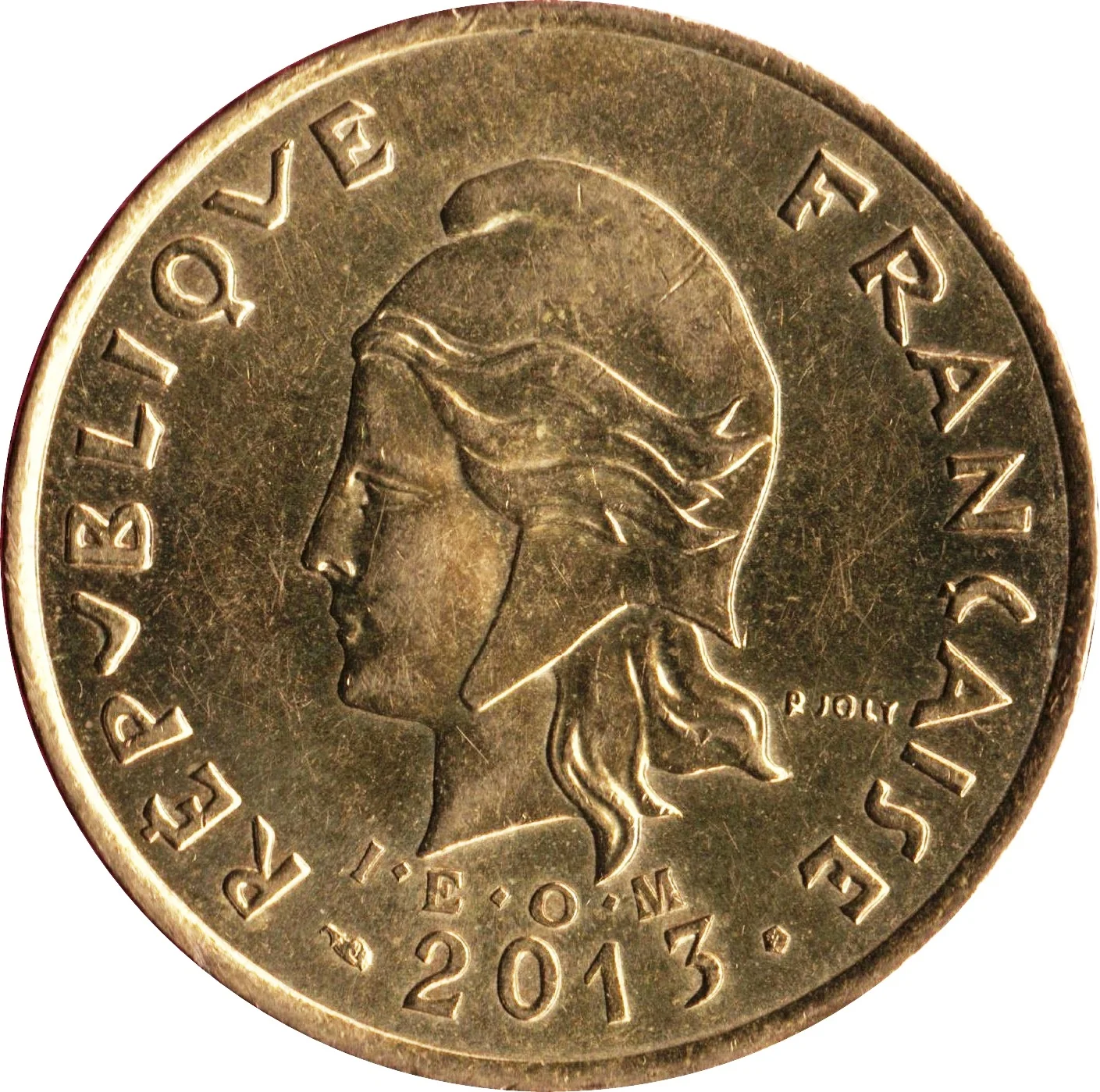
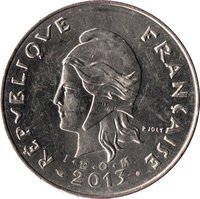
Marianne left, date below, legend around.
Inscription:
RÉPUBLIQUE FRANÇAISE
R JOLY
I·E·O·M
2013
R JOLY
I·E·O·M
2013
Translation:
FRENCH REPUBLIC
R JOLY
I·E·O·M
2013
R JOLY
I·E·O·M
2013
Script: Latin
Language: French
Engraver: Raymond Joly
Reverse
Edge
Reeded
Mints
| Name | Mark |
|---|---|
| Monnaie de Paris | — |
Mintings
| Year | Mint Mark | Mintage | Quality | Collection |
|---|---|---|---|---|
| 2006 | — | 300,000 | ||
| 2007 | — | 800,000 | ||
| 2008 | — | 1,100,000 | ||
| 2009 | — | 1,400,000 | ||
| 2010 | — | 250,000 | ||
| 2013 | — | 324,000 | ||
| 2014 | — | 648,000 | ||
| 2015 | — | 648,000 | ||
| 2016 | — | 720,000 | ||
| 2017 | — | 864,000 |
Historical background
In 2006, New Caledonia's currency situation was defined by its continued use of the CFP franc (XPF) as its legal tender, a monetary arrangement that had been in place since 1945. This currency is issued by the Institut d'émission d’outre-mer (IEOM) and is pegged to the French franc, and subsequently to the euro, at a fixed and guaranteed exchange rate. This peg provided significant monetary stability for the territory, insulating it from local inflation shocks and ensuring seamless financial integration with France, its primary economic partner and source of subsidies and public investment.
The currency framework was a direct reflection of New Caledonia's unique political status as a French special collectivity under the 1998 Nouméa Accord, which set a path toward increased autonomy and a possible independence referendum. Economically, the fixed peg to the euro facilitated trade and investment but also meant that New Caledonia had no independent monetary policy. This was a point of occasional debate, as the territory could not devalue its currency to boost the competitiveness of its key export, nickel, whose booming prices in the mid-2000s were driving a period of significant economic growth and budgetary surplus.
Thus, in 2006, the CFP franc was not a subject of imminent crisis but rather a stable pillar within a broader, evolving political-economic landscape. The discussions around currency sovereignty were largely theoretical and linked to long-term political decisions under the Nouméa Accord, rather than immediate policy changes. The system's benefits of stability and credibility were generally seen as outweighing the costs of forgone monetary autonomy, especially during a period of robust nickel-driven economic expansion.
The currency framework was a direct reflection of New Caledonia's unique political status as a French special collectivity under the 1998 Nouméa Accord, which set a path toward increased autonomy and a possible independence referendum. Economically, the fixed peg to the euro facilitated trade and investment but also meant that New Caledonia had no independent monetary policy. This was a point of occasional debate, as the territory could not devalue its currency to boost the competitiveness of its key export, nickel, whose booming prices in the mid-2000s were driving a period of significant economic growth and budgetary surplus.
Thus, in 2006, the CFP franc was not a subject of imminent crisis but rather a stable pillar within a broader, evolving political-economic landscape. The discussions around currency sovereignty were largely theoretical and linked to long-term political decisions under the Nouméa Accord, rather than immediate policy changes. The system's benefits of stability and credibility were generally seen as outweighing the costs of forgone monetary autonomy, especially during a period of robust nickel-driven economic expansion.
🌱 Common