

3 Rubles (Liberation of Kiev) – Russian Federation
Non-circulating coins
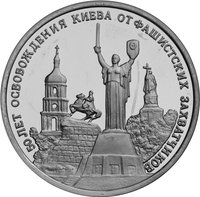
Commemoration: The 50th Anniversary of the Liberation of Kiev from Fascist Invaders
Russia
Context
Year: 1993
Country: Russia 
Issuer: Russian Federation
Issuing organization: Central Bank of Russia
Period:
(since 1991)
Currency:
(1992—1997)
Demonetization: 1 January 1998
Total mintage: 850,000
Material
Diameter: 33 mm
Weight: 14.35 g
Thickness: 2.3 mm
Shape: Round
Composition: Copper-nickel
Technique: Milled
Alignment: Medal alignment
flip
References
Value
Exchange value: 3 RUR
Inflation-adjusted value: 17795.35 RUR
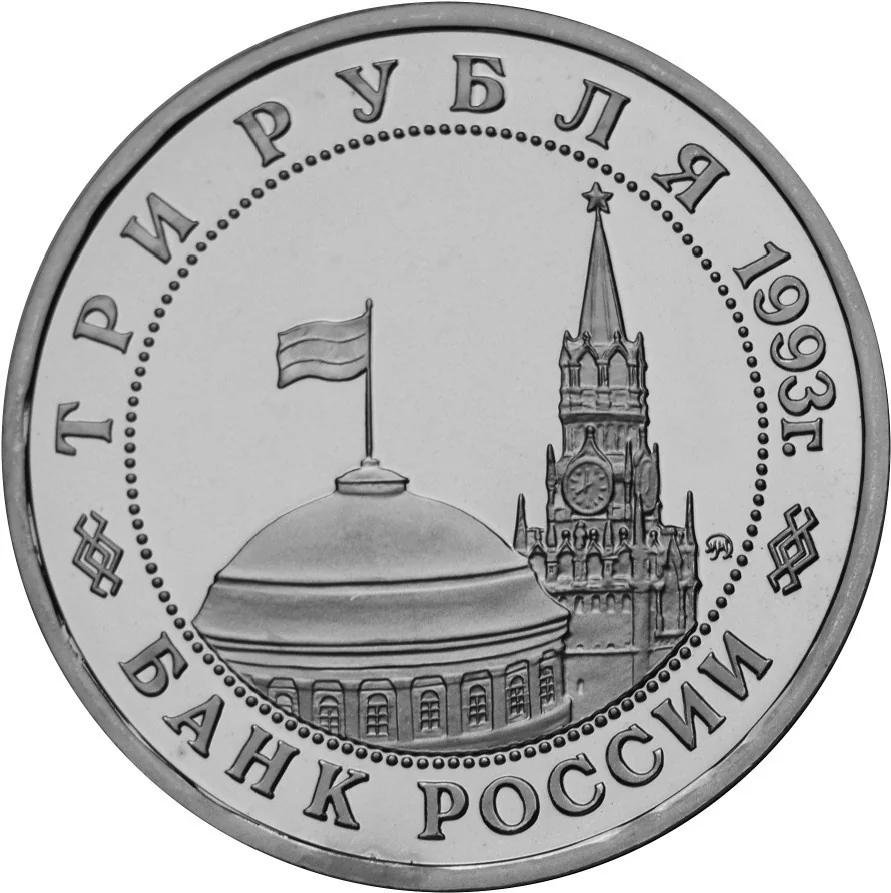
Obverse
Description:
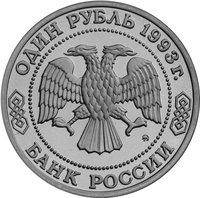
Center: Senate dome and Saviour's Tower of the Moscow Kremlin. Right: Mint mark. Rim inscriptions within dotted circle: "THREE ROUBLES 1993" above, "BANK OF RUSSIA" below.
Inscription:
ТРИ РУБЛЯ 1993г.
ММД
БАНК РОССИИ
ММД
БАНК РОССИИ
Translation:
THREE RUBLES 1993
Moscow Mint
BANK OF RUSSIA
Moscow Mint
BANK OF RUSSIA
Script: Cyrillic
Language: Russian
Designer and engraver: Alexander Vasilyevich Baklanov
Reverse
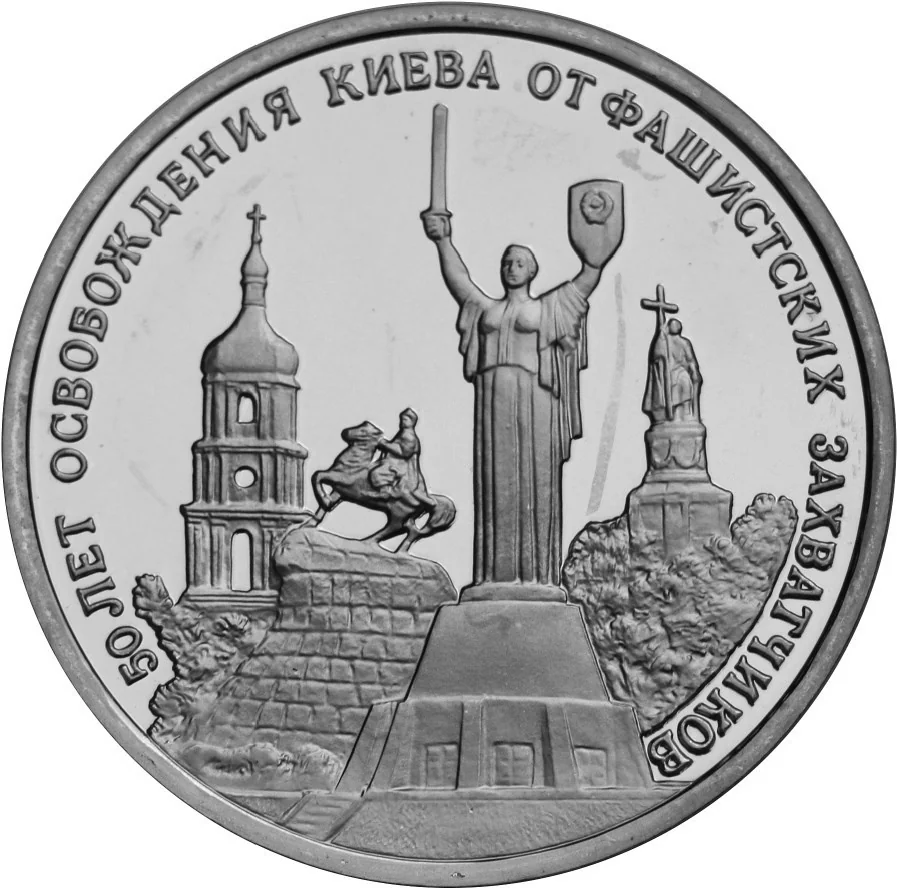
Description:
The Motherland statue framed by St. Sophia's belfry and monuments to Khmelnitsky and Prince Vladimir.
Inscription:
50 ЛЕТ ОСВОБОЖДЕНИЯ КИЕВА ОТ ФАШИСТСКИХ ЗАХВАТЧИКОВ
Translation:
50 Years of the Liberation of Kiev from the Fascist Invaders
Script: Cyrillic
Language: Russian
Engraver: Vyacheslav Mikhaylovich Kharlamov
Designer: Alexander Anatolyevich Kolodkin
Edge
Two incised insriptions "ТРИ РУБЛЯ" (THREE ROUBLES) separated by two asterisks.
Legend:
ТРИ РУБЛЯ * ТРИ РУБЛЯ *
Translation:
THREE RUBLES * THREE RUBLES *
Language: Russian
Categories
| Art> Sculpture |
| Building> Governmental building |
| Building> Religious building |
| Building> Tower |
| History> War |
Mints
| Name | Mark |
|---|---|
| Moscow Mint | (ММД) |
Mintings
| Year | Mint Mark | Mintage | Quality | Collection |
|---|---|---|---|---|
| 1993 | ММД | 350,000 | Prooflike | |
| 1993 | ММД | 350,000 | Proof | |
| 1993 | ММД | 150,000 | BU |
Historical background
In 1993, the Russian Federation was engulfed in a severe monetary crisis, a direct consequence of the economic shock therapy and price liberalization begun in 1992. Hyperinflation, running at an annual rate of over 800%, was eroding savings and wages, while the Central Bank of Russia (CBR), under pressure from industrial lobbies and parliament, continued to print massive amounts of rubles to finance government deficits and provide cheap credits to failing state enterprises. This flood of money, chasing a collapsing supply of goods, created a self-reinforcing cycle of price increases and a dramatic loss of confidence in the ruble, which was still using Soviet-era designs.
The situation reached a critical point in July 1993 when the government of Prime Minister Viktor Chernomyrdin and CBR Chairman Viktor Gerashchenko launched a sudden and confiscatory currency reform. Aimed at curbing inflation in other former Soviet states and reasserting Moscow's monetary control, the reform declared that pre-1993 Soviet and Russian ruble banknotes would be withdrawn from circulation. Citizens were given a narrow two-week window to exchange limited amounts of old cash for new Russian ruble notes, with severe restrictions on sums for non-residents. The move was widely perceived as a brutal de facto confiscation of cash savings, particularly affecting the populations of other post-Soviet republics still using the ruble zone.
The 1993 reform effectively dismantled the crumbling ruble zone, forcing independent currencies in neighboring states. While it succeeded in temporarily tightening the money supply and consolidating the Russian ruble, it came at a tremendous social cost, further devastating public trust in state institutions and the currency itself. The fundamental drivers of inflation—soft budget constraints and directed credits—remained largely unaddressed, meaning the stabilization was short-lived. The crisis of 1993 set the stage for the even more traumatic hyperinflation and monetary collapse that would culminate in the ruble's redenomination in 1998.
The situation reached a critical point in July 1993 when the government of Prime Minister Viktor Chernomyrdin and CBR Chairman Viktor Gerashchenko launched a sudden and confiscatory currency reform. Aimed at curbing inflation in other former Soviet states and reasserting Moscow's monetary control, the reform declared that pre-1993 Soviet and Russian ruble banknotes would be withdrawn from circulation. Citizens were given a narrow two-week window to exchange limited amounts of old cash for new Russian ruble notes, with severe restrictions on sums for non-residents. The move was widely perceived as a brutal de facto confiscation of cash savings, particularly affecting the populations of other post-Soviet republics still using the ruble zone.
The 1993 reform effectively dismantled the crumbling ruble zone, forcing independent currencies in neighboring states. While it succeeded in temporarily tightening the money supply and consolidating the Russian ruble, it came at a tremendous social cost, further devastating public trust in state institutions and the currency itself. The fundamental drivers of inflation—soft budget constraints and directed credits—remained largely unaddressed, meaning the stabilization was short-lived. The crisis of 1993 set the stage for the even more traumatic hyperinflation and monetary collapse that would culminate in the ruble's redenomination in 1998.
🌟 Uncommon