

2 Francs – Monaco
Monaco
Context

Material
Diameter: 27 mm
Weight: 8 g
Thickness: 2 mm
Shape: Round
Composition: Aluminium bronze
Magnetic: No
Technique: Milled
Alignment: Coin alignment
flip
References
KM: #Click to copy to clipboard121a
Numista: #2811
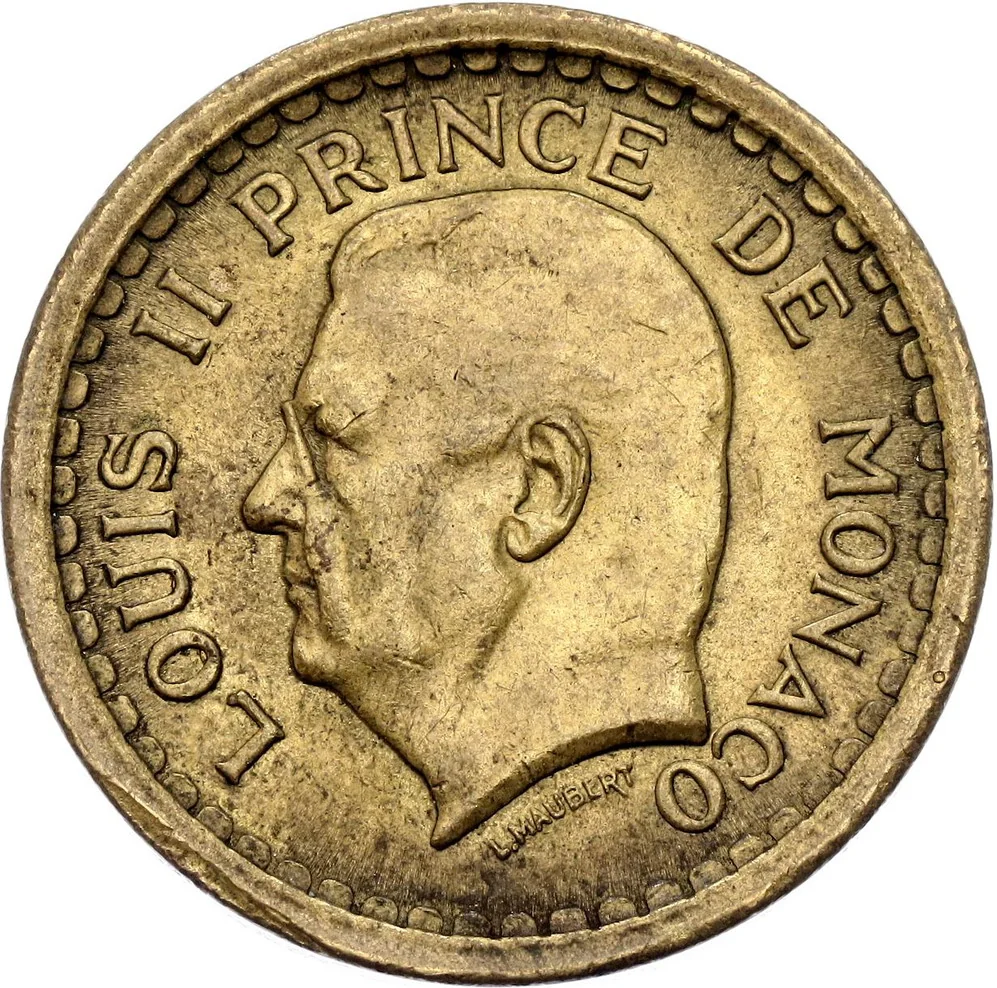
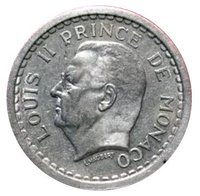
Obverse
Description:
Louis II, left profile.
Inscription:
LOUIS II PRINCE DE MONACO
L. MAUBERT
L. MAUBERT
Translation:
Louis II Prince of Monaco
L. Maubert
L. Maubert
Script: Latin
Language: French
Engraver: Louis Maubert
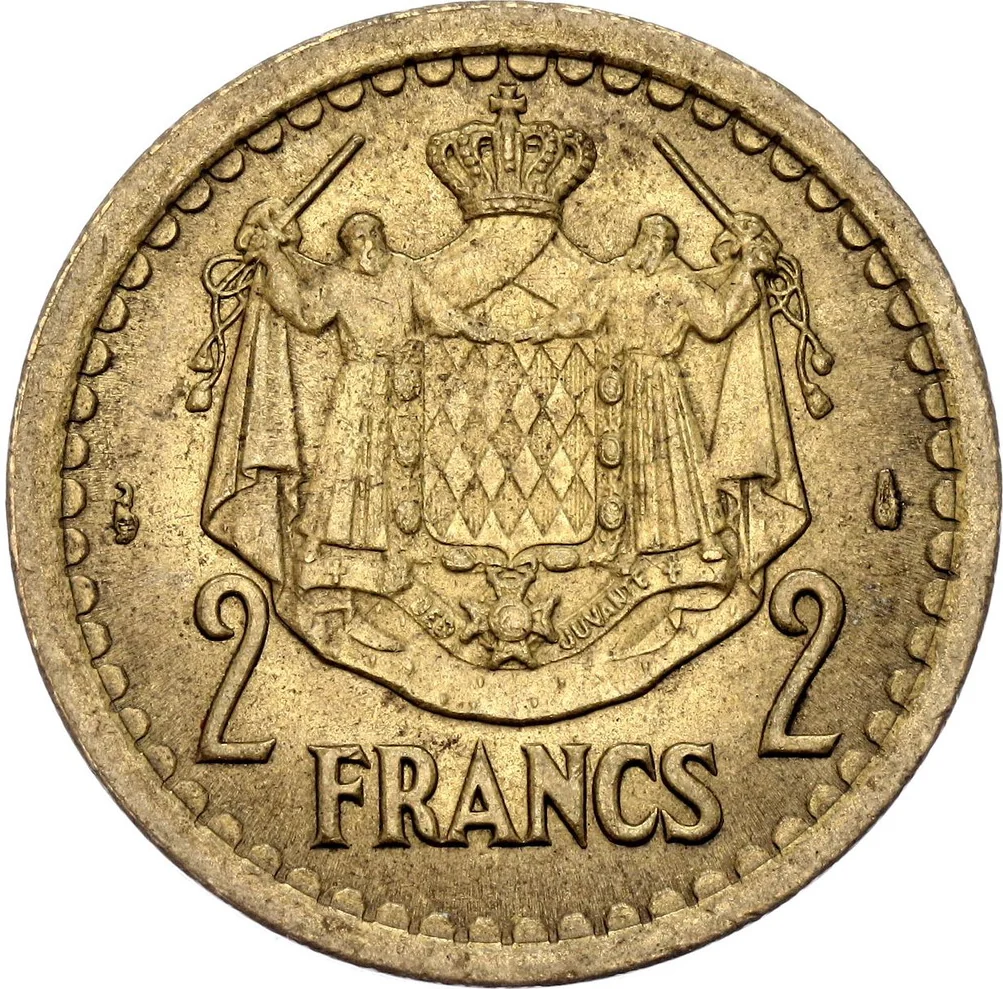
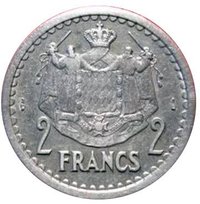
Reverse
Description:
Arms with crown and mantle, value beneath.
Inscription:
2 FRANCS 2
DEO JUVANTE
DEO JUVANTE
Translation:
Two Francs Two
With God's Help
With God's Help
Script: Latin
Engraver: Louis Maubert
Edge
Plain
Categories
| Object> Cold weapons |
| Symbol> Crown |
| Person> Monarch |
| Person> Religious figure |
Mints
| Name | Mark |
|---|---|
| Monnaie de Paris | — |
Mintings
| Year | Mint Mark | Mintage | Quality | Collection |
|---|---|---|---|---|
| 1945 | — | 1,082,687 |
Historical background
Following the Liberation of Monaco in September 1944, the Principality found itself in a complex monetary situation in 1945, deeply entangled with that of France. While Monaco had its own coinage, the French franc had been the official and circulating currency since the 1865 Monetary Convention. The war and occupation had left a legacy of multiple, devalued note issues, including pre-war French francs, occupation-era notes from the Vichy regime, and even Allied military currency.
The pivotal event defining 1945 was the French government's major monetary reform enacted in June. This reform aimed to purge the inflationary overhang from the war by voiding all existing banknotes and requiring their exchange for new francs at a discriminatory rate. As Monaco's economy and currency were legally fused with France's, this reform was imposed directly on the Principality. Monegasque authorities and citizens were compelled to exchange their old notes for the new French francs, with strict limits on the amount that could be converted at a favourable rate, effectively enacting a capital levy.
Consequently, Monaco in 1945 had no independent currency policy. Its monetary landscape was wholly dictated by the French reform, which sought to stabilise the franc and curb black-market activity. The Principality's challenge was not managing a separate currency, but navigating the immediate economic hardship caused by the forced conversion, which reduced the nominal value of many cash holdings. This period reinforced Monaco's absolute dependence on French monetary sovereignty, a relationship that would be formally reconfirmed with a new Franco-Monegasque Monetary Convention in 1963.
The pivotal event defining 1945 was the French government's major monetary reform enacted in June. This reform aimed to purge the inflationary overhang from the war by voiding all existing banknotes and requiring their exchange for new francs at a discriminatory rate. As Monaco's economy and currency were legally fused with France's, this reform was imposed directly on the Principality. Monegasque authorities and citizens were compelled to exchange their old notes for the new French francs, with strict limits on the amount that could be converted at a favourable rate, effectively enacting a capital levy.
Consequently, Monaco in 1945 had no independent currency policy. Its monetary landscape was wholly dictated by the French reform, which sought to stabilise the franc and curb black-market activity. The Principality's challenge was not managing a separate currency, but navigating the immediate economic hardship caused by the forced conversion, which reduced the nominal value of many cash holdings. This period reinforced Monaco's absolute dependence on French monetary sovereignty, a relationship that would be formally reconfirmed with a new Franco-Monegasque Monetary Convention in 1963.
🌱 Very Common