

5 Pounds (Gibraltar Chronicle) – Gibraltar
Non-circulating coins
Commemoration: Bicentenary of the Gibraltar Chronicle
United Kingdom
Context
Material
References
KM: #Click to copy to clipboard953
Numista: #28083
Value
Exchange value: 5 GIP
Inflation-adjusted value: 10.75 GIP
Obverse
Description:
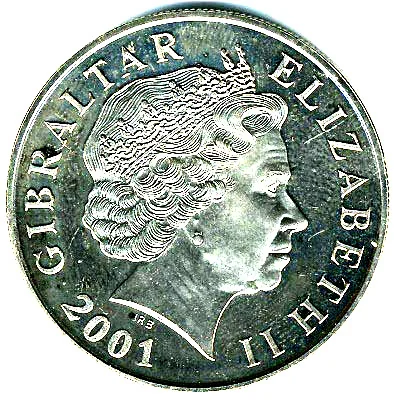
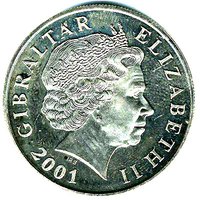
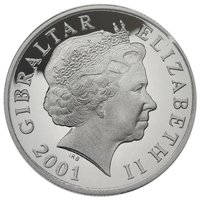
Queen Elizabeth II facing right, wearing the "Girls of Great Britain and Ireland" Tiara, with legend and date.
Inscription:
GIBRALTAR ELIZABETH II
IRB
2001
IRB
2001
Script: Latin
Designer: Ian Rank-Broadley
Reverse
Description:
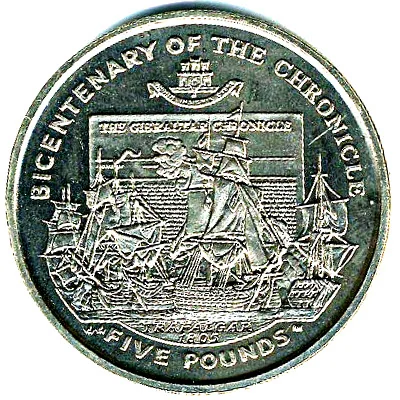
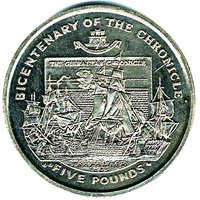
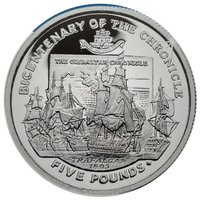
Trafalgar victory reported by the Chronicle a week before London's accounts.
Inscription:
BICENTENARY OF THE CHRONICLE
MONTIS INSIGNIA CALPE
THE GIBRALTAR CHRONICLE
TRAFALGAR
1805
FIVE POUNDS
MONTIS INSIGNIA CALPE
THE GIBRALTAR CHRONICLE
TRAFALGAR
1805
FIVE POUNDS
Script: Latin
Edge
Segmented reeding (reeded with three equally space plain sections)
Categories
| Transportation> Watercraft |
Mints
| Name | Mark |
|---|---|
| Pobjoy Mint | (PM) |
Mintings
| Year | Mint Mark | Mintage | Quality | Collection |
|---|---|---|---|---|
| 2001 | PM | — |
Historical background
In 2001, Gibraltar's currency situation was defined by its unique political status as a British Overseas Territory and its practical economic integration with neighbouring Spain. The legal tender was, and remains, the Gibraltar pound (GIP), issued by the Government of Gibraltar and pegged at par with the pound sterling (GBP). Sterling notes and coins also circulated freely and were accepted interchangeably, providing monetary stability and a firm link to the UK financial system. This arrangement underscored Gibraltar's British sovereignty, a point of ongoing diplomatic tension with Spain.
However, the reality on the ground was more complex due to Gibraltar's geography and daily cross-border flow of thousands of Spanish workers and visitors. While the Gibraltar pound was not a convertible currency internationally, Spanish pesetas (and later euros from 2002) were widely accepted in many retail businesses, especially those in the main town and tourist areas. This de facto dual-currency environment was essential for facilitating commerce and easing transactions for the significant Spanish clientele, reflecting the territory's economic interdependence with the surrounding region.
The period around 2001 was also one of anticipation for the upcoming euro cash changeover in the eurozone, which included Spain in January 2002. Gibraltar businesses and financial institutions prepared for this shift, expecting the new euro notes and coins to rapidly replace the peseta in cross-border transactions. The government maintained its commitment to the sterling peg, but the widespread acceptance of the euro solidified as a pragmatic commercial necessity, cementing Gibraltar's hybrid monetary identity—officially sterling-based but functionally accommodating the currencies of its closest neighbours and economic partners.
However, the reality on the ground was more complex due to Gibraltar's geography and daily cross-border flow of thousands of Spanish workers and visitors. While the Gibraltar pound was not a convertible currency internationally, Spanish pesetas (and later euros from 2002) were widely accepted in many retail businesses, especially those in the main town and tourist areas. This de facto dual-currency environment was essential for facilitating commerce and easing transactions for the significant Spanish clientele, reflecting the territory's economic interdependence with the surrounding region.
The period around 2001 was also one of anticipation for the upcoming euro cash changeover in the eurozone, which included Spain in January 2002. Gibraltar businesses and financial institutions prepared for this shift, expecting the new euro notes and coins to rapidly replace the peseta in cross-border transactions. The government maintained its commitment to the sterling peg, but the widespread acceptance of the euro solidified as a pragmatic commercial necessity, cementing Gibraltar's hybrid monetary identity—officially sterling-based but functionally accommodating the currencies of its closest neighbours and economic partners.
💎 Extremely Rare