

100 euro – Finland
Add to wishlist
Non-circulating coins
Commemoration: Journalism and free press supporting Finnish democracy
Finland
Context
Material
References
KM: #
Numista: #280490
Value
Exchange value: 100 EUR
Bullion value: $794.86
Inflation-adjusted value: 120.15 EUR
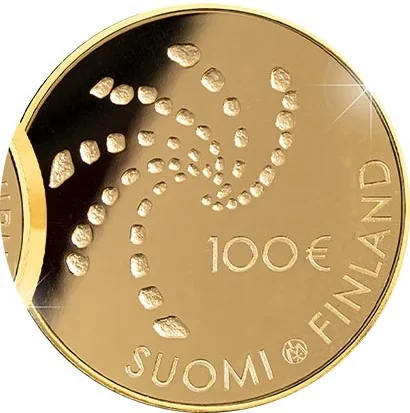
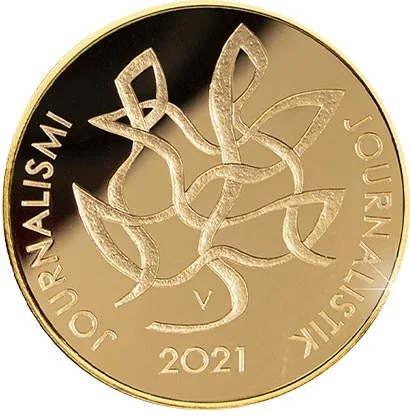
Obverse
Inscription:
JOIRNALISMI JOURNALISTIK
V
2021
V
2021
Translation:
JOURNALISM
V
2021
V
2021
Script: Latin
Designer: Hannu Jasoni Veijalainen
Reverse
Edge
Mints
| Name | Mark |
|---|---|
| Lithuanian Mint | — |
Mintings
| Year | Mint Mark | Mintage | Quality | Collection |
|---|---|---|---|---|
| 2021 | — | 950 | Proof |
Historical background
In 2021, Finland remained a full and integrated member of the Eurozone, using the euro (€) as its sole official currency since 2002. The country's monetary policy was therefore set by the European Central Bank (ECB), which continued its expansive measures to support the euro area economy through the ongoing COVID-19 pandemic. Key policies included a historically low main refinancing rate of 0% and the continued implementation of the Pandemic Emergency Purchase Programme (PEPP), which aimed to ensure favourable financing conditions and stabilize inflation.
Domestically, the Finnish economy showed resilience but faced challenges. After a contraction in 2020, a recovery was underway in 2021, though it was uneven across sectors. Inflation began to rise moderately during the year, primarily driven by increasing energy costs and supply chain disruptions, a trend observed across Europe. However, core inflation remained relatively subdued. The Bank of Finland, as part of the Eurosystem, supported the ECB's stance, emphasizing the need for sustained accommodative policy to secure a robust recovery and return inflation to the target of below, but close to, 2%.
Looking forward, a significant national discussion in 2021 centered on the digital euro project, with the Bank of Finland actively participating in the ECB's investigation phase. Domestically, there was little political appetite to revert to a national currency, as the euro was widely seen as providing stability and deeper economic integration with the EU. Thus, Finland's currency situation in 2021 was characterized by its embeddedness in the common European monetary framework, navigating post-pandemic recovery while contributing to the future evolution of digital currency within that system.
Domestically, the Finnish economy showed resilience but faced challenges. After a contraction in 2020, a recovery was underway in 2021, though it was uneven across sectors. Inflation began to rise moderately during the year, primarily driven by increasing energy costs and supply chain disruptions, a trend observed across Europe. However, core inflation remained relatively subdued. The Bank of Finland, as part of the Eurosystem, supported the ECB's stance, emphasizing the need for sustained accommodative policy to secure a robust recovery and return inflation to the target of below, but close to, 2%.
Looking forward, a significant national discussion in 2021 centered on the digital euro project, with the Bank of Finland actively participating in the ECB's investigation phase. Domestically, there was little political appetite to revert to a national currency, as the euro was widely seen as providing stability and deeper economic integration with the EU. Thus, Finland's currency situation in 2021 was characterized by its embeddedness in the common European monetary framework, navigating post-pandemic recovery while contributing to the future evolution of digital currency within that system.
✨ Legendary