


500 Réis (Discovery of India) – Portugal
Circulating commemorative coins
Commemoration: 400th Anniversary of the Discovery of India
Portugal
Context

Material
References
KM: #Click to copy to clipboard538
Numista: #28032
Value
Bullion value: $32.81
Obverse
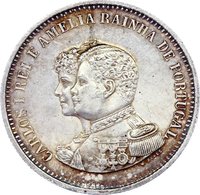
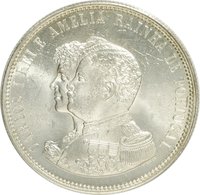
Description:
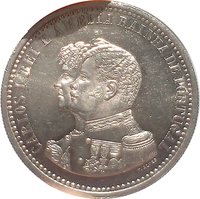
Conjoined left-facing busts.
Inscription:
CARLOS I REI E AMELIA RAINHA DE PORTUGAL
Translation:
CARLOS I KING AND AMELIA QUEEN OF PORTUGAL
Script: Latin
Language: Portuguese
Engraver: Valancio Alves
Reverse
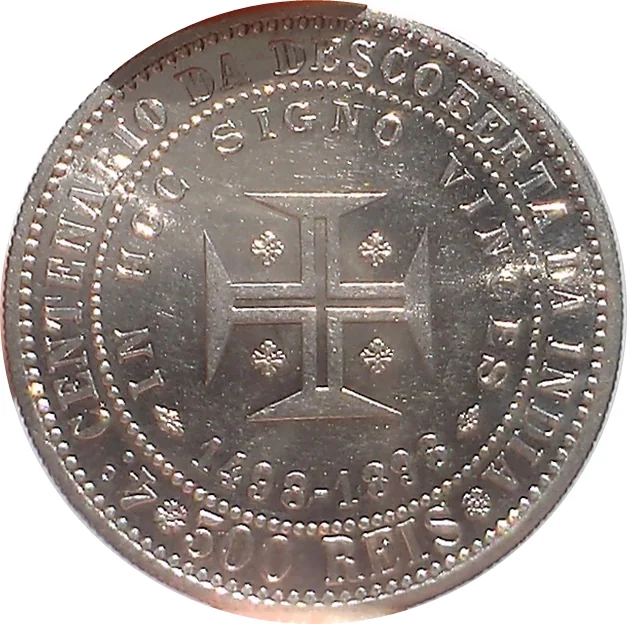
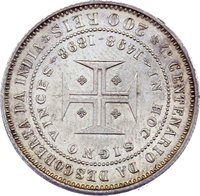
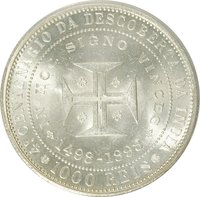
Description:
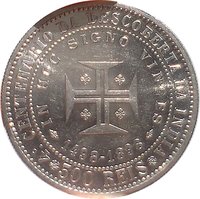
Maltese cross with corner rosettes.
Inscription:
4º. CENTENARIO DA DESCOBERTA DA INDIA
IN HOC SIGNO VINCES
1498-1898
500 REIS
IN HOC SIGNO VINCES
1498-1898
500 REIS
Translation:
Fourth Centenary of the Discovery of India
In This Sign You Will Conquer
1498-1898
500 Reis
In This Sign You Will Conquer
1498-1898
500 Reis
Script: Latin
Edge
Reeded
Mints
| Name | Mark |
|---|---|
| Imprensa Nacional - Casa da Moeda | — |
Mintings
| Year | Mint Mark | Mintage | Quality | Collection |
|---|---|---|---|---|
| 1898 | — | 300,000 | ||
| 1898 | — | — | Proof |
Historical background
By 1898, Portugal’s currency situation was defined by a prolonged period of financial instability and a deeply devalued currency, the real. The root cause was a severe public debt crisis, exacerbated by decades of fiscal mismanagement, costly colonial expeditions in Africa, and a default on external debt in the 1890s. This led to a dramatic loss of confidence, rampant inflation, and a significant fall in the external value of the real, which traded at a substantial discount against gold-backed currencies like the British pound sterling.
The government, under the regenerator Prime Minister José Luciano de Castro, was actively seeking a solution through a complex international loan agreement known as the Funding Loan. Finalized in 1898, this loan was brokered with a consortium of foreign banks and was designed to consolidate Portugal's scattered debts and restore metallic convertibility. The key condition, however, was placing Portugal's finances under effective foreign supervision, administered by a commission known as the Caixa de Conversão (Conversion Office), which would manage the gold reserves backing the currency.
Consequently, 1898 represents a pivotal transitional moment. The country was moving from a chaotic system of paper money and floating exchange rates toward the gold standard, a move intended to stabilize the currency and attract foreign investment. This shift came at a significant cost to national sovereignty, embedding foreign control over monetary policy and symbolizing the profound economic and political vulnerabilities of the Portuguese monarchy in its final decade.
The government, under the regenerator Prime Minister José Luciano de Castro, was actively seeking a solution through a complex international loan agreement known as the Funding Loan. Finalized in 1898, this loan was brokered with a consortium of foreign banks and was designed to consolidate Portugal's scattered debts and restore metallic convertibility. The key condition, however, was placing Portugal's finances under effective foreign supervision, administered by a commission known as the Caixa de Conversão (Conversion Office), which would manage the gold reserves backing the currency.
Consequently, 1898 represents a pivotal transitional moment. The country was moving from a chaotic system of paper money and floating exchange rates toward the gold standard, a move intended to stabilize the currency and attract foreign investment. This shift came at a significant cost to national sovereignty, embedding foreign control over monetary policy and symbolizing the profound economic and political vulnerabilities of the Portuguese monarchy in its final decade.
🌱 Fairly Common