

100 Lei – Romania
Non-circulating coins
Commemoration: Winter Olympics, 1998
Romania
Context

Material

References
KM: #Click to copy to clipboard141
Numista: #28021
Value
Exchange value: 100 ROL
Bullion value: $71.00
Inflation-adjusted value: 1863.57 ROL
Obverse
Description:
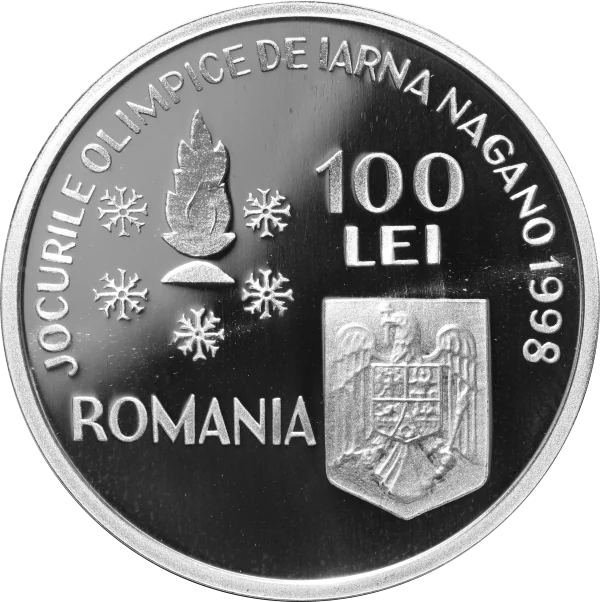
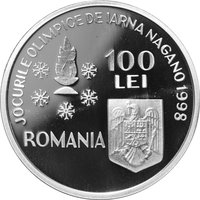
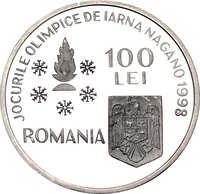
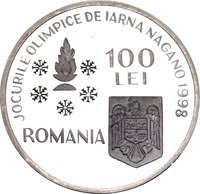
100 LEI, 1996. Features the Olympic flame, five snowflakes, Romania's coat of arms, and the inscription "NAGANO WINTER OLYMPIC GAMES 1998."
Inscription:
JOCURILE OLIMPICE DE IARNA NAGANO 1998
100
LEI
ROMANIA
100
LEI
ROMANIA
Translation:
THE WINTER OLYMPIC GAMES NAGANO 1998
100
LEI
ROMANIA
100
LEI
ROMANIA
Script: Latin
Language: Romanian
Engraver: Stefan Ursachi
Reverse
Description:
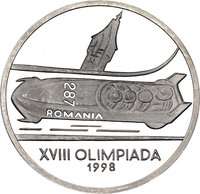
Skating pair in 1998 Olympic gala attire.
Inscription:
XVIII OLIMPIADA 1998
Script: Latin
Engraver: Stefan Ursachi
Edge
Plain
Categories
| Sport> Winter Olympic Games |
Mintings
| Year | Mint Mark | Mintage | Quality | Collection |
|---|---|---|---|---|
| 1998 | — | 13,500 | Proof |
Historical background
In 1998, Romania was navigating a critical and turbulent phase in its post-communist economic transition, characterized by a severe currency and macroeconomic crisis. Following the economic liberalization of the early 1990s, the country had struggled with high inflation, a large budget deficit, and a growing current account deficit. The Romanian leu (ROL) was under intense pressure, having undergone several devaluations and a period of high inflation in the preceding years. Despite a stabilization program initiated in 1997 that included price liberalization and subsidy cuts, the intended shift to a market economy resulted in a deep recession, soaring inflation (reaching 59% in 1997), and a sharp decline in living standards, which eroded confidence in the national currency.
The government's response to the crisis centered on a tight monetary policy enforced by the National Bank of Romania (NBR) and a crawling peg exchange rate regime, introduced in 1997. This system allowed the leu to depreciate at a pre-announced, controlled rate against a basket of foreign currencies, aiming to curb inflation expectations and stabilize the currency after the hyperinflation of the mid-1990s. However, in 1998, this regime was severely tested. External pressures from the 1997-1998 Asian and Russian financial crises, combined with persistent domestic fiscal imbalances and a loss of confidence, led to intense speculative attacks on the leu. The NBR was forced to spend heavily from its foreign exchange reserves to defend the peg, culminating in a significant, one-time devaluation of over 30% in late 1998 and a subsequent shift to a more flexible managed float.
The aftermath of the 1998 currency crisis was a watershed moment, forcing more stringent economic reforms. It underscored the unsustainable nature of loose fiscal policy combined with a rigid exchange rate. The painful adjustments paved the way for a stricter IMF-backed stabilization program, which included tighter fiscal discipline, accelerated privatization, and banking sector reforms. These difficult measures, though socially costly, laid the groundwork for the gradual macroeconomic stabilization that would follow in the early 2000s, eventually leading to inflation control, stronger growth, and the later redenomination of the leu in 2005.
The government's response to the crisis centered on a tight monetary policy enforced by the National Bank of Romania (NBR) and a crawling peg exchange rate regime, introduced in 1997. This system allowed the leu to depreciate at a pre-announced, controlled rate against a basket of foreign currencies, aiming to curb inflation expectations and stabilize the currency after the hyperinflation of the mid-1990s. However, in 1998, this regime was severely tested. External pressures from the 1997-1998 Asian and Russian financial crises, combined with persistent domestic fiscal imbalances and a loss of confidence, led to intense speculative attacks on the leu. The NBR was forced to spend heavily from its foreign exchange reserves to defend the peg, culminating in a significant, one-time devaluation of over 30% in late 1998 and a subsequent shift to a more flexible managed float.
The aftermath of the 1998 currency crisis was a watershed moment, forcing more stringent economic reforms. It underscored the unsustainable nature of loose fiscal policy combined with a rigid exchange rate. The painful adjustments paved the way for a stricter IMF-backed stabilization program, which included tighter fiscal discipline, accelerated privatization, and banking sector reforms. These difficult measures, though socially costly, laid the groundwork for the gradual macroeconomic stabilization that would follow in the early 2000s, eventually leading to inflation control, stronger growth, and the later redenomination of the leu in 2005.

💎 Very Rare