

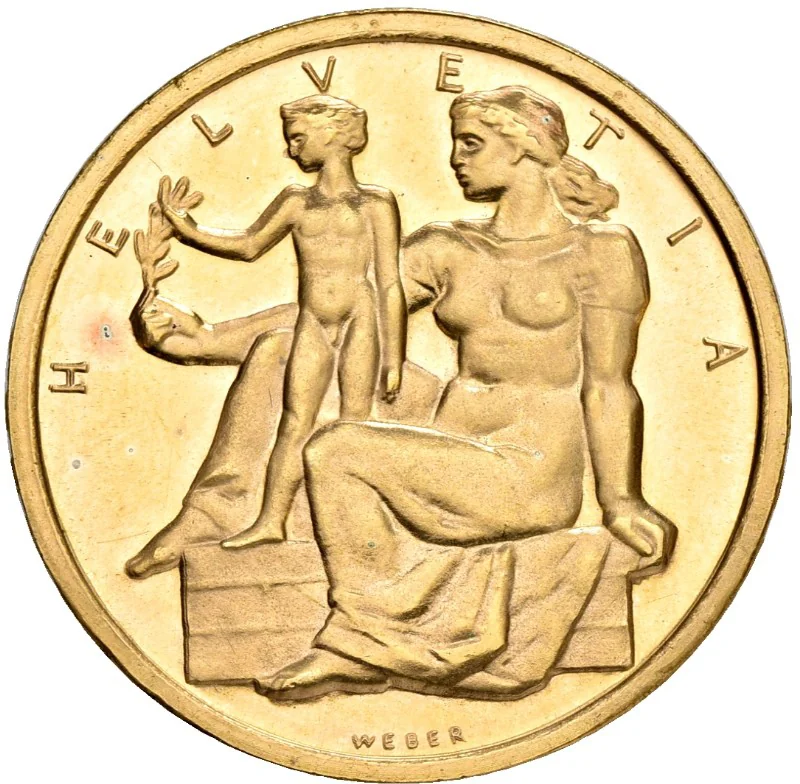
5 Francs (Constitution) – Switzerland
Non-circulating coins
Commemoration: 100th Anniversary of the Constitution
Switzerland
Context
Year: 1948
Issuer: Switzerland 
Period:
(since 1848)
Currency:
(since 1850)
Demonetization: 1 April 1971
Total mintage: 15
Material
References
KM: #Click to copy to clipboard–
Numista: #278576
Value
Exchange value: 5 CHF = $6.46
Bullion value: $4378.43
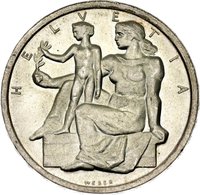
Obverse
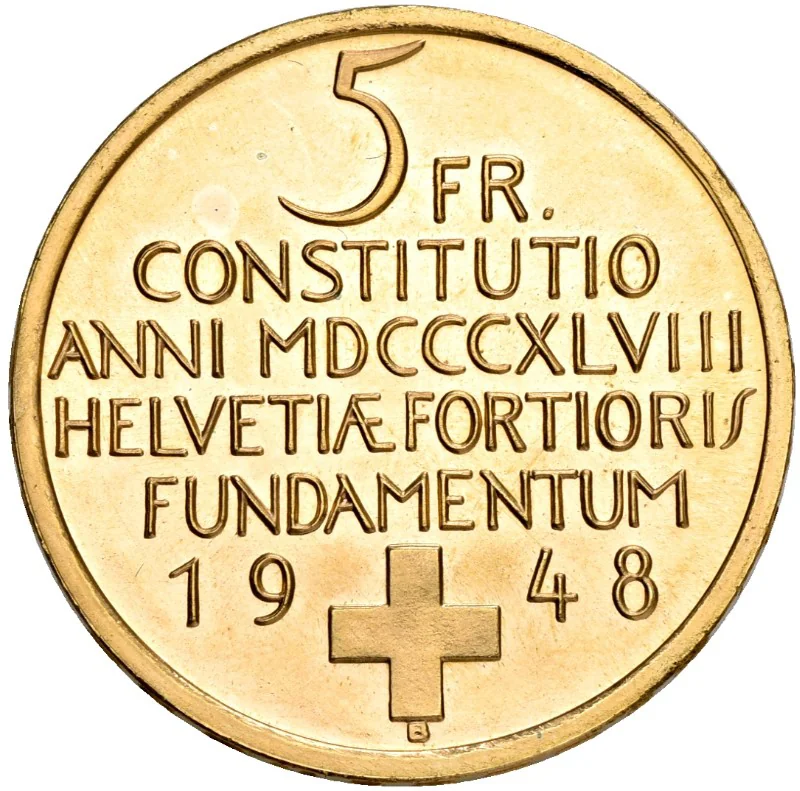
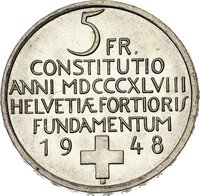
Reverse
Description:
Six-line inscription. Swiss cross beneath.
Inscription:
5 FR.
CONSTITUTIO
ANNI MDCCCXLVIII
HELVETIÆ FORTIORIS
FUNDAMENTUM
1948
B
CONSTITUTIO
ANNI MDCCCXLVIII
HELVETIÆ FORTIORIS
FUNDAMENTUM
1948
B
Translation:
5 FR.
CONSTITUTION
OF THE YEAR 1848
FOUNDATION OF A STRONGER SWITZERLAND
1948
B
CONSTITUTION
OF THE YEAR 1848
FOUNDATION OF A STRONGER SWITZERLAND
1948
B
Script: Latin
Designer: August Blaesi
Edge
Lettering:★★★ DOMINUS PROVIDEBIT ★★★★★★★★★★
Legend:
★★★ DOMINUS PROVIDEBIT ★★★★★★★★★★
Translation:
The Lord will provide.
Language: Latin
Mints
| Name | Mark |
|---|---|
| Bern | B |
Mintings
| Year | Mint Mark | Mintage | Quality | Collection |
|---|---|---|---|---|
| 1948 | B | 15 |
Historical background
In 1948, Switzerland's currency situation was defined by remarkable stability amidst a continent still grappling with post-war monetary chaos. Unlike most European nations, Switzerland had avoided physical destruction and maintained its political and economic independence. The Swiss franc was a coveted "hard currency," backed by substantial gold reserves, a conservative banking tradition, and a robust, diversified economy. This strength was institutionalized by the Swiss National Bank's (SNB) commitment to price stability and the legal requirement that at least 40% of the currency in circulation be backed by gold.
This stability created a significant dichotomy with the rest of Europe. Many European currencies, weakened by reconstruction costs and inflationary financing, were subject to strict exchange controls and were not freely convertible. The Swiss franc, in contrast, was fully convertible and trusted internationally. This led to strong demand for francs, putting upward pressure on its value. The SNB therefore actively intervened in foreign exchange markets to prevent excessive appreciation, which would have harmed Swiss exporters, by purchasing foreign currencies and expanding its reserves.
Consequently, Switzerland faced the unique post-war challenge of managing strength rather than weakness. The primary focus of monetary authorities was to sterilize the inflationary potential of large foreign currency inflows and maintain the franc's gold parity, which was central to its identity. This prudent management in 1948 solidified the franc's role as a global safe-haven asset, a status it retains today, and provided a stable foundation for the country's rapid economic expansion in the ensuing decades.
This stability created a significant dichotomy with the rest of Europe. Many European currencies, weakened by reconstruction costs and inflationary financing, were subject to strict exchange controls and were not freely convertible. The Swiss franc, in contrast, was fully convertible and trusted internationally. This led to strong demand for francs, putting upward pressure on its value. The SNB therefore actively intervened in foreign exchange markets to prevent excessive appreciation, which would have harmed Swiss exporters, by purchasing foreign currencies and expanding its reserves.
Consequently, Switzerland faced the unique post-war challenge of managing strength rather than weakness. The primary focus of monetary authorities was to sterilize the inflationary potential of large foreign currency inflows and maintain the franc's gold parity, which was central to its identity. This prudent management in 1948 solidified the franc's role as a global safe-haven asset, a status it retains today, and provided a stable foundation for the country's rapid economic expansion in the ensuing decades.
✨ Legendary