

5 Pounds (Queen Elizabeth II) – United Kingdom
Non-circulating coins
Commemoration: 70th anniversary of the birth of Queen Elizabeth II
United Kingdom
Context
Year: 1996
Issuer: United Kingdom 
Ruler: Elizabeth II
Currency:
(since 1971)
Total mintage: 2,536,992
Material
Diameter: 38.61 mm
Weight: 28.28 g
Thickness: 2.89 mm
Shape: Round
Composition: Copper-nickel
Technique: Milled
Alignment: Medal alignment
flip
References
KM: #Click to copy to clipboard974
Numista: #13392
Value
Exchange value: 5 GBP = $6.77
Inflation-adjusted value: 12.28 GBP
Obverse
Description:
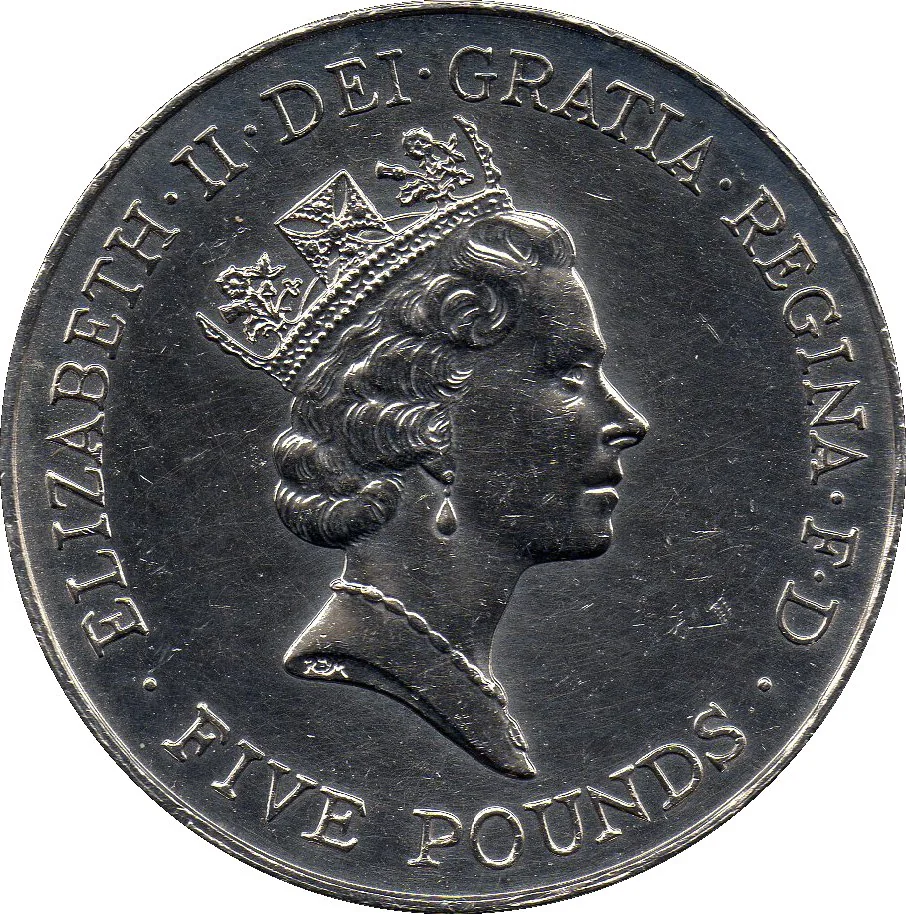
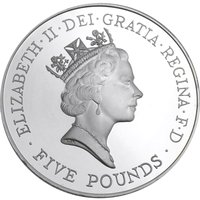
Third crowned portrait of Queen Elizabeth II facing right, wearing the George IV State Diadem.
Inscription:
ELIZABETH·II·DEI·GRATIA·REGINA·F·D
RDM
· FIVE POUNDS ·
RDM
· FIVE POUNDS ·
Translation:
Elizabeth the Second, by the Grace of God, Queen, Defender of the Faith.
Five Pounds.
Five Pounds.
Script: Latin
Language: Latin
Engraver: Raphael David Maklouf
Reverse
Description:
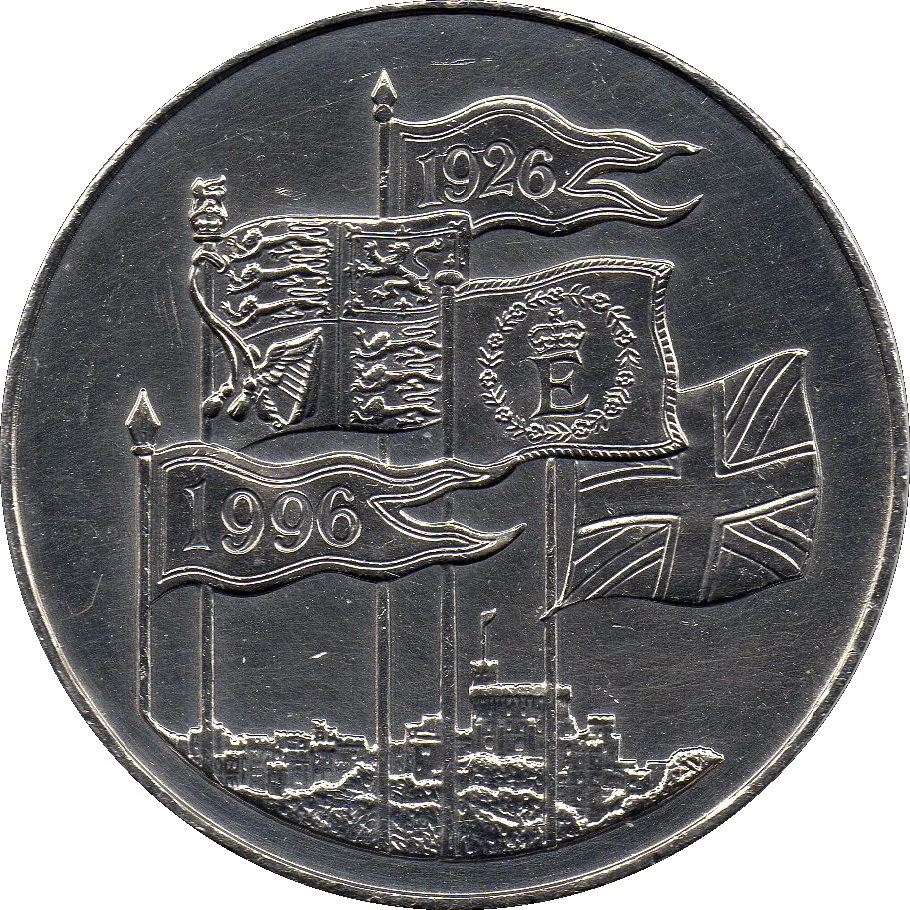
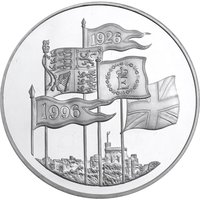
Windsor Castle flying the Royal Standard, Union Flag, and Queen's personal flag, with two anniversary pennants.
Inscription:
1926
1996
1996
Script: Latin
Engraver: Avril Vaughan
Edge
Plain with incuse lettering
Legend:
+ VIVAT REGINA ELIZABETHA +
Translation:
Long live Queen Elizabeth.
Language: Latin
Categories
| Building> Castle or fortification |
| Event> Birth anniversary |
Mints
| Name | Mark |
|---|---|
| Royal Mint | — |
Mintings
| Year | Mint Mark | Mintage | Quality | Collection |
|---|---|---|---|---|
| 1996 | — | 2,396,100 | ||
| 1996 | — | 73,311 | BU | |
| 1996 | — | 67,581 | Proof |
Historical background
In 1996, the United Kingdom's currency situation was defined by its position outside the European single currency and the lingering effects of the 1992 Exchange Rate Mechanism (ERM) crisis. The pound sterling was floating freely, with its value determined by market forces rather than being pegged to other currencies. This followed the traumatic exit from the European ERM on "Black Wednesday" in September 1992, when speculative attacks forced the government to withdraw and devalue the pound, a event that severely damaged the Conservative government's reputation for economic competence but ultimately provided a foundation for economic recovery through lower interest rates.
The political context was dominated by the approaching question of European Monetary Union (EMU). The ruling Conservative Party, led by Prime Minister John Major, was deeply divided on Europe, making the adoption of the future euro a highly contentious issue. Chancellor Kenneth Clarke, while personally more pro-European, adhered to the government's official "wait and see" policy, stating that the decision to join would be based on a clear assessment of the national economic interest when the time came. The Labour opposition, positioning itself for the 1997 election, sought to project economic stability by promising a referendum on the single currency and supporting the government's cautious stance, thereby neutralizing Europe as a major campaign issue.
Economically, the pound was relatively strong in 1996, buoyed by rising interest rates to curb inflation and a growing economy. This strength, however, began to concern exporters and manufacturers, who warned that an overvalued currency was hurting international competitiveness. The Bank of England, operating without the independence it would gain in 1997, managed monetary policy under the direction of the Treasury. The overall financial landscape was one of cautious stability, with the government carefully managing the legacy of the ERM disaster while navigating intense political pressure regarding the nation's future relationship with the continent's monetary project.
The political context was dominated by the approaching question of European Monetary Union (EMU). The ruling Conservative Party, led by Prime Minister John Major, was deeply divided on Europe, making the adoption of the future euro a highly contentious issue. Chancellor Kenneth Clarke, while personally more pro-European, adhered to the government's official "wait and see" policy, stating that the decision to join would be based on a clear assessment of the national economic interest when the time came. The Labour opposition, positioning itself for the 1997 election, sought to project economic stability by promising a referendum on the single currency and supporting the government's cautious stance, thereby neutralizing Europe as a major campaign issue.
Economically, the pound was relatively strong in 1996, buoyed by rising interest rates to curb inflation and a growing economy. This strength, however, began to concern exporters and manufacturers, who warned that an overvalued currency was hurting international competitiveness. The Bank of England, operating without the independence it would gain in 1997, managed monetary policy under the direction of the Treasury. The overall financial landscape was one of cautious stability, with the government carefully managing the legacy of the ERM disaster while navigating intense political pressure regarding the nation's future relationship with the continent's monetary project.
🌱 Common