

10 Bani – Romania
Romania
Context
Year: 1954
Issuer: Romania 
Period: 
(1947—1965)
Currency:
(1952—2005)
Demonetization: 31 December 1996
Total mintage: 1,600,000
Material
Diameter: 17.5 mm
Weight: 1.8 g
Thickness: 1.1 mm
Shape: Round
Composition: Copper-nickel
Technique: Milled
Alignment: Coin alignment

flip
References
KM: #Click to copy to clipboard84.2
Numista: #133861
Value
Exchange value: 0.10 ROL
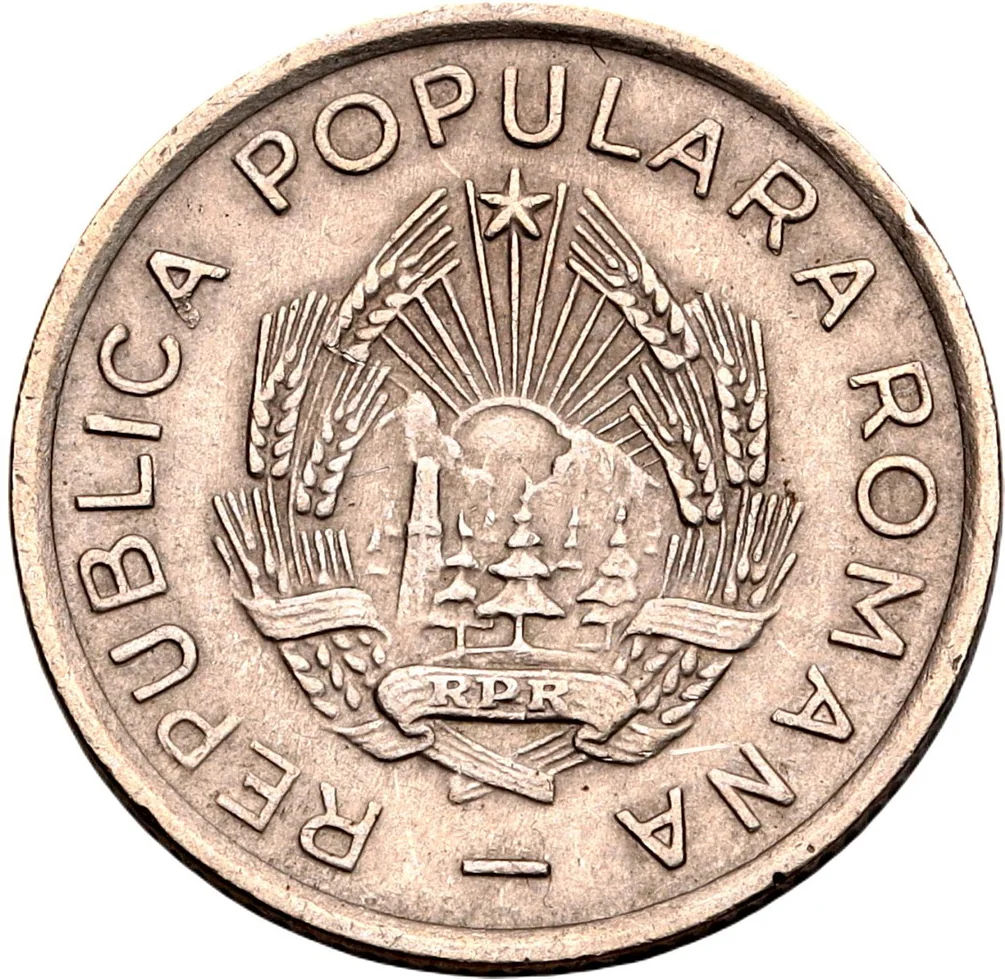
Obverse
Description:
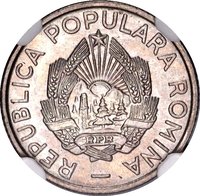
State emblem with star (KM#84.2, 84.3) or without (KM#84.1). Country name uses old spelling "ROMANA" (KM#84.1, 84.2) or new "ROMÎNA" (KM#84.3).
Inscription:
REPUBLICA POPULARA ROMANA
RPR
RPR
Translation:
ROMANIAN PEOPLE'S REPUBLIC
RPR
RPR
Script: Latin
Language: Romanian
Engraver: Haralambie Ionescu
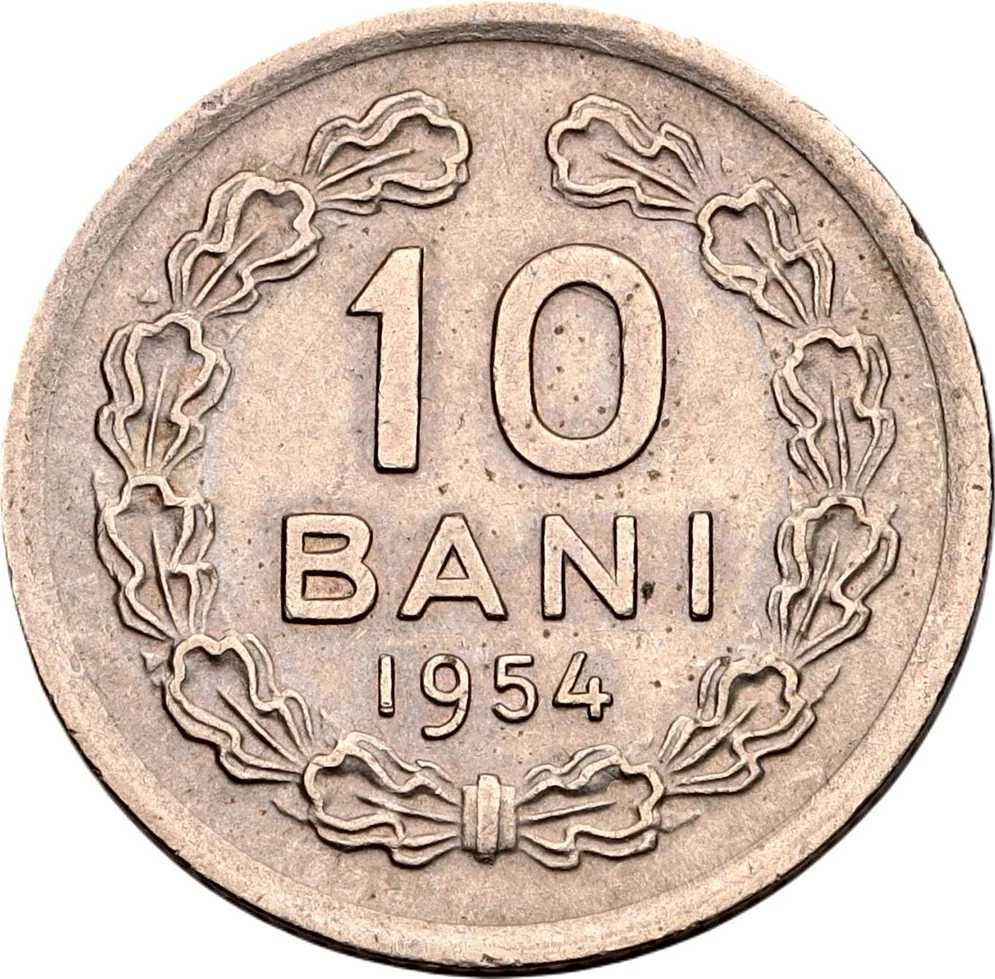
Reverse
Description:
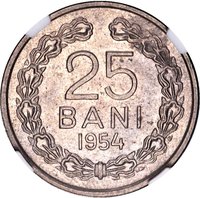
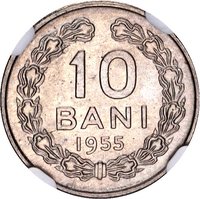
Oak wreath encircles date and denomination.
Inscription:
10
BANI
1954
BANI
1954
Script: Latin
Engraver: Haralambie Ionescu
Edge
Reeded
Mints
| Name | Mark |
|---|---|
| State Mint | — |
Mintings
| Year | Mint Mark | Mintage | Quality | Collection |
|---|---|---|---|---|
| 1954 | — | 1,600,000 |
Historical background
In 1954, Romania's currency situation was defined by its integration into the Soviet-style command economy and the aftermath of a drastic 1947 monetary reform. The official currency was the leu, but it existed in a complex, multi-tiered system typical of centrally planned states. The economy operated with non-convertible "bank money" for accounting between state enterprises, while the population used cash for limited daily transactions. A significant black market for foreign currency and goods persisted, where the leu's real value was far lower than its artificial official exchange rate, set at approximately 6 lei to 1 US Dollar—a rate that bore no relation to purchasing power or international market forces.
This period fell within the early stages of Gheorghiu-Dej's leadership, focused on heavy industrialization and the collectivization of agriculture. Monetary policy was entirely subservient to the state plan, with the primary goal of funding industrialization and controlling inflation through administrative measures rather than market tools. The National Bank acted as a passive financier for state projects, not an independent central bank. Price controls on essential goods created an illusion of stability, but they masked widespread shortages and suppressed inflationary pressures, which manifested in long queues and a scarcity of quality consumer goods.
Consequently, the average Romanian citizen experienced a disconnect between wages and the availability of goods. Savings in lei had limited utility due to the sparse selection in state shops, incentivizing the use of foreign currency (especially the US dollar) or barter for accessing higher-quality or restricted items. The year 1954 itself did not see a major monetary event, but it represented a point of entrenched stability within this repressive financial system. The currency situation would remain largely frozen in this controlled, inefficient state until the later decades of the communist regime, when foreign debt accumulation would introduce new pressures.
This period fell within the early stages of Gheorghiu-Dej's leadership, focused on heavy industrialization and the collectivization of agriculture. Monetary policy was entirely subservient to the state plan, with the primary goal of funding industrialization and controlling inflation through administrative measures rather than market tools. The National Bank acted as a passive financier for state projects, not an independent central bank. Price controls on essential goods created an illusion of stability, but they masked widespread shortages and suppressed inflationary pressures, which manifested in long queues and a scarcity of quality consumer goods.
Consequently, the average Romanian citizen experienced a disconnect between wages and the availability of goods. Savings in lei had limited utility due to the sparse selection in state shops, incentivizing the use of foreign currency (especially the US dollar) or barter for accessing higher-quality or restricted items. The year 1954 itself did not see a major monetary event, but it represented a point of entrenched stability within this repressive financial system. The currency situation would remain largely frozen in this controlled, inefficient state until the later decades of the communist regime, when foreign debt accumulation would introduce new pressures.
🌱 Common