

10 euro – Estonia
Add to wishlist
Non-circulating coins
Commemoration: XXXI Olympic Games in Rio de Janeiro
Estonia
Context
Material
References
KM: #
Numista: #102089
Value
Exchange value: 10 EUR
Bullion value: $66.84
Inflation-adjusted value: 15.66 EUR
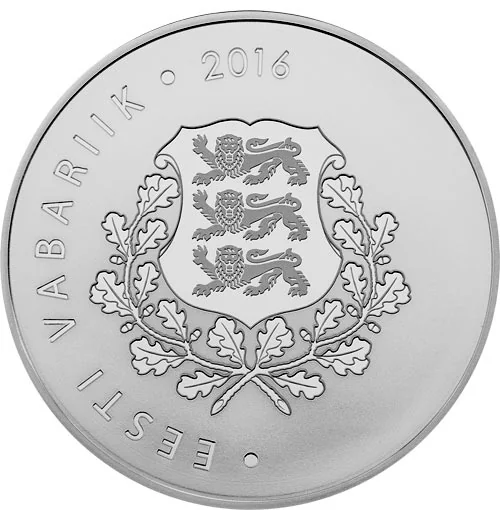
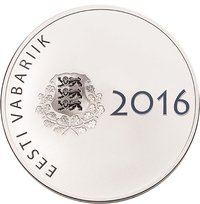
Obverse
Description:
National coat of arms.
Inscription:
· EESTI VABARIIK · 2016
Translation:
REPUBLIC OF ESTONIA · 2016
Script: Latin
Language: Estonian
Engraver: Martin Pärn
Reverse
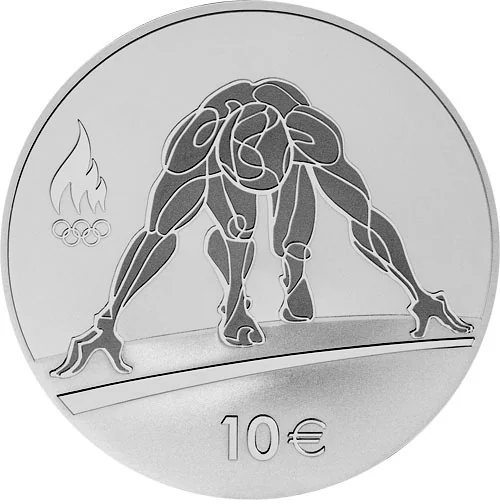
Description:
Sprinter poised at the start, Olympic emblem beside.
Inscription:
10 €
Script: Latin
Engraver: Martin Pärn
Edge
Categories
| Symbols> Coat of Arms |
| Sport> Summer Olympic Games |
Mints
| Name | Mark |
|---|---|
| Lithuanian Mint | — |
Mintings
| Year | Mint Mark | Mintage | Quality | Collection |
|---|---|---|---|---|
| 2016 | — | 5,000 | Proof |
Historical background
In 2016, Estonia was a stable member of the Eurozone, having adopted the euro as its official currency on 1 January 2011. This move replaced the Estonian kroon, which had been pegged to the euro (and previously the Deutsche Mark) since its reintroduction in 1992, a cornerstone of the country's economic policy. By 2016, the transition was complete, with the euro deeply embedded in everyday financial transactions, public finances, and Estonia's export-driven economy. The country continued to benefit from the credibility and low interest rates associated with the common currency, which supported investment and economic convergence with core Eurozone nations.
The primary domestic economic context in 2016 was one of strong growth, with GDP increasing by 2.1% despite a slowdown in key export markets. However, a significant background concern was rising inflation, largely imported due to the European Central Bank's expansive monetary policy. For Estonia, this meant the ECB's low interest rates, appropriate for struggling southern Eurozone economies, were potentially stoking local price and wage pressures, a typical tension within the currency union. Domestically, there was little political debate about leaving the euro, as it was widely seen as a strategic guarantee of economic stability and political alignment with Western Europe.
Internationally, Estonia's currency situation was viewed through the lens of its role as a model Eurozone member. It maintained a balanced state budget and one of the lowest public debt levels in the EU (around 9.4% of GDP in 2016), strictly adhering to the Maastricht criteria. This fiscal discipline stood in contrast to the broader challenges facing the Eurozone, such as the Greek debt crisis and Brexit referendum in June 2016, which created market uncertainty. For Estonia, the euro provided a shield against external volatility, reinforcing its economic resilience and its identity as a fully integrated core member of the European project.
The primary domestic economic context in 2016 was one of strong growth, with GDP increasing by 2.1% despite a slowdown in key export markets. However, a significant background concern was rising inflation, largely imported due to the European Central Bank's expansive monetary policy. For Estonia, this meant the ECB's low interest rates, appropriate for struggling southern Eurozone economies, were potentially stoking local price and wage pressures, a typical tension within the currency union. Domestically, there was little political debate about leaving the euro, as it was widely seen as a strategic guarantee of economic stability and political alignment with Western Europe.
Internationally, Estonia's currency situation was viewed through the lens of its role as a model Eurozone member. It maintained a balanced state budget and one of the lowest public debt levels in the EU (around 9.4% of GDP in 2016), strictly adhering to the Maastricht criteria. This fiscal discipline stood in contrast to the broader challenges facing the Eurozone, such as the Greek debt crisis and Brexit referendum in June 2016, which created market uncertainty. For Estonia, the euro provided a shield against external volatility, reinforcing its economic resilience and its identity as a fully integrated core member of the European project.
💎 Very Rare