

50 Cash – Honan Province
China
Context
Year: 1921
Country: China 
Issuer: Honan Province
Period:
(1912—1949)
Currency:
(1905—1949)
Demonetized: Yes
Material
References
Y: #Click to copy to clipboard394a
Numista: #276083
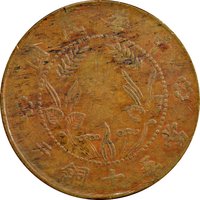
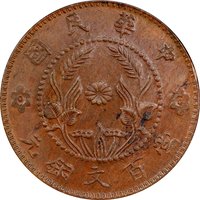
Obverse
Description:
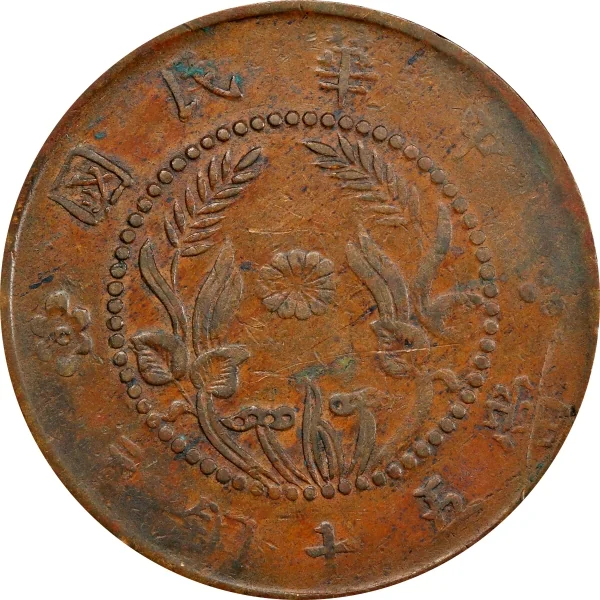
Wreath with central and side flowers, each flanked by Chinese ideograms.
Inscription:
國民華中
元銅十五當
元銅十五當
Translation:
Nationalist China
Fifteen Copper Cents Equal One Yuan
Fifteen Copper Cents Equal One Yuan
Language: Chinese
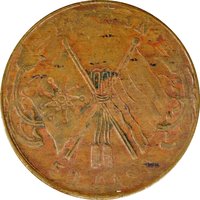
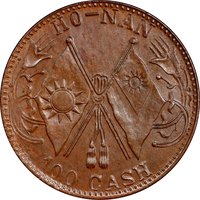
Reverse
Description:
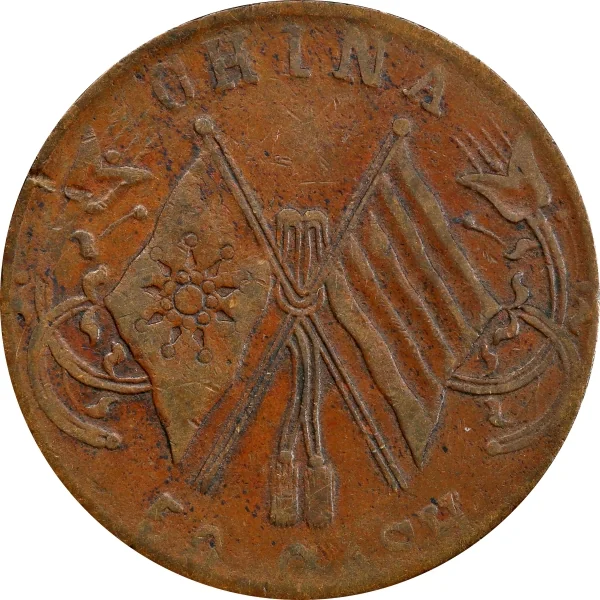
Crossed flags flanked by flowers, with English text above and below.
Inscription:
CHINA
50 CASH
50 CASH
Edge
Plain
Mintings
| Year | Mint Mark | Mintage | Quality | Collection |
|---|---|---|---|---|
| 1921 | — | — |
Historical background
In 1921, Honan Province was engulfed in a severe and multifaceted currency crisis, symptomatic of the wider financial disintegration of the Warlord Era. The national currency system had collapsed, leading to a chaotic proliferation of unbacked paper money. In Honan, this took the form of vast quantities of Honan Provincial Bank notes and military scrip forcibly issued by the local warlord, Chao Ti'en, to fund his army and administration. These notes were not convertible to silver and were printed with little regard for fiscal responsibility, leading to rapid and catastrophic depreciation.
The consequences for the populace were devastating. Hyperinflation eroded savings and made market transactions perilous, as the value of paper money could halve in a matter of weeks. Farmers, in particular, were caught in a brutal trap: they sold their harvests for depreciating paper, only to need that currency to pay land taxes which warlord authorities often demanded at artificially high rates pegged to the old silver standard. This effectively amounted to confiscatory taxation, deepening widespread rural poverty.
Compounding the man-made disaster were natural calamities. In 1920-1921, Honan was struck by a severe drought followed by a locust plague, leading to crop failure and famine. The currency chaos crippled relief efforts and market responses, as the devalued paper money could not effectively purchase grain from other regions. Thus, the monetary anarchy directly exacerbated the famine, creating a vicious cycle where financial collapse, warlord exactions, and ecological disaster merged into a single humanitarian catastrophe for the people of Honan.
The consequences for the populace were devastating. Hyperinflation eroded savings and made market transactions perilous, as the value of paper money could halve in a matter of weeks. Farmers, in particular, were caught in a brutal trap: they sold their harvests for depreciating paper, only to need that currency to pay land taxes which warlord authorities often demanded at artificially high rates pegged to the old silver standard. This effectively amounted to confiscatory taxation, deepening widespread rural poverty.
Compounding the man-made disaster were natural calamities. In 1920-1921, Honan was struck by a severe drought followed by a locust plague, leading to crop failure and famine. The currency chaos crippled relief efforts and market responses, as the devalued paper money could not effectively purchase grain from other regions. Thus, the monetary anarchy directly exacerbated the famine, creating a vicious cycle where financial collapse, warlord exactions, and ecological disaster merged into a single humanitarian catastrophe for the people of Honan.
💎 Extremely Rare