

50 Pence – United Kingdom
Non-circulating coins
Commemoration: Entry into the European Economic Community
United Kingdom
Context
Year: 1973
Issuer: United Kingdom 
Ruler: Elizabeth II
Currency:
(since 1971)
Demonetization: 28 February 1998
Material
Diameter: 30 mm
Weight: 27 g
Silver weight: 24.98 g
Shape: Equilateral curve heptagon
Composition: 92.5% Silver
Magnetic: No
Technique: Milled
Alignment: Medal alignment
flip
References
KM: #Click to copy to clipboardP1
Numista: #275853
Value
Exchange value: 0.50 GBP = $0.68
Bullion value: $72.23
Inflation-adjusted value: 8.43 GBP
Obverse
Description:
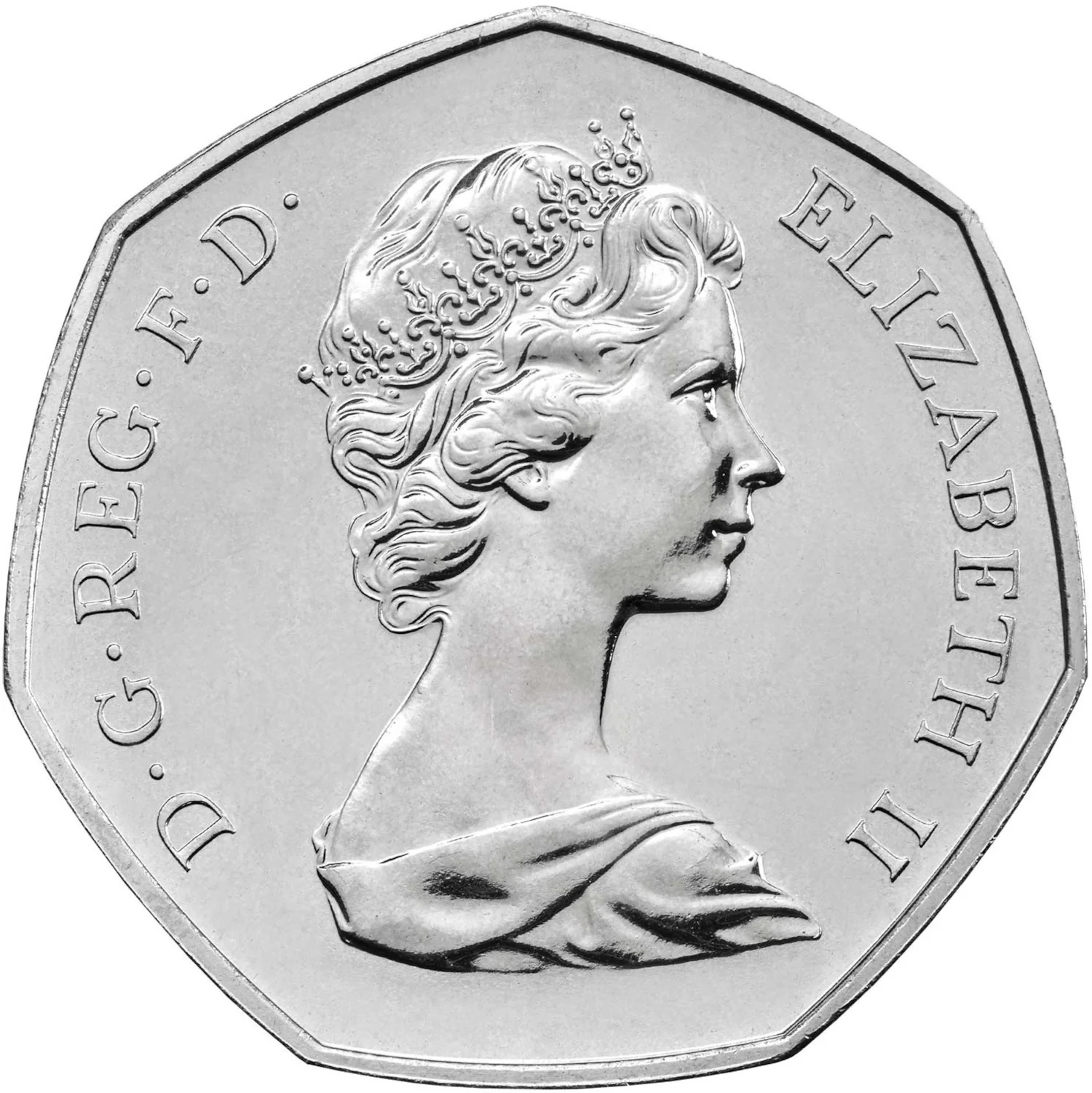
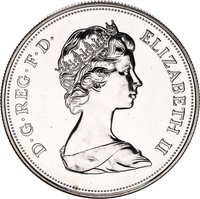
Queen Elizabeth II facing right, wearing the Girls of Great Britain and Ireland tiara.
Inscription:
ELIZABETH II D∙G∙REG∙F∙D∙
Translation:
Elizabeth II, by the Grace of God, Queen, Defender of the Faith.
Script: Latin
Language: Latin
Engraver: Arnold Machin
Reverse
Description:
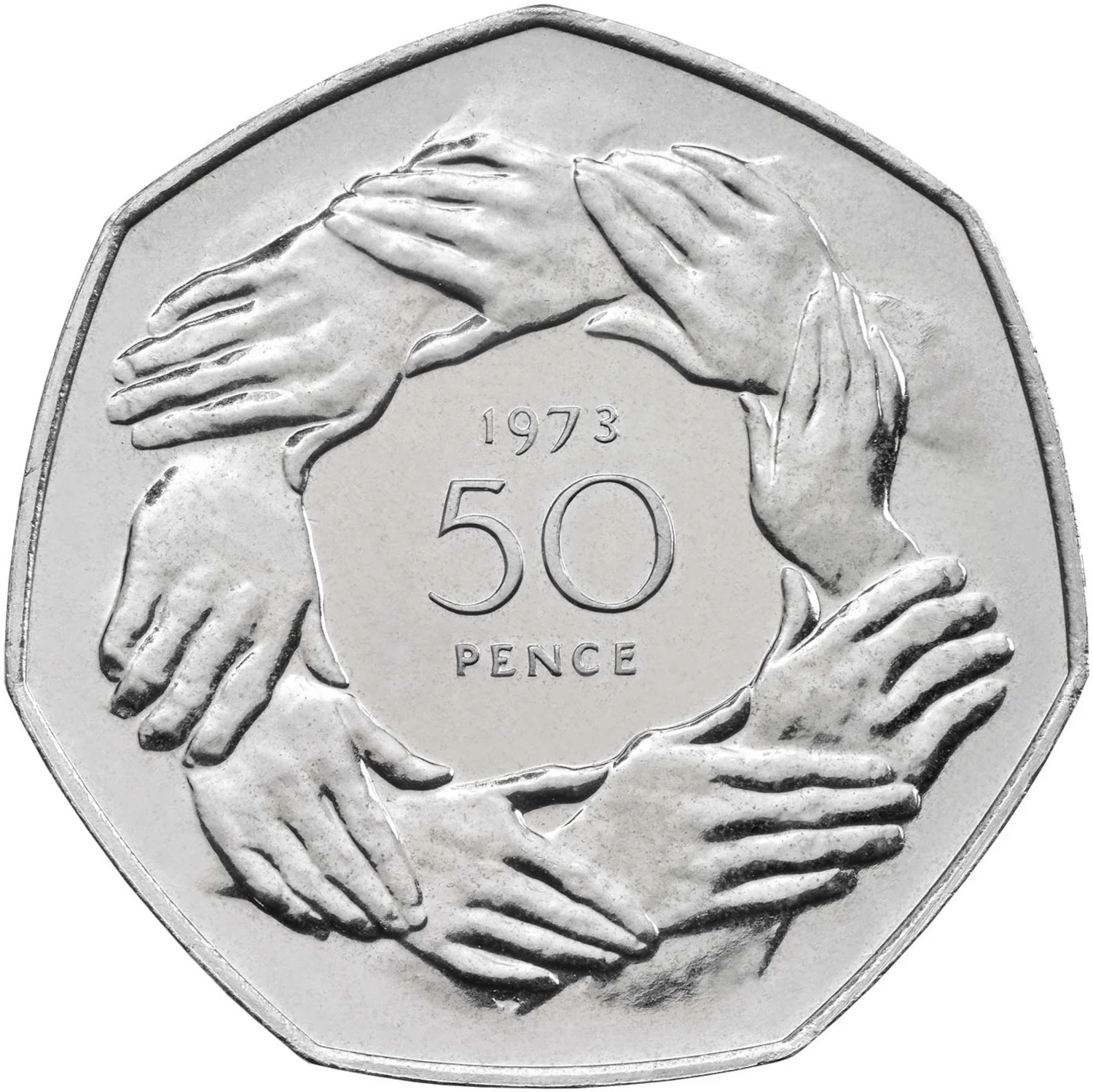
Nine hands clasping in trust, assistance, and friendship, symbolising the EEC's nine members.
Inscription:
1973
50
PENCE
50
PENCE
Script: Latin
Engraver: David Wynne
Edge
Plain
Mints
| Name | Mark |
|---|---|
| Royal Mint | — |
Mintings
| Year | Mint Mark | Mintage | Quality | Collection |
|---|---|---|---|---|
| 1973 | — | — | Proof |
Historical background
In 1973, the United Kingdom's currency situation was defined by its entry into the European Economic Community (EEC) and its participation in a major international monetary agreement. Domestically, the pound sterling was under significant pressure, grappling with high inflation, industrial unrest, and the economic legacy of the 1972 "Barber Boom"—a period of rapid expansion that had exacerbated inflationary pressures. This turbulent domestic backdrop set the stage for a pivotal year in international currency relations.
Internationally, 1973 marked the UK's first full year within the European "snake in the tunnel," a mechanism designed to limit exchange rate fluctuations between EEC currencies. However, the pound's inherent weakness, driven by Britain's economic difficulties and a global loss of confidence in the US dollar, made this commitment unsustainable. After just six weeks of tumultuous participation, the UK was forced to withdraw from the snake in June 1973, allowing the pound to float independently—a stark symbol of its struggle to align with European monetary stability.
The year culminated with the effective end of the Bretton Woods system of fixed exchange rates, as major economies, including the UK, moved to floating rates. This shift, following the 1971 Nixon Shock, was cemented by the 1973 oil crisis. The quadrupling of oil prices in October severely worsened the UK's trade deficit and inflation, further battering the pound's value. Thus, 1973 was a transitional and challenging period where the pound navigated the collapse of the old global monetary order, failed integration into a European alternative, and was buffeted by profound domestic and external economic shocks.
Internationally, 1973 marked the UK's first full year within the European "snake in the tunnel," a mechanism designed to limit exchange rate fluctuations between EEC currencies. However, the pound's inherent weakness, driven by Britain's economic difficulties and a global loss of confidence in the US dollar, made this commitment unsustainable. After just six weeks of tumultuous participation, the UK was forced to withdraw from the snake in June 1973, allowing the pound to float independently—a stark symbol of its struggle to align with European monetary stability.
The year culminated with the effective end of the Bretton Woods system of fixed exchange rates, as major economies, including the UK, moved to floating rates. This shift, following the 1971 Nixon Shock, was cemented by the 1973 oil crisis. The quadrupling of oil prices in October severely worsened the UK's trade deficit and inflation, further battering the pound's value. Thus, 1973 was a transitional and challenging period where the pound navigated the collapse of the old global monetary order, failed integration into a European alternative, and was buffeted by profound domestic and external economic shocks.
⭐ Rare