

Obverse
Description:
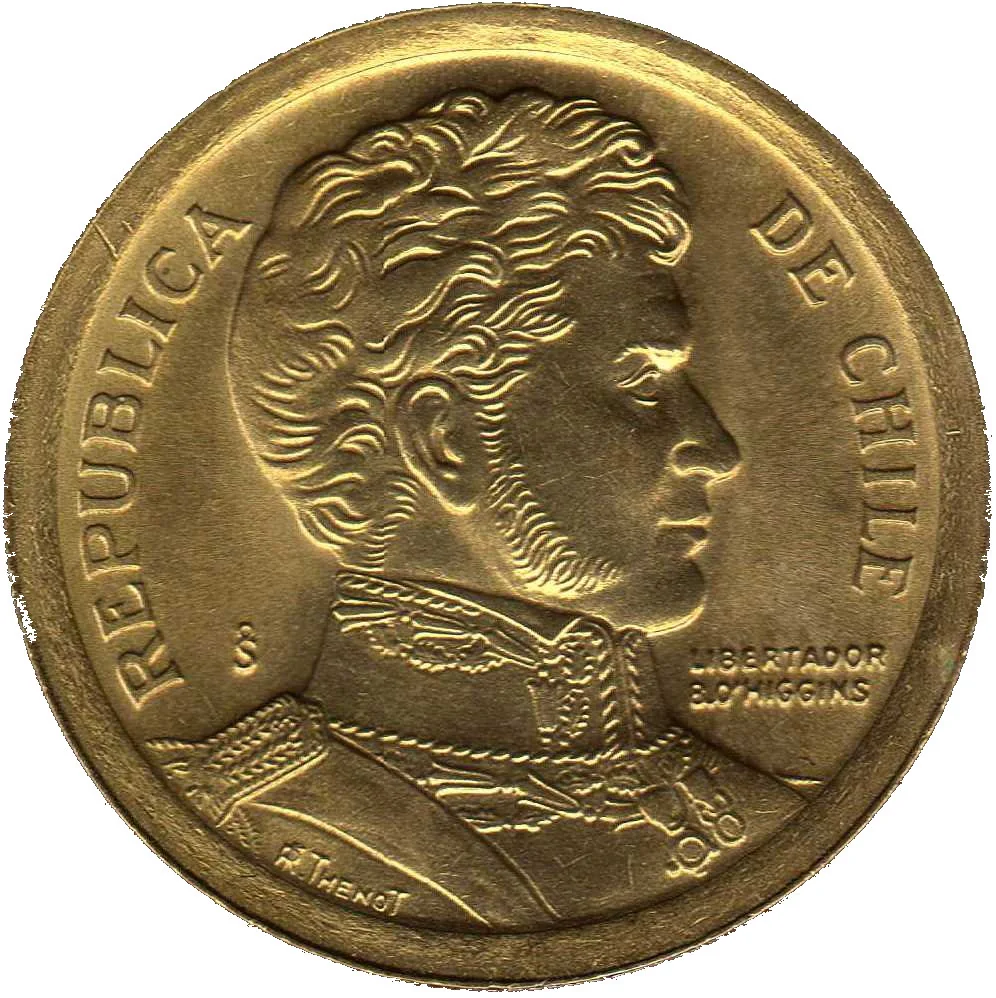
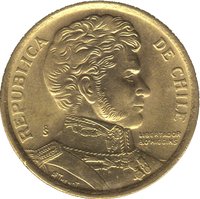
Bernardo O'Higgins facing right, mintmark left.
Inscription:
REPUBLICA DE CHILE
So
LIBERTADOR
B O'HIGGINS
FR.THENOT
So
LIBERTADOR
B O'HIGGINS
FR.THENOT
Translation:
REPUBLIC OF CHILE
So
LIBERATOR
B O'HIGGINS
FR.THENOT
So
LIBERATOR
B O'HIGGINS
FR.THENOT
Script: Latin
Engraver: Francois Maurice Thénot
Reverse
Edge
Categories
| Person> Politician |
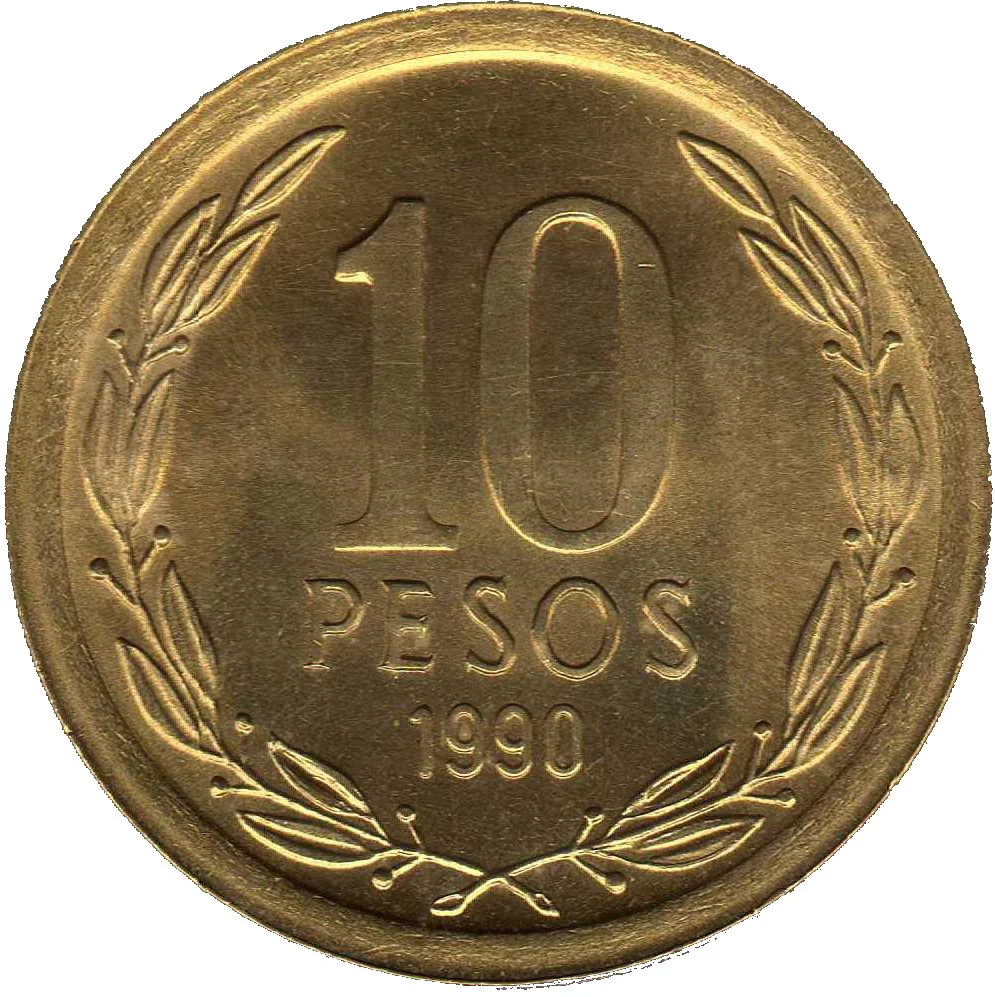
| Symbol> Wreath |
Mints
| Name | Mark |
|---|---|
| Royal Dutch Mint | — |
| Royal Canadian Mint of Winnipeg | L |
| Casa de Moneda de Chile | (So) |
Mintings
| Year | Mint Mark | Mintage | Quality | Collection |
|---|---|---|---|---|
| 1990 | So | 5,000,000 | ||
| 1991 | So | 25,000,000 | ||
| 1992 | So | 44,000,000 | ||
| 1993 | So | 98,000,000 | ||
| 1994 | So | 66,500,000 | ||
| 1995 | So | 94,000,000 | ||
| 1996 | So | 113,500,000 | ||
| 1997 | So | 150,700,000 | ||
| 1998 | So | 83,600,000 | ||
| 1999 | So | 106,700,000 | ||
| 2000 | So | 123,600,000 | ||
| 2002 | So | 32,000,000 | ||
| 2003 | So | 84,000,000 | ||
| 2004 | So | 88,000,000 | ||
| 2005 | So | 80,000,000 | ||
| 2006 | So | 147,000,000 | ||
| 2007 | L | 255,000,000 | ||
| 2008 | So | 157,000,000 | ||
| 2009 | So | 250,200,000 | ||
| 2010 | So | 375,500,000 | ||
| 2010 | So | — | BU | |
| 2011 | So | 290,000,000 | ||
| 2012 | So | 600,000,000 | ||
| 2013 | So | 492,000,000 | ||
| 2014 | So | — | ||
| 2014 | — | 495,500,000 | ||
| 2015 | — | 727,000,000 | ||
| 2015 | So | — | ||
| 2016 | So | 261,000,000 | ||
| 2017 | So | 368,880,000 | ||
| 2019 | So | 189,040,000 | ||
| 2020 | So | 100,000,000 | ||
| 2021 | So | — | ||
| 2022 | So | — | ||
| 2023 | So | — |
Historical background
In 1990, Chile's currency situation was characterized by a managed exchange rate system and a context of emerging from profound economic transformation and political transition. The country was operating under a tablita cambiaria (a pre-announced crawling peg), a system implemented in the early 1980s to curb high inflation. The Central Bank set a daily reference exchange rate, the dólar observado, which was allowed to depreciate at a pre-determined, gradual pace against the US dollar. This policy aimed to provide stability for trade and investment while maintaining a competitive export sector, a cornerstone of Chile's outward-oriented growth model established under the prior military government.
This monetary framework existed within a challenging economic environment marked by the legacy of the 1982 debt crisis and subsequent austerity. While inflation had been reduced from hyperinflationary levels, it remained stubbornly high at around 27% annually, creating tension with the fixed depreciation schedule. Furthermore, Chile faced significant external pressures, including high foreign debt and volatile copper prices, its main export. The newly inaugurated democratic government of Patricio Aylwin, taking office in March 1990, inherited this system with a primary goal of sustaining economic stability while addressing pressing social demands, making any abrupt change to the currency regime politically and economically risky.
Consequently, the Aylwin administration initially maintained the crawling peg, prioritizing continuity and credibility. However, the combination of large capital inflows attracted by Chile's growth prospects and high domestic interest rates began to put upward pressure on the peso, challenging the Central Bank's ability to maintain the pre-announced band. This tension set the stage for future evolution, leading to a widening of the exchange rate band in 1992 and a gradual move toward greater flexibility throughout the decade, as authorities sought to manage inflation and prevent excessive real appreciation that could harm the export-led economy.
This monetary framework existed within a challenging economic environment marked by the legacy of the 1982 debt crisis and subsequent austerity. While inflation had been reduced from hyperinflationary levels, it remained stubbornly high at around 27% annually, creating tension with the fixed depreciation schedule. Furthermore, Chile faced significant external pressures, including high foreign debt and volatile copper prices, its main export. The newly inaugurated democratic government of Patricio Aylwin, taking office in March 1990, inherited this system with a primary goal of sustaining economic stability while addressing pressing social demands, making any abrupt change to the currency regime politically and economically risky.
Consequently, the Aylwin administration initially maintained the crawling peg, prioritizing continuity and credibility. However, the combination of large capital inflows attracted by Chile's growth prospects and high domestic interest rates began to put upward pressure on the peso, challenging the Central Bank's ability to maintain the pre-announced band. This tension set the stage for future evolution, leading to a widening of the exchange rate band in 1992 and a gradual move toward greater flexibility throughout the decade, as authorities sought to manage inflation and prevent excessive real appreciation that could harm the export-led economy.
🌱 Very Common