

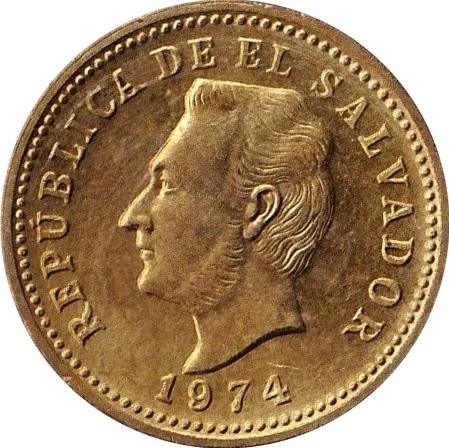
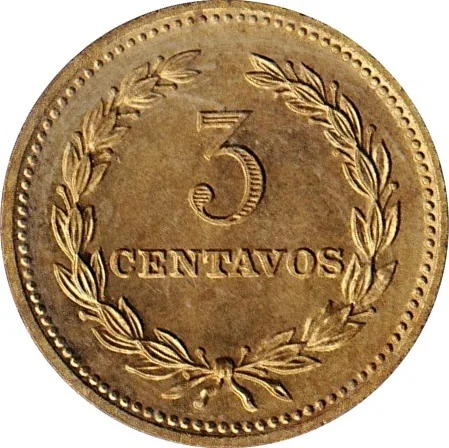
3 Centavos – El Salvador
El Salvador
Context
Year: 1974
Issuer: El Salvador 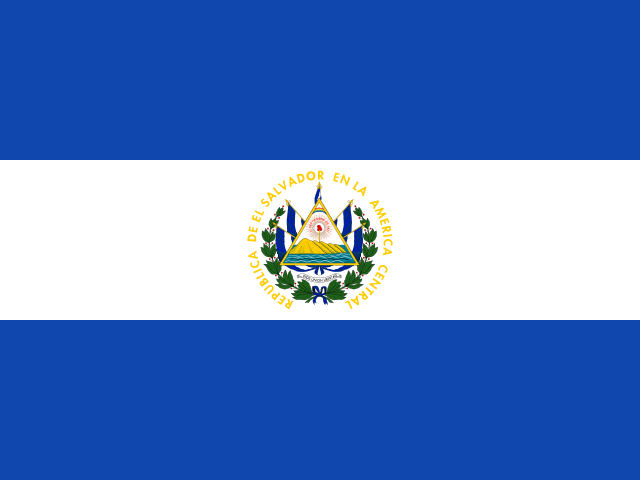
Issuing organization: Central Reserve Bank of El Salvador
Period:
(since 1841)
Currency:
(since 1892)
Demonetization: 1 January 2001
Total mintage: 10,002,000
Material
References
KM: #Click to copy to clipboard148
Numista: #2748
Value
Exchange value: 0.03 SVC
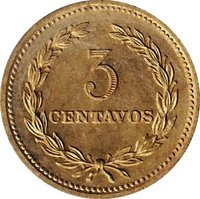
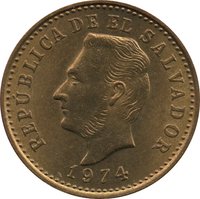
Obverse
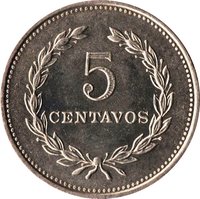
Reverse
Edge
Plain
Categories
| Person> Politician |
| Symbol> Wreath |
Mints
| Name | Mark |
|---|---|
| Royal Mint (Tower Hill) | — |
Mintings
| Year | Mint Mark | Mintage | Quality | Collection |
|---|---|---|---|---|
| 1974 | — | 10,000,000 | ||
| 1974 | — | 2,000 | Proof |
Historical background
In 1974, El Salvador operated under a fixed exchange rate system, with its currency, the colón, pegged to the United States dollar at a rate of 2.50 colones per dollar. This regime, established in the early 1930s, was managed by the country's central bank, the Banco Central de Reserva de El Salvador. The peg provided a long period of monetary stability and low inflation, which was credited with fostering a favorable environment for export-led growth, particularly in the dominant coffee sector. This stability was a cornerstone of the economic policy pursued by the military-led governments of the period, which prioritized agro-export expansion.
However, underlying economic pressures were mounting. The country's growth model was heavily dependent on a few primary commodities, chiefly coffee, cotton, and sugar, making the economy vulnerable to international price fluctuations. Furthermore, the rigid peg limited the government's ability to use monetary policy to respond to domestic economic challenges. A significant and growing issue was the structural inequality in land ownership, which concentrated wealth and contributed to social unrest. While the currency itself appeared stable on the surface, these deep-seated socio-economic fissures posed a latent threat to the overall economic framework.
Consequently, 1974 represents a point of apparent calm before a gathering storm. The fixed exchange rate was a symbol of the entrenched economic order, but it was increasingly mismatched with the country's social realities. Within a few years, these tensions would erupt into civil conflict, and the economic pressures—including the constraints of the fixed peg—would eventually force a major devaluation in 1986, ending over five decades of monetary stability. Thus, the currency situation in 1974 was one of superficial stability masking profound structural weaknesses.
However, underlying economic pressures were mounting. The country's growth model was heavily dependent on a few primary commodities, chiefly coffee, cotton, and sugar, making the economy vulnerable to international price fluctuations. Furthermore, the rigid peg limited the government's ability to use monetary policy to respond to domestic economic challenges. A significant and growing issue was the structural inequality in land ownership, which concentrated wealth and contributed to social unrest. While the currency itself appeared stable on the surface, these deep-seated socio-economic fissures posed a latent threat to the overall economic framework.
Consequently, 1974 represents a point of apparent calm before a gathering storm. The fixed exchange rate was a symbol of the entrenched economic order, but it was increasingly mismatched with the country's social realities. Within a few years, these tensions would erupt into civil conflict, and the economic pressures—including the constraints of the fixed peg—would eventually force a major devaluation in 1986, ending over five decades of monetary stability. Thus, the currency situation in 1974 was one of superficial stability masking profound structural weaknesses.
🌱 Very Common