

50 pence (Scouting Movement founding) – United Kingdom
Add to wishlist
Non-circulating coins
Commemoration: Centenary of the founding of the Scouting Movement
United Kingdom
Context
Years: 2007–2009
Issuer: United Kingdom
Ruler: Elizabeth II
Currency:
(since 1971)
Total mintage: 12,063
Material
Diameter: 27.3 mm
Weight: 8 g
Silver Weight:: 7.40 g
Shape: Equilateral curve heptagon
Composition: 92.5% Silver
Magnetic: No
Technique: Milled
Alignment: Medal alignment
flip
References
KM: #
Numista: #274733
Value
Exchange value: 0.50 GBP
Bullion value: $18.10
Inflation-adjusted value: 0.92 GBP
Obverse
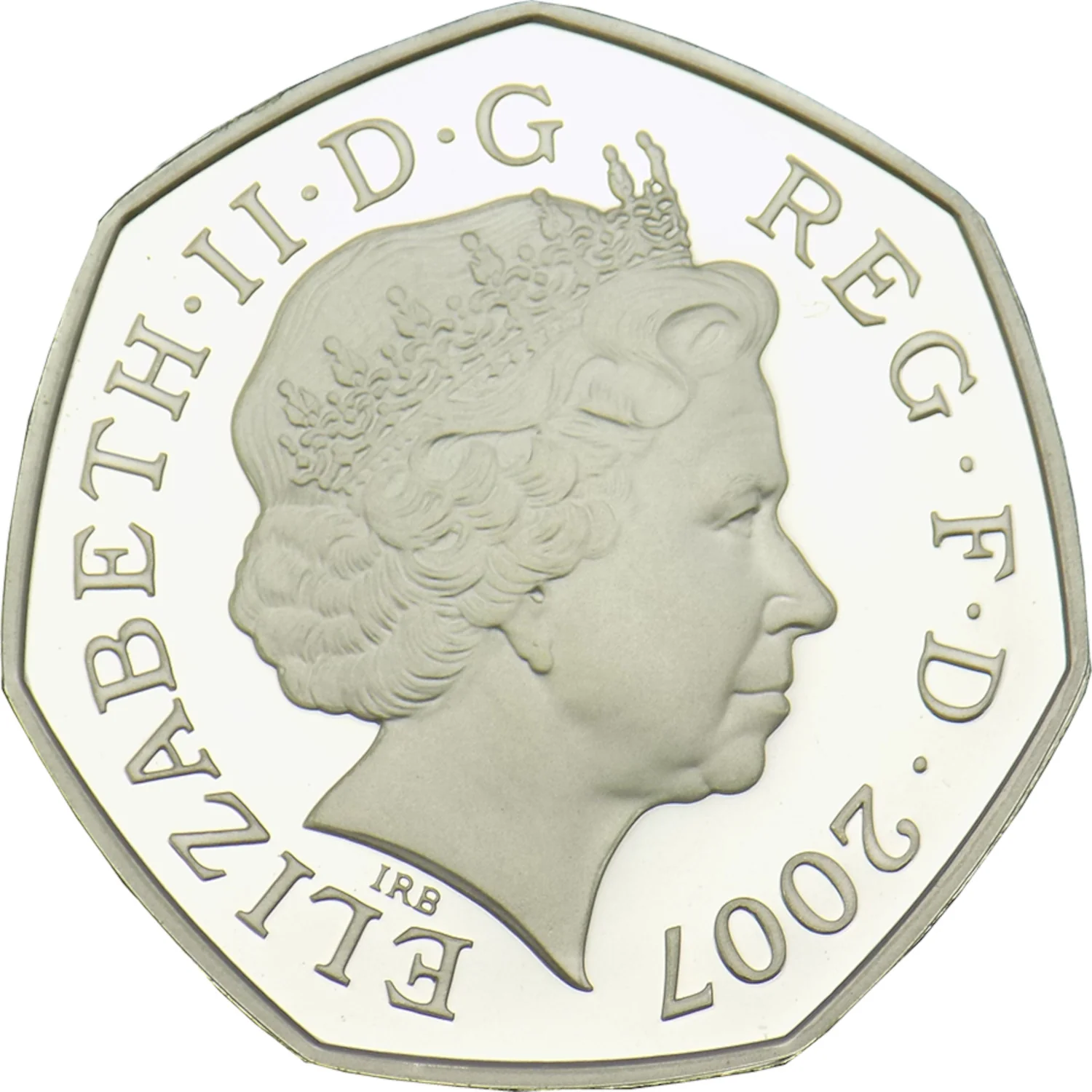
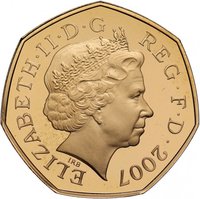
Description:
Queen Elizabeth IV facing right, wearing the Girls of Great Britain and Ireland tiara.
Inscription:
ELIZABETH·II·D·G REG·F·D·2007
IRB
IRB
Translation:
Elizabeth II by the Grace of God Queen Defender of the Faith 2007
Script: Latin
Engraver: Ian Rank-Broadley
Reverse
Description:
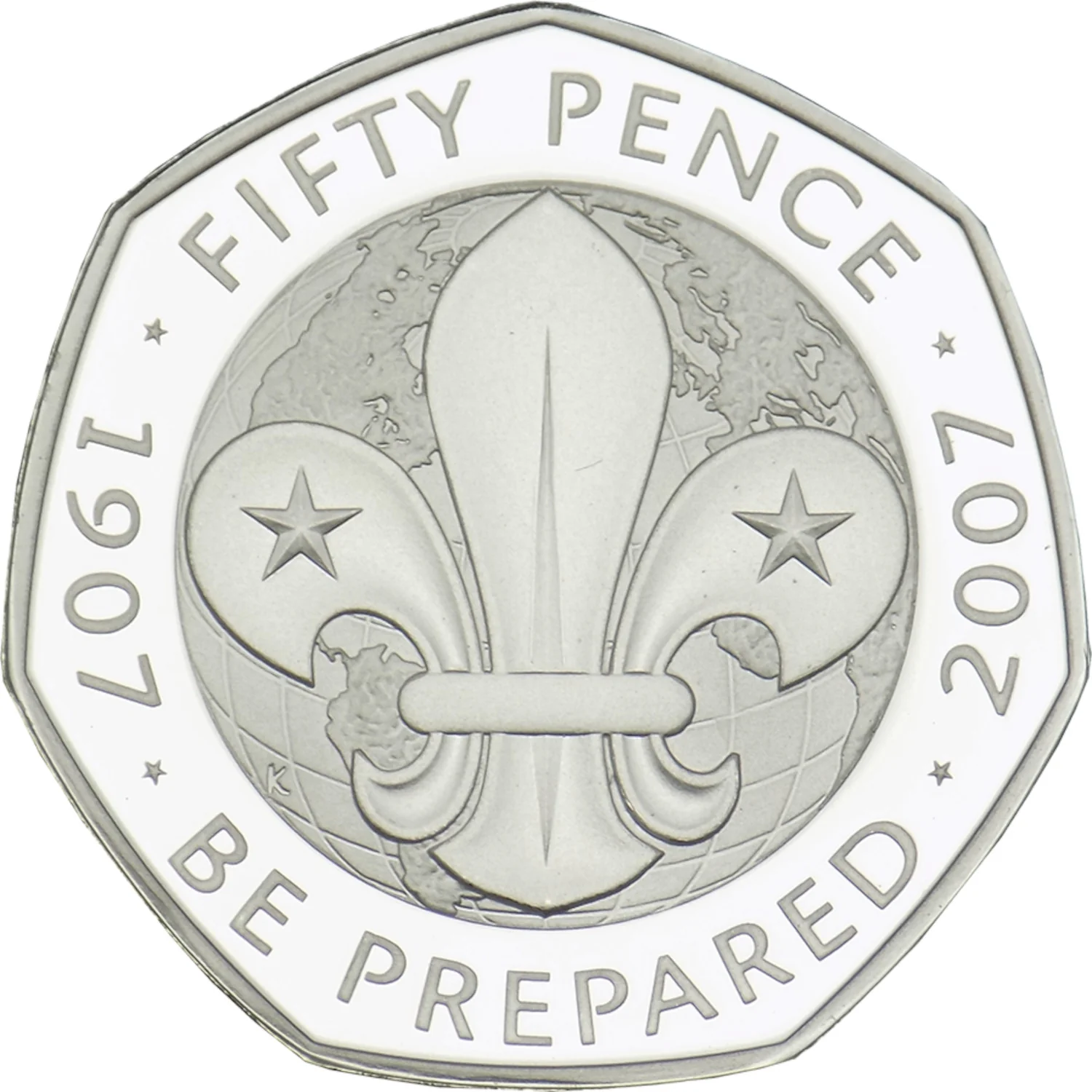
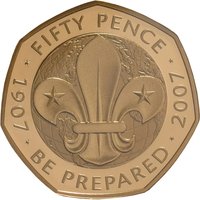
Scouting symbol between dates, denomination above, legend below.
Inscription:
* FIFTY PENCE *
1907 * BE PREPARED * 2007
K
1907 * BE PREPARED * 2007
K
Script: Latin
Engraver: Kerry Jones
Edge
Plain
Categories
| Symbol> Fleur-de-lis |
Mints
| Name | Mark |
|---|---|
| Royal Mint | — |
Mintings
| Year | Mint Mark | Mintage | Quality | Collection |
|---|---|---|---|---|
| 2007 | — | 10,895 | Proof | |
| 2009 | — | 1,168 | Proof |
Historical background
In 2007, the United Kingdom's currency situation was characterised by a period of sustained strength for the Pound Sterling (GBP), which was trading near multi-year highs against the US Dollar and was strong within its historical range against the Euro. This strength was underpinned by a robust domestic economy, with GDP growth consistently above its long-term trend, low unemployment, and a booming housing market. Crucially, the Bank of England had been implementing a relatively tight monetary policy, having raised its base interest rate five times since August 2006 to a peak of 5.75% in July 2007. This high yield made Sterling an attractive currency for international investors seeking returns, further driving demand and supporting its value.
However, this apparent stability was built on fragile foundations. The UK economy was heavily reliant on the financial services sector and had significant imbalances, including high levels of household debt and a large current account deficit. The seeds of crisis were sown in the global financial system, and by the late summer of 2007, the first major tremors were felt in the UK with the run on Northern Rock in September. This event marked a dramatic loss of confidence in the banking sector and signalled the beginning of the end for the Sterling's strong run. Financial markets began to price in a sharp shift in monetary policy, anticipating that the Bank of England would need to cut interest rates to stave off a recession, thereby diminishing Sterling's yield appeal.
Consequently, the latter part of 2007 saw a pivotal turning point. While the Pound entered the year with momentum, it began a steep and sustained decline in the final quarter as the credit crunch intensified. The currency fell sharply against both the Dollar and the Euro as investors fled to perceived safe havens and reassessed the UK's economic vulnerabilities. By the end of the year, the narrative had completely shifted from one of robust strength to one of acute vulnerability, setting the stage for Sterling's dramatic fall and the unprecedented monetary policy actions—including interest rate cuts and quantitative easing—that would define the subsequent years of the financial crisis.
However, this apparent stability was built on fragile foundations. The UK economy was heavily reliant on the financial services sector and had significant imbalances, including high levels of household debt and a large current account deficit. The seeds of crisis were sown in the global financial system, and by the late summer of 2007, the first major tremors were felt in the UK with the run on Northern Rock in September. This event marked a dramatic loss of confidence in the banking sector and signalled the beginning of the end for the Sterling's strong run. Financial markets began to price in a sharp shift in monetary policy, anticipating that the Bank of England would need to cut interest rates to stave off a recession, thereby diminishing Sterling's yield appeal.
Consequently, the latter part of 2007 saw a pivotal turning point. While the Pound entered the year with momentum, it began a steep and sustained decline in the final quarter as the credit crunch intensified. The currency fell sharply against both the Dollar and the Euro as investors fled to perceived safe havens and reassessed the UK's economic vulnerabilities. By the end of the year, the narrative had completely shifted from one of robust strength to one of acute vulnerability, setting the stage for Sterling's dramatic fall and the unprecedented monetary policy actions—including interest rate cuts and quantitative easing—that would define the subsequent years of the financial crisis.
💎 Extremely Rare